
Things
United Nations Charter
The Charter of the United Nations is the founding treaty of the United Nations. Signed in San Francisco on 26 June 1945 by representatives of 50 countries, and in force from 24 October 1945, it created the General Assembly, the Security Council and the International Court of Justice, bound member states to settle disputes peacefully, and still governs the organisation today.
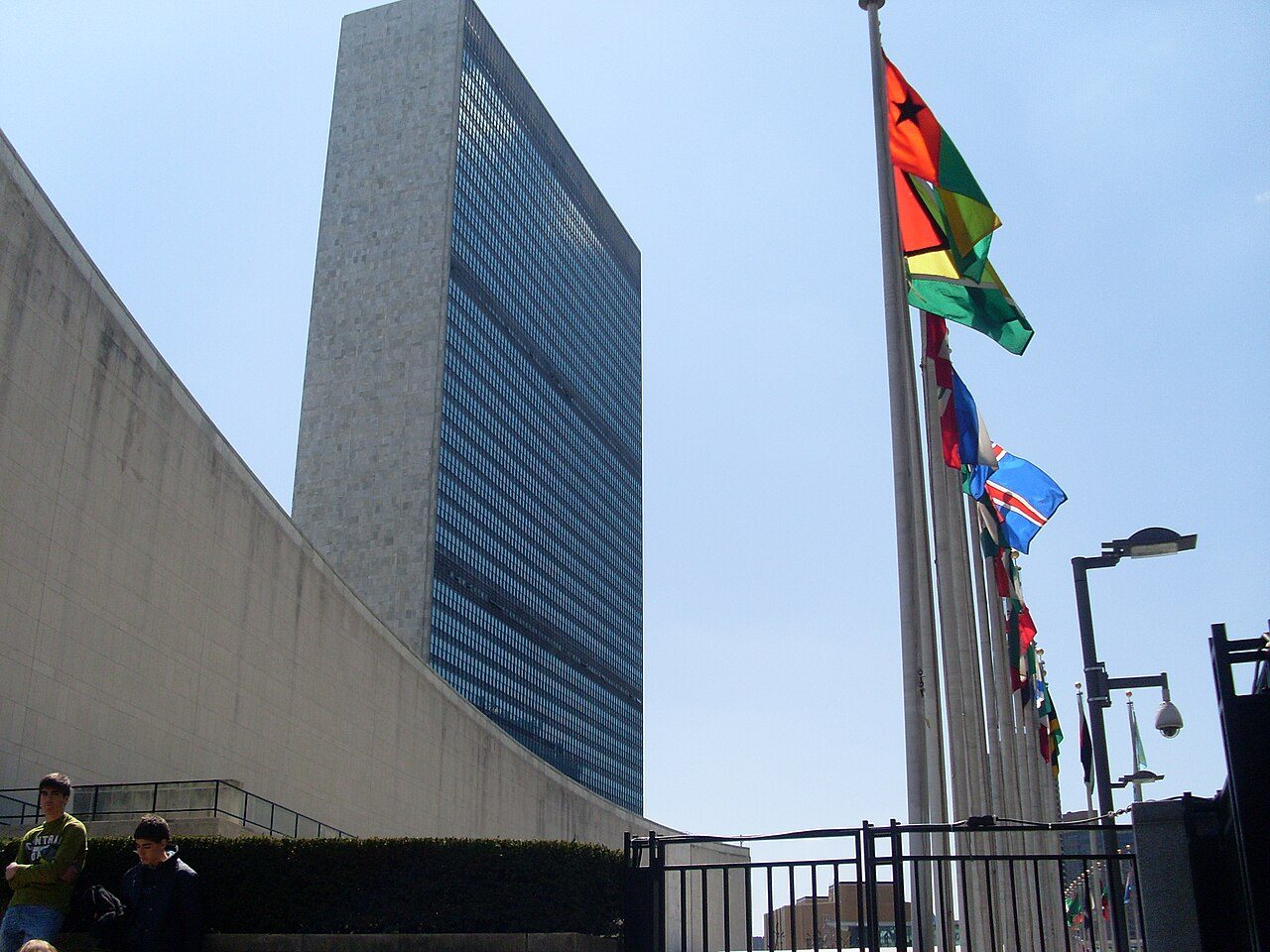
At a Glance
- What it is
- The founding treaty of the United Nations, treated as an instrument of international law binding on all member states
- Signed
- 26 June 1945, in San Francisco, at the close of the United Nations Conference on International Organization
- In force
- 24 October 1945, after ratification by the five permanent Security Council members and a majority of the other signatories; 24 October is now United Nations Day
- Original members
- 51 - the 50 states that signed at San Francisco plus Poland, which was not represented there and signed later
- Structure
- A preamble and 111 articles in 19 chapters, plus the Statute of the International Court of Justice as an integral part
- Principal organs
- General Assembly, Security Council, Economic and Social Council, Trusteeship Council, International Court of Justice and Secretariat
- Amended
- Three times in the UN's own summary - amendments entering into force in 1965, 1968 and 1973 enlarged the Security Council and the Economic and Social Council
Introduction
Most international organisations are created by a treaty; the United Nations is unusual because its treaty is also its constitution. The Charter sets out the UN's purposes - to save succeeding generations from the scourge of war, to reaffirm faith in fundamental human rights, and to promote social progress - and then builds the machinery to pursue them: an assembly of all members, a council empowered to keep the peace, a world court, and a permanent secretariat.
The United Nations itself states the Charter's legal weight plainly: it is considered an international treaty, it is an instrument of international law, and UN member states are bound by it. It codifies the major principles of international relations, from the sovereign equality of states to the prohibition of the use of force. Every state that joins the UN accepts the Charter, which is why a document drafted in the last months of the Second World War still frames arguments about war and peace today.
Origins: A Failed League and a Wartime Alliance
The Charter's prehistory is the failure of the League of Nations, which had been unable to prevent the aggression of the 1930s or the Second World War. The Allied governments began planning its replacement while the war still raged. At St. James's Palace in London on 12 June 1941, Britain, the dominions and the exiled governments of occupied Europe declared that enduring peace required the willing co-operation of free peoples. Two months later, on 14 August 1941, President Franklin D. Roosevelt and Prime Minister Winston Churchill issued the Atlantic Charter, which looked forward to a wider and permanent system of general security.
On 1 January 1942, twenty-six states at war with the Axis signed the Declaration by United Nations in Washington - the first official use of the name United Nations, which Roosevelt coined. At Moscow in October 1943, the United States, Britain, the Soviet Union and China jointly recognised the necessity of establishing a general international organisation based on the sovereign equality of all peace-loving states. The wartime alliance had become a building project.
Dumbarton Oaks, Yalta and San Francisco
The blueprint was drafted at Dumbarton Oaks, an estate in Washington, D.C., where from 21 August to 7 October 1944 the Big Four - the United States, Britain, the Soviet Union and China - negotiated proposals for a general international organisation with a General Assembly, a Security Council, an International Court of Justice and a Secretariat. One gap remained: how the Security Council would vote. That was settled at Yalta in February 1945, where Roosevelt, Churchill and Stalin agreed the formula that gave the great powers their permanent seats and concurring votes, and called a conference at San Francisco for 25 April 1945.
The United Nations Conference on International Organization ran from 25 April to 26 June 1945, attended, in Britannica's count, by representatives of 50 countries from every region of the world. Working from the Dumbarton Oaks proposals as modified at Yalta, the delegates produced the final Charter. It was unanimously adopted and opened for signature on 26 June 1945, signed that day at the Veterans' War Memorial Building by 50 of the 51 original member states. Poland, not represented at the conference, signed later, on 15 October 1945.
Timeline
- 12 June 1941
The Declaration of St. James's Palace in London commits the Allies to work for a postwar world of co-operation and security.
- 14 August 1941
Roosevelt and Churchill issue the Atlantic Charter, pointing towards a wider and permanent system of general security.
- 1 January 1942
Twenty-six states sign the Declaration by United Nations in Washington - the first official use of the name.
- October 1943
The Moscow Declaration of the four powers recognises the necessity of a general international organisation based on sovereign equality.
- August-October 1944
The Dumbarton Oaks Conference drafts the proposals that become the working text for the Charter.
- February 1945
At Yalta, Roosevelt, Churchill and Stalin settle Security Council voting and summon the San Francisco Conference.
- 25 April 1945
The United Nations Conference on International Organization opens in San Francisco with 50 countries represented.
- 26 June 1945
The Charter is unanimously adopted and signed in San Francisco by representatives of 50 countries.
- 24 October 1945
The Charter enters into force after ratification by the five permanent members and a majority of other signatories; the date is now United Nations Day.
- January 1946
The General Assembly, representing all 51 original members, opens its first session in London.
- 31 August 1965
Amendments enter into force enlarging the Security Council from 11 to 15 members and the Economic and Social Council from 18 to 27.
- 24 September 1973
A further amendment enlarges the Economic and Social Council from 27 to 54 members, matching the UN's near-quadrupled membership.
Significance
The Charter matters because it changed the legal starting point of international life. War between states, once a lawful instrument of policy, was placed under a general prohibition: members must refrain from the threat or use of force against the territorial integrity or political independence of any state, with exceptions for self-defence and for action authorised by the Security Council. The Council alone was given power to bind all members and to authorise enforcement, while the General Assembly gave every member state, large or small, one vote and a platform.
Membership tells the story of its reach. The organisation began with 51 members and has grown to 193 member states, as decolonisation turned the wartime alliance's club into a near-universal parliament of nations. The Charter's references to human rights - seven of them, as the UN Chronicle notes - also supplied the mandate from which the Universal Declaration of Human Rights was drafted three years later.
Questions readers ask
Does the Charter give five countries a veto? Not in those words. The word veto never appears in the Charter. Article 27 requires decisions of the Security Council on non-procedural matters to be made by nine affirmative votes including the concurring votes of the five permanent members - China, France, Russia (as successor to the Soviet Union), the United Kingdom and the United States. The effect is a veto, but the mechanism is the requirement of permanent-member concurrence agreed at Yalta.
Is the Charter a world constitution? It is often called one, and this page treats that as a description to handle carefully rather than a fact. The Charter is a treaty: states join it, and it can be amended only by two-thirds of the General Assembly ratified by two-thirds of member states including all five permanent members - which is why its text has changed so rarely. Unlike a national constitution, it creates no world government; the UN's authority rests on what member states agreed in 1945 and have accepted since.
Why has Security Council reform stalled? Because the Charter itself locks the door: any amendment enlarging the Council or changing permanent membership needs the ratification of the existing permanent five. Proposals to add members have circulated for decades, but the amendment rule means reform requires the consent of the very states whose privilege it would dilute.
Legacy
The Charter's legacy is that it survived its founders' world. Written for 51 states emerging from a world war, it still supplies the legal framework for peacekeeping, sanctions, international courts and the daily diplomacy of 193 states. Its preamble's opening words - We the peoples of the United Nations - deliberately echoed a constitution rather than a diplomatic contract, and that ambition is why arguments about legitimacy at the UN still begin with its text.
It is also a deliberately conservative document: hard to amend, protective of the great-power settlement of 1945, and dependent on member states for money and troops. Both its endurance and its frustrations flow from the same source - a bargain struck at San Francisco that no generation since has been able, or willing, to renegotiate from scratch.
Sources
- United Nations - UN Charter
- United Nations - Preparatory Years: UN Charter History
- United Nations - The Story of the Charter
- Encyclopaedia Britannica - Dumbarton Oaks Conference
The facts on this page were checked against these sources on 19 November 2026. The History Trail's permanent pages are researched and written for this site; the live profiles elsewhere on The History Trail are assembled automatically from Wikipedia and Wikidata.
About the Author
Researched and written by the The History Trail Editorial Team — the accountable editorial function behind this site's permanent story pages. The team works from the published sources cited on each page; it does not invent historians, reviewers or credentials, and it corrects errors openly.
Fact Check
Every load-bearing fact on this page traces to one of the sources listed above, and significant claims link to their source in the text. Our checking method is described on the methodology page; errors can be reported via the corrections page.
Sources & Citations
Cite this page as: The History Trail Editorial Team, The History Trail — this article's title, publication and update dates are shown beneath its headline. The full source list appears under Sources above; the site's source standards are on the sources page.