
Things
Magna Carta
Magna Carta was a peace deal that failed within weeks in 1215, when King John persuaded the Pope to annul it. Yet reissues in 1216, 1217 and 1225 kept its promises alive, and two of its clauses became lasting symbols of the rule of law.
At a Glance
- Agreed
- 15 June 1215, at Runnymede, between Windsor and Staines
- Parties
- King John of England and his rebel barons
- Clauses
- 63 clauses in the 1215 text
- Most famous clauses
- 39 and 40 — lawful judgement and no sale, denial or delay of justice
- Annulled
- 24 August 1215, by Pope Innocent III
- Reissued
- 1216, 1217 and, in definitive form, 1225, under Henry III
- Surviving 1215 copies
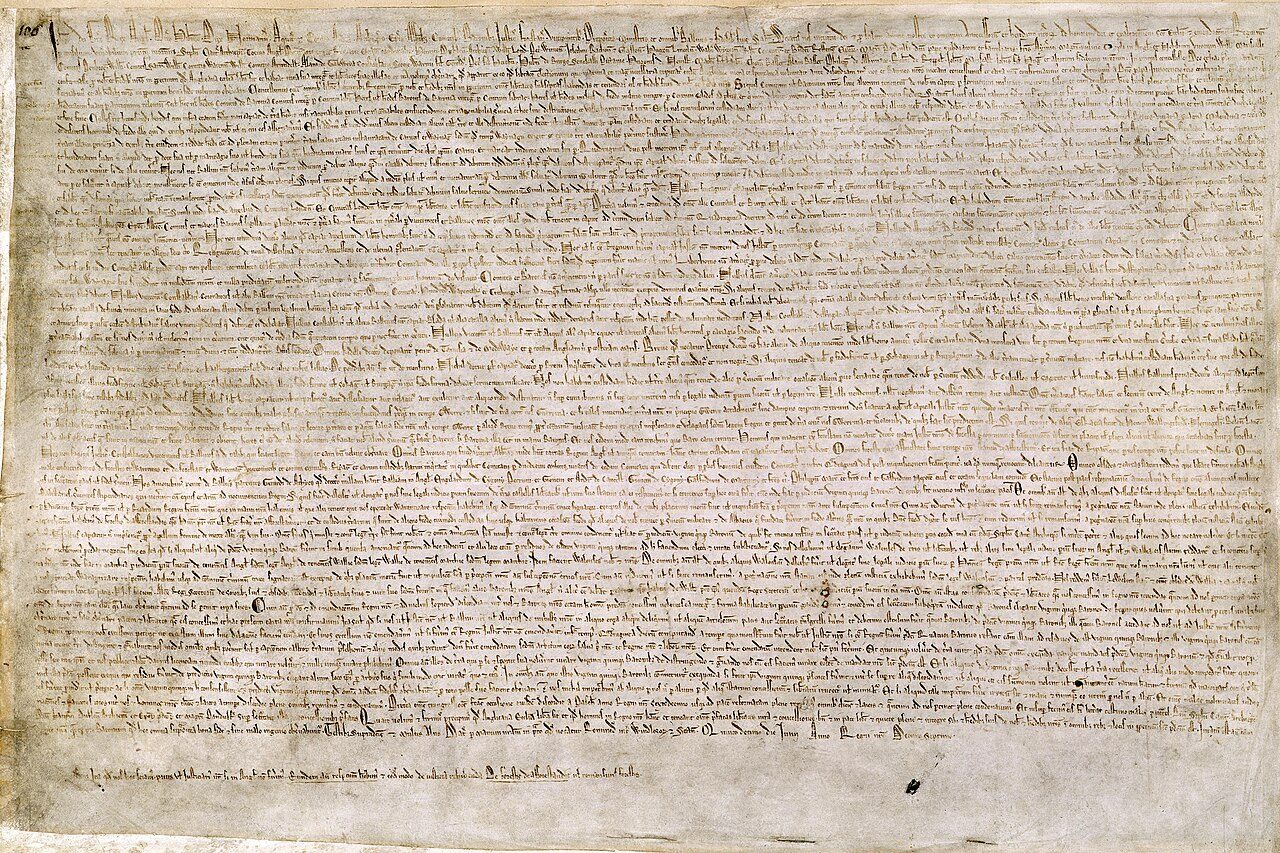
- Four exemplifications — two at the British Library, one at Lincoln Castle, one at Salisbury Cathedral
Introduction
Magna Carta, the Great Charter, was agreed on 15 June 1215 at Runnymede, a meadow beside the Thames between Windsor and Staines, when King John accepted terms put to him by his rebel barons. It was not a declaration of democracy. It was a detailed settlement of a political crisis, written in Latin on parchment, containing 63 clauses about taxation, inheritance, widows, debts, forests, standard measures and the behaviour of royal officials. Its central promise, however, reached further: the king himself was to be bound by the law of the land.
That promise is why a failed peace treaty is still famous eight centuries later. John repudiated the charter almost at once, Pope Innocent III annulled it on 24 August 1215, and England slid back into civil war. But after John's death the charter was reissued in the name of his young son, Henry III, in 1216 and 1217, and again in 1225. Through those reissues, rather than through the events of a single June day, Magna Carta entered English law and political memory.
Origins: A King Who Had Run Out of Credit
John's barons had concrete grievances. He had demanded ever heavier feudal payments and fines to fund expensive campaigns to recover English lands in France, campaigns that repeatedly failed. He quarrelled with the Church, exploited inheritance and marriage rights for revenue, and used justice as a source of income. When rebellion came in 1215, the barons occupied London and forced negotiation. The Articles of the Barons set out their demands, and the charter agreed at Runnymede turned those demands into a general grant made, in its own words, to all free men of the kingdom.
Most of the 63 clauses are specific to feudal society, and many were dropped from later versions. Two have carried the charter's fame. Clause 39 provided that no free man should be seized, imprisoned, stripped of his rights or possessions, outlawed or exiled except by the lawful judgement of his equals or by the law of the land. Clause 40 added, in a single sentence, that to no one would the king sell, deny or delay right or justice. In 1215 'free men' were a minority of the population, but the wording was general enough for later generations to read much more into it.
Timeline
- 1204
John loses Normandy, and his costly attempts to recover English lands in France drive the taxation and demands that alienate his barons.
- May 1215
Rebel barons occupy London, forcing John to negotiate rather than fight a war he cannot be sure of winning.
- 15 June 1215
John agrees Magna Carta at Runnymede. Copies, called exemplifications, are made and distributed around the kingdom.
- 24 August 1215
Pope Innocent III, John's feudal overlord, annuls the charter as shameful, demeaning, illegal and unjust, declaring it null and void.
- Autumn 1215
Civil war resumes. Rebel barons offer the English crown to Prince Louis of France, who invades in 1216.
- October 1216
John dies. His nine-year-old son succeeds as Henry III, and his regents reissue a revised Magna Carta in November 1216 to win back support.
- 1217
After the royalist victory, the charter is reissued again as part of the peace settlement, alongside the separate Charter of the Forest. It is now that it gains the name Magna Carta, the Great Charter, to distinguish it from the Forest charter.
- 1225
Henry III reissues the charter in its definitive form in return for a grant of taxation. This shorter 1225 text becomes the version that enters the statute book.
- 1297
Edward I confirms the 1225 charter and places it on the statute roll, giving Magna Carta a permanent place in English law.
- 3 February 2015
The four surviving 1215 exemplifications are brought together at the British Library for one day to mark the charter's 800th anniversary.
Significance: Clauses 39 and 40 Grow Beyond 1215
Magna Carta's importance was made, not simply found. In the seventeenth century, lawyers and parliamentarians fighting the Stuart kings revived clauses 39 and 40 as ancient authority for due process and against arbitrary imprisonment. From there the language travelled: the idea that no one may be punished except by the law of the land fed into later constitutional documents, including the United States Constitution and Bill of Rights, and in the twentieth century into modern declarations of human rights. The charter became a symbol far larger than the feudal bargain its makers intended.
The symbol rests on something real. Magna Carta was the first time an English king's agreement to limits on his own power was written down, sealed, distributed and repeatedly reconfirmed. Taxation in clause 12 and its successors, the promise of swift and unsold justice, and the principle that the ruler is subject to law all began as practical restraints demanded by elites. Later societies widened who counted as a rights-holder. The charter did not do that widening itself, but it supplied words durable enough to be widened.
Myths and disputes
Did Magna Carta found democracy? No. It created no parliament, no elections and no votes for anyone, and its protections applied to free men, a minority in a kingdom of villeins who were expressly left under their lords' authority. Some clauses are products of their prejudices, including restrictions aimed at Jewish moneylenders and at women bringing legal appeals. Treating 1215 as the birthday of modern democracy reads the thirteenth century backwards.
Was it signed? Not in the modern sense. John did not sign the charter; his great seal was attached to exemplifications prepared after the Runnymede meeting, and the familiar image of a reluctant king penning his name in a meadow is a later invention. Was there one original? No single master copy survives or may ever have existed; several exemplifications were produced in 1215, of which four survive. Even the clause numbers are modern editorial additions — the original text runs on without numbering, which is why historians cite clauses 39 and 40 by a numbering the barons never saw.
What remains genuinely disputed is how much of its later meaning was present at the start. The British Library notes that both John and the barons would likely have been horrified to find their peace treaty celebrated 800 years on, since its terms applied to the elite of society. Its afterlife, not its intention, is the extraordinary part of the story.
Legacy: Four Sheets of Parchment
Four exemplifications of the 1215 charter survive: two at the British Library, one at Lincoln Castle and one at Salisbury Cathedral, whose copy is often described as the best preserved. They are inscribed on UNESCO's Memory of the World register. Of the 1225 text, only a small number of clauses remain in force in England and Wales today, yet the charter's presence in courtrooms, constitutions and civic ritual worldwide is out of all proportion to its surviving legal text.
That disproportion is the point. Magna Carta endures because each generation that needed an argument against arbitrary power found one ready-made in clauses 39 and 40. A document annulled within ten weeks of its making became, by reissue, argument and myth, the most famous statement in the common-law world that power must answer to law.
Sources
- British Library — Shameful and Demeaning: The Annulment of Magna Carta
- UK Parliament — Magna Carta and Parliament (booklet, Parliamentary Archives)
- The National Archives — Magna Carta, 1215 (British Library translation)
- Salisbury Cathedral — Magna Carta
- Magna Carta Project — The Copies of Magna Carta
The facts on this page were checked against these sources on 19 November 2026. The History Trail's permanent pages are researched and written for this site; the live profiles elsewhere on The History Trail are assembled automatically from Wikipedia and Wikidata.
About the Author
Researched and written by the The History Trail Editorial Team — the accountable editorial function behind this site's permanent story pages. The team works from the published sources cited on each page; it does not invent historians, reviewers or credentials, and it corrects errors openly.
Fact Check
Every load-bearing fact on this page traces to one of the sources listed above, and significant claims link to their source in the text. Our checking method is described on the methodology page; errors can be reported via the corrections page.
Sources & Citations
Cite this page as: The History Trail Editorial Team, The History Trail — this article's title, publication and update dates are shown beneath its headline. The full source list appears under Sources above; the site's source standards are on the sources page.