
Things
Treaty of Versailles
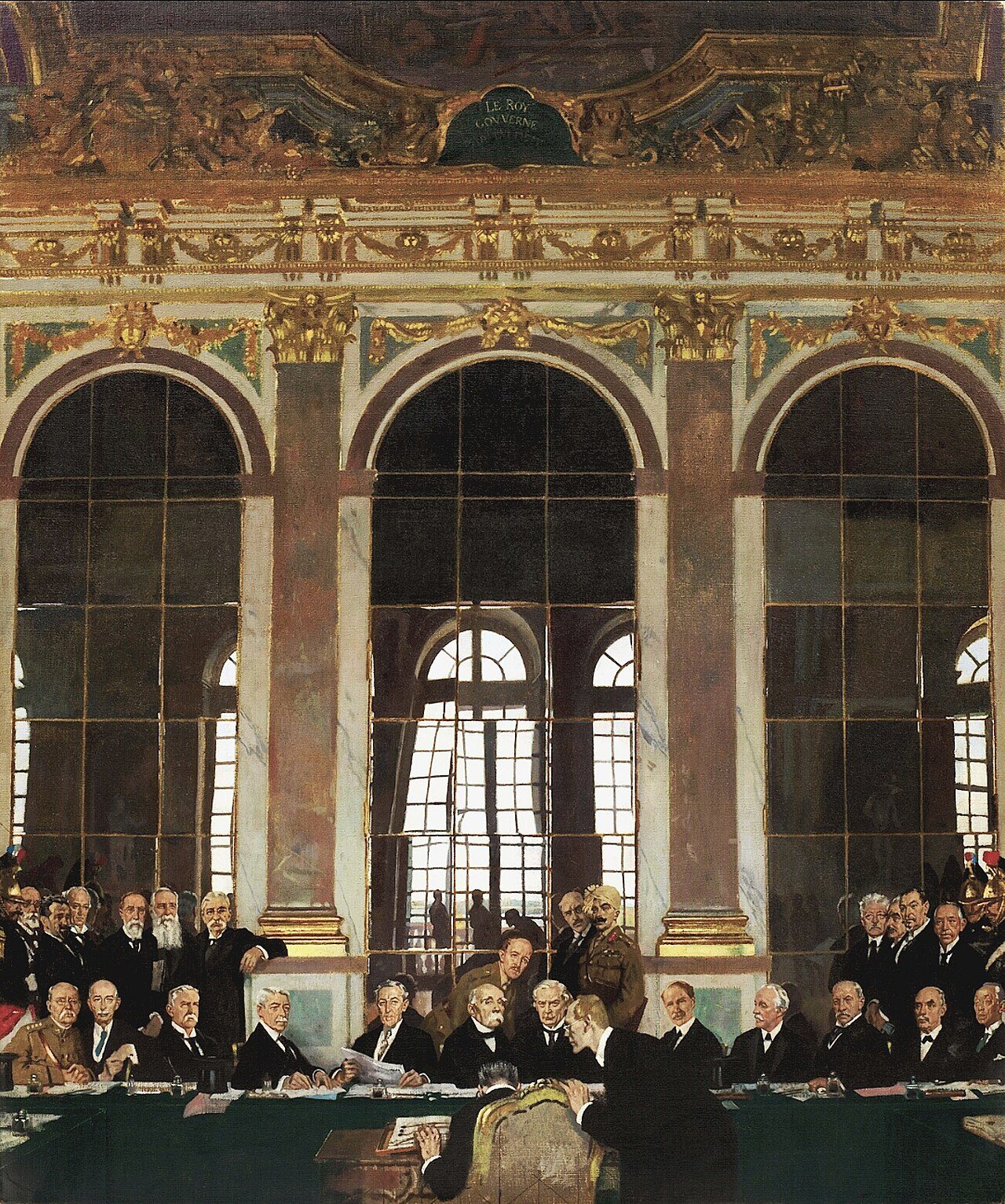
The Treaty of Versailles, signed on 28 June 1919 in the Hall of Mirrors at the Palace of Versailles, was the peace treaty that formally ended the First World War between Germany and the Allied and Associated Powers. It redrew Germany's borders, limited its army to 100,000 men, imposed reparations under the Article 231 responsibility clause, took away its colonies, and, as its first part, created the League of Nations.
At a Glance
- Signed
- 28 June 1919, in the Hall of Mirrors at the Palace of Versailles, exactly five years after the assassination of Archduke Franz Ferdinand
- In force
- 10 January 1920, on ratification by Germany and three of the principal Allied and Associated Powers
- The document
- 440 articles in fifteen parts; Part I is the Covenant of the League of Nations and Part XIII created the International Labour Organization
- Territory
- Germany lost about 13 percent of its European territory and roughly a tenth of its population, and all of its overseas colonies
- Arms
- The German army was limited to 100,000 men, conscription was abolished, and tanks, military aircraft and submarines were forbidden
- Article 231
- Germany and her allies accepted responsibility for the Allies' loss and damage - the war guilt clause and the legal basis for reparations
- Reparations
- Left unspecified in the treaty; fixed by the Reparation Commission in 1921 at 132 billion gold marks
Introduction
The fighting of the First World War stopped on 11 November 1918, when an armistice agreed at 5 a.m. took effect at 11 a.m. and the guns fell silent on the Western Front. But an armistice is only a ceasefire. The state of war between Germany and the Allied and Associated Powers ended with a treaty, and that treaty was negotiated - or, from the German point of view, dictated - at the Paris Peace Conference of 1919.
Its signing was staged for symbolism. On 28 June 1919, exactly five years after the assassination of Archduke Franz Ferdinand at Sarajevo, German delegates signed in the Hall of Mirrors at the Palace of Versailles - the same room in which the German Empire had been proclaimed in 1871. The document they signed ran to 440 articles in fifteen parts, and its first part was not about Germany: it was the Covenant of the League of Nations.
Making the Peace: Paris, 1919
The conference opened on 18 January 1919 and was dominated by the Big Four: Woodrow Wilson of the United States, Georges Clemenceau of France, David Lloyd George of Britain and Vittorio Orlando of Italy. Germany, which had asked Wilson in October 1918 to broker a ceasefire on the basis of his Fourteen Points, was not at the table; the victors decided the terms among themselves, as the Imperial War Museums notes, and presented the treaty to a German delegation on 7 May 1919. Germany could object only in writing.
The result departed radically from the Fourteen Points. Wilson got his League of Nations, written into the treaty as Part I. Clemenceau got security against Germany: territory, disarmament and a demilitarised Rhineland. Lloyd George got German colonies and reparations politics that played at home. The treaty was the compromise of those aims, and it satisfied none of them - one reason it has been argued over since.
The Terms: Territory, Arms and Article 231
Germany lost about 13 percent of its European territory and a tenth of its population. Alsace-Lorraine returned to France; Eupen-Malmedy went to Belgium; northern Schleswig to Denmark after a plebiscite; and in the east, Posen and West Prussia went to a restored Poland, cutting East Prussia off from the rest of Germany, while Danzig became a free city under League protection. The Saar was placed under League administration for fifteen years, with its coal mines to France, and all of Germany's overseas colonies were taken away as League mandates. The army was capped at 100,000 men, conscription was abolished, and tanks, military aircraft and submarines were forbidden; the Rhineland was demilitarised and occupied.
Article 231, the so-called war guilt clause, affirmed that Germany accepted the responsibility of Germany and her allies for causing all the loss and damage suffered by the Allies as a consequence of the war imposed upon them by German aggression. It was the legal basis for reparations - whose total the treaty itself left unspecified. Only in May 1921 did the Reparation Commission fix the sum at 132 billion gold marks. In Germany the clause was read as a national humiliation, and resentment of it, the Imperial War Museums records, proved a significant factor in the growing popularity of Hitler's Nazi Party in the 1920s and early 1930s.
Timeline
- 8 January 1918
President Wilson sets out his Fourteen Points, the programme on the basis of which Germany later seeks an armistice.
- 4 October 1918
The German government asks Wilson to broker a ceasefire with the Allied powers.
- 11 November 1918
The Armistice, agreed at 5 a.m., takes effect at 11 a.m.; fighting on the Western Front stops, but the state of war continues.
- 18 January 1919
The Paris Peace Conference opens, dominated by Wilson, Clemenceau, Lloyd George and Orlando; Germany is excluded from the negotiations.
- 28 April 1919
The conference approves the Covenant of the League of Nations, which becomes Part I of the treaty.
- 7 May 1919
The finished treaty is presented to the German delegation; German objections may be made only in writing.
- 28 June 1919
Germany signs the Treaty of Versailles in the Hall of Mirrors, five years to the day after the Sarajevo assassination.
- 19 November 1919
The United States Senate rejects the treaty; a second vote in March 1920 fails, and it never joins the League of Nations.
- 10 January 1920
The treaty takes force, and the League of Nations comes into existence; its inauguration follows on 16 January.
- May 1921
The Reparation Commission fixes Germany's reparations at 132 billion gold marks under the London schedule of payments.
- 25 August 1921
The United States, which never ratified Versailles, concludes its own separate peace treaty with Germany.
- 1 September 1939
Germany invades Poland; Britain and France declare war two days later.
Significance
Versailles was the centrepiece of a five-treaty settlement that redrew Europe: new or restored states from Poland to Czechoslovakia and Yugoslavia took shape in its order, four empires - German, Austro-Hungarian, Ottoman and Russian - were gone, and the League of Nations, the first international organisation charged with keeping the peace, began work in January 1920. Part XIII of the treaty also created the International Labour Organization, which outlasted the League itself.
For Germany, the treaty defined the Weimar Republic's unhappy life. Its governments had to sign, pay and disarm under a document almost all Germans regarded as a dictated peace, and calls to revise Versailles became, as the Imperial War Museums puts it, a major aspect of international politics in the 1920s and 1930s. Germany left the League in 1933, announced rearmament and conscription in 1935 in open breach of the treaty, and remilitarised the Rhineland in 1936.
Myths and disputes
Did Article 231 call Germany solely guilty of the war? The word guilt does not appear in it. The article, in terms similar to clauses in the treaties with Germany's allies, made Germany and her allies accept responsibility for the Allies' loss and damage - a formula the Allies used to ground reparations. German opinion read it as a verdict of sole moral guilt, and the name war guilt clause stuck; historians still distinguish between what the text says and what it was heard to say. Nor did the treaty itself name the famous reparations figure: it left the amount open, and the 132 billion gold marks was set by the Reparation Commission in 1921, structured in bonds of which, on the Allied assessment, only part was ever genuinely expected to be paid.
Did Versailles cause the Second World War? That is disputed, and this page does not present it as settled. The Imperial War Museums judges that the peace settlements were imposed rather than negotiated and contained many compromise solutions, that their conditions were not unduly harsh, and that they did not in themselves make the Second World War inevitable - while also recording that the treaty's terms caused immediate outrage and lasting bitterness in Germany, which Hitler exploited. The treaty's weakness, on this view, lay as much in its enforcement as in its text: the United States never ratified it, never joined the League it created, and concluded a separate peace with Germany in 1921.
Legacy
The League of Nations failed to prevent a second world war, but the idea inside Part I of Versailles - a permanent organisation of states bound to settle disputes without war - returned in 1945 as the United Nations, designed with the League's failures in mind. The International Labour Organization survives as a UN agency. Germany's reparations, rescheduled and reduced in the interwar years, were finally closed out in 2010, when the last payment on the bonds that serviced the debt was made - ninety-one years after the signing.
Versailles remains the standing example of how hard it is to end a war well. William Orpen's official painting of the signing, held by the Imperial War Museums, shows the statesmen dwarfed by the Hall of Mirrors around them - an artist's comment on a peace whose makers were already smaller than the forces they were trying to settle.
Sources
- Imperial War Museums - How We Made the Peace
- Imperial War Museums - How Europe Went to War in 1939
- Encyclopaedia Britannica - Paris Peace Conference
- Encyclopaedia Britannica - Weimar Republic: The Treaty of Versailles
- Office of the Historian, US Department of State - Papers Relating to the Foreign Relations of the United States, 1921: Reparation Commission decision
- Council on Foreign Relations - Senate Rejection of the Treaty of Versailles
The facts on this page were checked against these sources on 19 November 2026. The History Trail's permanent pages are researched and written for this site; the live profiles elsewhere on The History Trail are assembled automatically from Wikipedia and Wikidata.
About the Author
Researched and written by the The History Trail Editorial Team — the accountable editorial function behind this site's permanent story pages. The team works from the published sources cited on each page; it does not invent historians, reviewers or credentials, and it corrects errors openly.
Fact Check
Every load-bearing fact on this page traces to one of the sources listed above, and significant claims link to their source in the text. Our checking method is described on the methodology page; errors can be reported via the corrections page.
Sources & Citations
Cite this page as: The History Trail Editorial Team, The History Trail — this article's title, publication and update dates are shown beneath its headline. The full source list appears under Sources above; the site's source standards are on the sources page.