
Things
Geneva Conventions
The Geneva Conventions are the core of international humanitarian law: four treaties of 1949, ratified by every state in the world, that protect wounded soldiers, prisoners of war and civilians — people who are not, or are no longer, fighting.
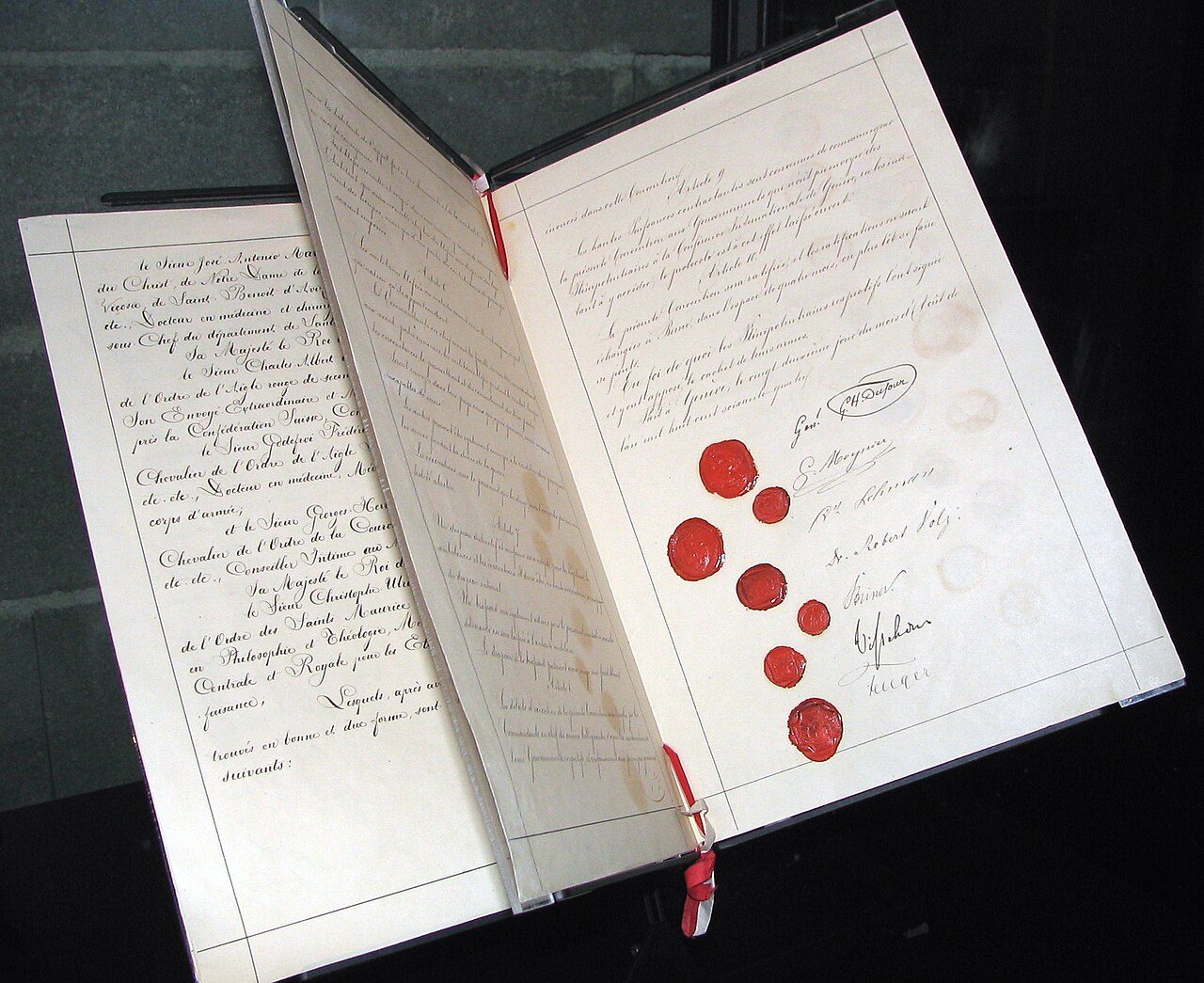
At a Glance
- Origin
- Henry Dunant's experience at the Battle of Solferino, 24 June 1859
- First convention
- 22 August 1864, Geneva — signed by twelve states
- Guardian
- International Committee of the Red Cross (ICRC), founded in Geneva in 1863
- Current conventions
- Four conventions adopted 12 August 1949
- They protect
- Wounded and sick on land, wounded and shipwrecked at sea, prisoners of war, and civilians
- Additional Protocols
- Adopted in 1977, extending protection in international and non-international conflicts
- Ratification
- Universal — the 1949 conventions have been ratified by every state
Introduction
The Geneva Conventions set limits on how war may be fought. Their answer to the question of who must be protected is direct: people who do not take part in the fighting — civilians, medics and aid workers — and people who can no longer fight, including wounded, sick and shipwrecked troops and prisoners of war, must be respected, protected and treated humanely. The four conventions adopted on 12 August 1949, together with their Additional Protocols, are at the core of international humanitarian law, and every state in the world has ratified them.
Unlike laws about when war may be started, these rules apply in the middle of it, to enemies as much as to friends. They require that the wounded be collected and cared for without discrimination, that prisoners not be tortured or humiliated, and that civilians not be made the object of attack. The International Committee of the Red Cross, the ICRC, describes them as the most important rules limiting the barbarity of war — a body of law that began with one businessman's horror at a single battlefield.
Origins: Solferino and a Book That Would Not Let Go
On 24 June 1859 the French and Piedmont-Sardinian armies fought Austria at Solferino in northern Italy, in one of the bloodiest battles Europe had seen since Waterloo. Henry Dunant, a Genevan businessman travelling on unrelated business, arrived that evening and found tens of thousands of wounded men with almost no organised care. He helped organise local civilians to tend the wounded of both sides. The experience stayed with him, and in 1862 he published A Memory of Solferino at his own expense, describing what he had seen.
The book ended with two practical proposals: that countries form volunteer relief societies, trained in peacetime, to care for the wounded in war, and that states agree an international treaty protecting those volunteers and the wounded they served. Geneva's Society for Public Welfare took the ideas up. A committee of five, including Dunant, first met on 17 February 1863 — the founding moment of what became the ICRC. That October an international conference formalised the idea of national relief societies and agreed a common emblem, a red cross on a white background, to identify medical personnel.
Timeline
- 24 June 1859
Dunant witnesses the aftermath of Solferino and helps care for wounded soldiers of both sides.
- 1862
Dunant publishes A Memory of Solferino, proposing national relief societies and an international treaty to protect the wounded and their carers.
- 17 February 1863
A committee of five meets in Geneva — the founding of what becomes the International Committee of the Red Cross.
- October 1863
An international conference in Geneva formalises national relief societies and adopts the red cross emblem for medical services.
- 22 August 1864
Delegates from twelve countries adopt the first Geneva Convention, obliging armies to care for all wounded soldiers, whatever side they are on.
- 1906 and 1929
The convention is revised and extended, including a dedicated convention on the treatment of prisoners of war in 1929.
- 12 August 1949
After the Second World War, four new Geneva Conventions are adopted, covering the wounded and sick on land, the wounded and shipwrecked at sea, prisoners of war, and — for the first time in a dedicated convention — civilians.
- 1949
Common Article 3, shared by all four conventions, sets minimum humane-treatment rules for non-international armed conflicts, banning murder, torture, hostage-taking and degrading treatment.
- 8 June 1977
Two Additional Protocols are adopted, strengthening protection for victims of international and of non-international armed conflicts.
- Today
The 1949 conventions are universally ratified, and the ICRC's updated Commentaries explain how they are interpreted in contemporary conflicts.
Significance: A Law for the Worst Days
The conventions changed what states could claim in wartime. Before 1864, care for enemy wounded rested on custom and goodwill; after it, protection was a legal obligation owed even to an adversary. The 1949 settlement went much further. The fourth convention protected civilians as a class for the first time, reflecting a war in which civilians had died in vast numbers. Common Article 3 carried minimum standards into civil wars, which earlier treaties had left outside the law. And the conventions defined grave breaches — the most serious violations — whose perpetrators must be pursued and tried or extradited, whatever their nationality.
In practice, protection works through detail. Medical units and transports displaying the emblem must not be attacked. Prisoners of war must be humanely treated, allowed contact with families, and visited by the ICRC, which acts as a neutral intermediary between belligerents — a role it has performed since sending delegates to both sides of a war in 1864. The wounded and sick must be searched for, collected and cared for without adverse distinction. These are not aspirations; they are treaty duties that commanders are required to teach and enforce.
Legacy: Universally Ratified, Constantly Tested
Universal ratification makes the conventions unusual in international law: there is no state that has not accepted them. The ICRC, guardian of the conventions, has spent the decades since 1949 updating its Commentaries so that rules written for mid-twentieth-century warfare can be applied to contemporary conflicts, and working in wars around the world to visit detainees, restore family links and remind parties of their obligations.
The conventions do not prevent war, and they are violated in war — sometimes gravely. Their legacy is different: they established that even in armed conflict there are acts that are never permitted, and people who must always be protected. That idea, carried from a battlefield in Lombardy into the law of every state on earth, remains the foundation on which all modern humanitarian law is built.
Sources
- ICRC — Founding and early years of the ICRC (1863–1914)
- ICRC — The Geneva Conventions and their Commentaries
- ICRC — Our history
- ICRC — Geneva Conventions: humanity must prevail (75th anniversary)
- ICRC — Summary of the Geneva Conventions of 12 August 1949 and their Additional Protocols
The facts on this page were checked against these sources on 19 November 2026. The History Trail's permanent pages are researched and written for this site; the live profiles elsewhere on The History Trail are assembled automatically from Wikipedia and Wikidata.
About the Author
Researched and written by the The History Trail Editorial Team — the accountable editorial function behind this site's permanent story pages. The team works from the published sources cited on each page; it does not invent historians, reviewers or credentials, and it corrects errors openly.
Fact Check
Every load-bearing fact on this page traces to one of the sources listed above, and significant claims link to their source in the text. Our checking method is described on the methodology page; errors can be reported via the corrections page.
Sources & Citations
Cite this page as: The History Trail Editorial Team, The History Trail — this article's title, publication and update dates are shown beneath its headline. The full source list appears under Sources above; the site's source standards are on the sources page.