
Things
Cold War
For forty-four years the United States and the Soviet Union circled each other with nuclear arsenals, fought through proxies on three continents — and never once met in open battle. This was the Cold War, the armed peace that organised a century.
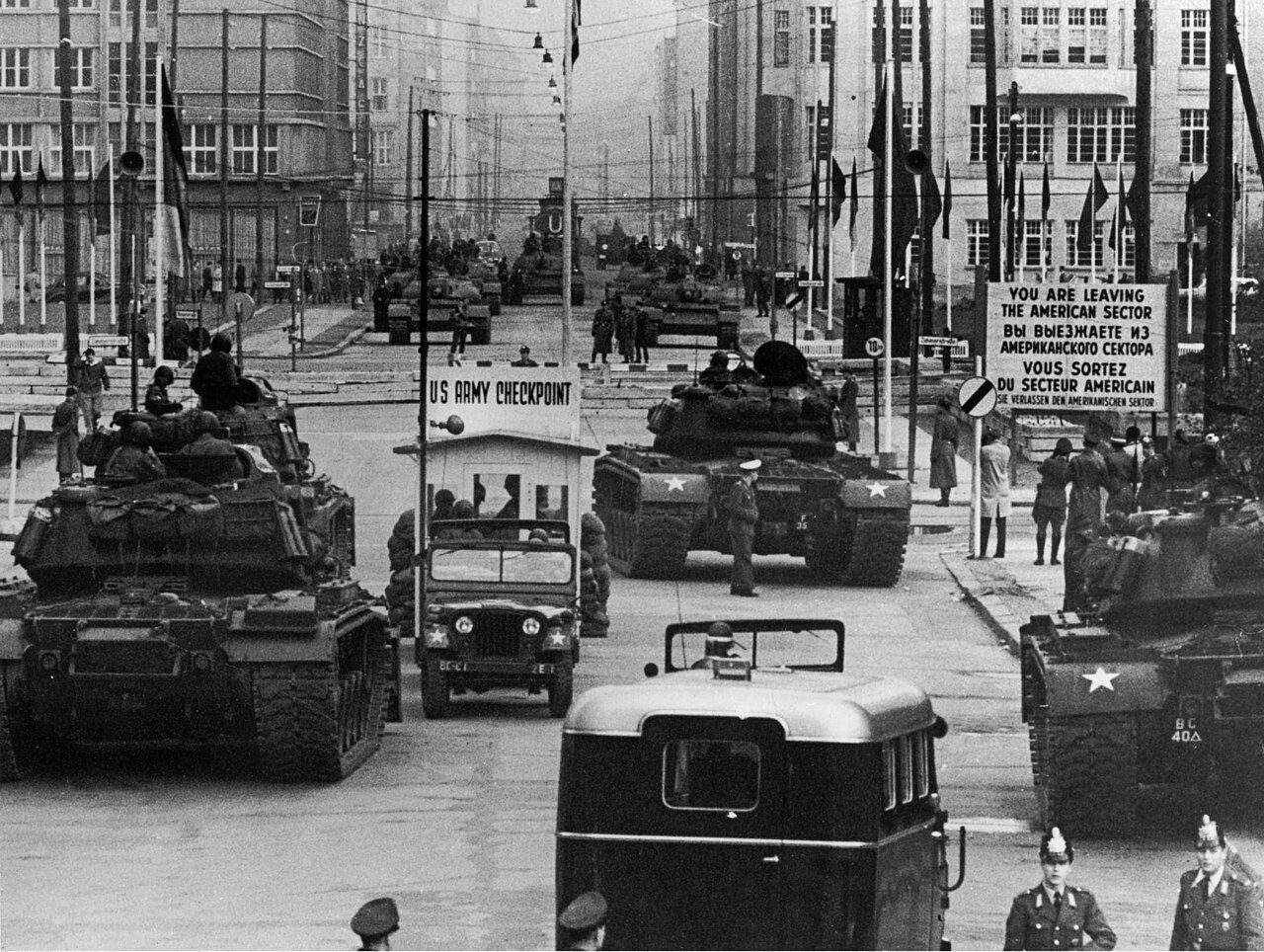
At a Glance
- Conventional dates
- 1947–1991, from the Truman Doctrine to the dissolution of the USSR
- Principals
- The United States and the Soviet Union, with their alliance systems
- Alliances
- NATO (1949) and the Warsaw Pact (1955)
- Fought by
- Politics, economics, propaganda, espionage, arms races and proxy wars — never direct US–Soviet battle
- Closest approach to war
- The Cuban Missile Crisis, October 1962
- Symbolic end
- The fall of the Berlin Wall, 9 November 1989
- Formal end
- Dissolution of the Soviet Union, December 1991
Introduction
The Cold War was a war in which the two principal enemies never fought each other directly. From 1947 to 1991 the United States and the Soviet Union — the only two superpowers left after the Second World War — waged what Britannica calls an open yet restricted rivalry, fought mainly on political, economic and propaganda fronts. Alliances were built, arsenals multiplied into the tens of thousands of nuclear warheads, and the actual shooting was done in other people's countries: Korea, Vietnam, Afghanistan and dozens of smaller battlegrounds.
The conventional dating, which Britannica adopts, runs from the announcement of the Truman Doctrine on 12 March 1947 to the dissolution of the Soviet Union at the end of 1991. In those forty-four years the rivalry organised almost everything in international life: it divided Europe with a wall, put men on the Moon, and at least twice — over Berlin and over Cuba — brought the world within sight of nuclear war.
Background
The wartime alliance of 1941–45 had always been a marriage of necessity against Hitler, and it dissolved as soon as the common enemy did. The Soviet Union, invaded twice in a generation, kept the Eastern European states its armies had liberated as a buffer of friendly governments; the United States and Britain saw the same facts as expansion. By 1946 Winston Churchill was speaking of an iron curtain descending across Europe. When Britain announced in 1947 that it could no longer support Greece and Turkey against communist pressure, President Harry Truman went to Congress on 12 March 1947, asked for 400 million dollars in aid for the two countries, and declared that the United States would support free peoples resisting subjugation — the Truman Doctrine, and the policy of containment that governed American strategy for four decades.
The confrontation hardened fast. The Marshall Plan offered American money to rebuild Europe; Moscow forbade its sphere to take it. In June 1948 the Soviets blockaded the western sectors of Berlin, and the Western allies supplied a city by air for eleven months rather than yield it. In 1949 the Western allies formed NATO, the Soviet Union tested its first atomic bomb, ending the American nuclear monopoly, and the communists won the Chinese civil war. The two-bloc world was complete: in 1955 the Soviet Union answered NATO with the Warsaw Pact, and the map of Europe froze along the line where the armies of 1945 had stopped.
Timeline
- 12 March 1947
President Truman announces the Truman Doctrine, committing the United States to resist communist expansion — the conventional start of the Cold War.
- June 1948 – May 1949
The Soviet Union blockades West Berlin; the Western allies sustain the city by airlift until the blockade is lifted.
- 1949
NATO is founded; the Soviet Union tests its first atomic bomb; communist forces win the Chinese civil war.
- 1950–1953
The Korean War: the first hot war of the Cold War ends in armistice near the pre-war border.
- 1955
The Warsaw Pact formalises the Soviet bloc's alliance, completing Europe's division into two armed camps.
- 13 August 1961
East Germany seals the border and begins building the Berlin Wall to stop its citizens fleeing west.
- October 1962
The Cuban Missile Crisis brings the superpowers to the brink of nuclear war before a negotiated withdrawal.
- 1964–1973
The United States escalates, then withdraws from, the Vietnam War — the Cold War's most costly American proxy conflict.
- 1979–1989
The Soviet Union invades Afghanistan and bleeds for a decade in its own proxy-war quagmire.
- 9 November 1989
The Berlin Wall falls; communist governments collapse across Eastern Europe.
- December 1991
The Soviet Union dissolves, ending the Cold War and leaving the United States the sole superpower.
Significance
The Cold War's strangest achievement was the long peace between the principals. Deterrence worked — at horrific potential cost. Both sides built arsenals capable of destroying civilisation in an afternoon, and both sides, in crisis after crisis, chose retreat or compromise over using them: over Berlin in 1948 and 1961, over Cuba in 1962. Britannica notes the rivalry reached its peak in 1948–53 and again in 1958–62, after which the superpowers began, cautiously, to manage the competition — test-ban and arms-limitation treaties, a direct hotline between Washington and Moscow after the Cuban crisis, and the détente of the 1970s.
For the rest of the world there was nothing cold about it. Proxy wars in Korea, Vietnam, Angola and Afghanistan killed millions, and the arms race consumed wealth on a scale that dwarfed most national economies. The space race — Sputnik, Gagarin, Apollo — was the rivalry in its most benign form, a contest of prestige that produced genuine exploration as a by-product.
Legacy
The Cold War ended not with a battle but with an abdication: reform under Mikhail Gorbachev loosened Moscow's grip, Eastern Europe walked away in 1989, the Berlin Wall fell on 9 November that year, the Warsaw Pact dissolved in July 1991, and on 31 December 1991 the Soviet Union itself ceased to exist. The bipolar world gave way to a unipolar moment, and NATO — the alliance built for a war that never came — outlived its enemy and began expanding into the former Soviet sphere, a fact that shapes European security arguments to this day.
Its deeper legacy is institutional and mental. The national-security state, the permanent standing military, the intelligence agencies, the nuclear command systems built to survive a first strike — all are Cold War creations that persisted after their justification dissolved.
Sources
- Encyclopaedia Britannica — Cold War
- John F. Kennedy Presidential Library and Museum — Launching into the Sixties (education materials)
- National Archives — Truman Doctrine (Milestone Documents)
- Encyclopaedia Britannica — Cuban missile crisis
The facts on this page were checked against these sources on 19 November 2026. The History Trail's permanent pages are researched and written for this site; the live profiles elsewhere on The History Trail are assembled automatically from Wikipedia and Wikidata.
About the Author
Researched and written by the The History Trail Editorial Team — the accountable editorial function behind this site's permanent story pages. The team works from the published sources cited on each page; it does not invent historians, reviewers or credentials, and it corrects errors openly.
Fact Check
Every load-bearing fact on this page traces to one of the sources listed above, and significant claims link to their source in the text. Our checking method is described on the methodology page; errors can be reported via the corrections page.
Sources & Citations
Cite this page as: The History Trail Editorial Team, The History Trail — this article's title, publication and update dates are shown beneath its headline. The full source list appears under Sources above; the site's source standards are on the sources page.