
Things
American Civil War
Eleven states seceded over slavery, and the republic answered with four years of industrial war. The Civil War killed at least three-quarters of a million soldiers, preserved the Union and ended slavery — on terms America is still arguing about.
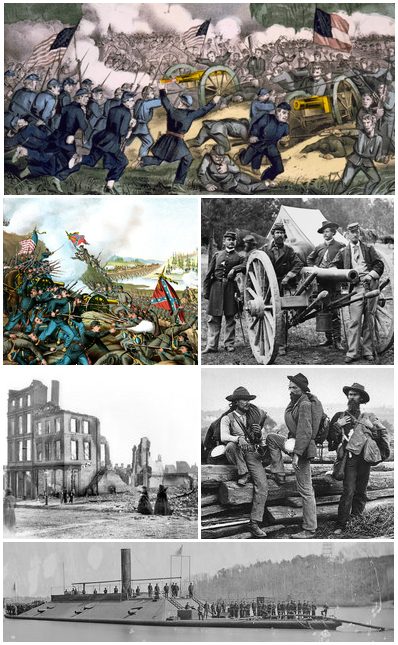
At a Glance
- Fought
- 12 April 1861 – spring 1865
- Belligerents
- The United States (Union) vs 11 seceded states (Confederate States of America)
- Central cause
- Slavery, above all its expansion into the western territories
- Soldier deaths (Britannica)
- An estimated 752,000–851,000 — about 2% of the 1860 population
- Turning point
- Gettysburg and the fall of Vicksburg, July 1863
- Emancipation Proclamation
- 1 January 1863 — declared enslaved people in rebellious states free
- Outcome
- Union victory; Confederacy dissolved; slavery abolished by the Thirteenth Amendment
Introduction
The American Civil War was the bloodiest conflict in the nation's history, fought between April 1861 and the spring of 1865 between the United States — the Union — and eleven Southern states that seceded to form the Confederate States of America. Encyclopaedia Britannica describes it as a four-year war arising from decades of growing sectional friction over slavery, and estimates that between 752,000 and 851,000 soldiers died — roughly two percent of the American population of 1860. No foreign war in American history comes close to that toll, and disease, as in most pre-modern wars, killed more men than bullets did.
Yet the war's significance is not measured only in loss. It settled, by force, the two questions the republic had avoided since its founding: whether the Union could be dissolved at will, and whether a nation proclaimed on the equality of men could continue to hold four million people in slavery.
Background
By 1860 the sections had grown into different societies. Britannica's account stresses the contrast: a North rapidly industrialising and investing in railroads, canals and banks, with agriculture based mostly on free labour; and a South whose economy rested on plantations producing commercial crops, above all cotton, worked by enslaved people, in whom Southerners had invested even more capital than in land. Every attempt to settle the status of slavery in the new western territories — the Missouri Compromise of 1820 and its successors — held the Union together by postponement, and each postponement made the next crisis sharper.
The trigger was electoral. When Abraham Lincoln, candidate of the explicitly antislavery Republican Party, won the presidential election of 1860, seven Southern states seceded and organised the Confederacy; the issue, as Britannica puts it, was whether slavery would be allowed to expand into the territories, which white Southerners believed was essential to the institution's survival. Lincoln refused to recognise secession as lawful. In the early morning of 12 April 1861 Confederate guns opened fire on the federal garrison at Fort Sumter in Charleston harbour, and four more Southern states joined the Confederacy. The first battle of the bloodiest American war, curiously, killed no one: after a 34-hour bombardment Major Robert Anderson surrendered his roughly 85 soldiers to some 5,500 besieging troops.
Timeline
- 12 April 1861
Confederate forces bombard Fort Sumter, Charleston, South Carolina; the garrison surrenders after 34 hours and the war begins.
- 21 July 1861
At the First Battle of Bull Run, Union troops advancing on Richmond are driven back to Washington — the North's first lesson that the war will be long.
- 9 March 1862
The ironclads Monitor and Virginia (the former Merrimack) fight at Hampton Roads, opening the modern era of naval warfare.
- 17 September 1862
Antietam becomes the bloodiest single day in American military history; Lincoln uses the Union stand to issue the preliminary Emancipation Proclamation days later.
- 1 January 1863
The Emancipation Proclamation takes effect, declaring enslaved people in the rebellious states free and opening Union ranks to Black soldiers — nearly 180,000 enlist.
- 1–3 July 1863
The Battle of Gettysburg ends Lee's invasion of the North with about 51,000 total casualties; on 4 July Vicksburg surrenders, splitting the Confederacy along the Mississippi.
- March 1864
Ulysses S. Grant takes command of all Union armies and begins the strategy of relentless pressure that Lee cannot match.
- 9 April 1865
Lee surrenders to Grant at Appomattox Court House, Virginia; remaining Confederate armies surrender over the following weeks.
- 14 April 1865
President Lincoln is assassinated in Washington, five days after Appomattox.
- 18 December 1865
The Thirteenth Amendment, abolishing slavery throughout the United States, is proclaimed in force.
Significance
Militarily, the war was a hinge between eras. It was among the first industrial wars: railroads moved armies, the telegraph moved orders, mass-produced rifles and ironclad warships changed what battle meant, and photography brought the dead home. Grant's capture of Vicksburg on 4 July 1863 split the Confederacy along the Mississippi in the same weekend that Lee's defeat at Gettysburg ended Confederate hopes of victory on Northern soil or recognition from Europe.
Politically, the Emancipation Proclamation transformed the war's meaning. Issued after Antietam and effective from 1 January 1863, it declared the enslaved people of the rebellious states free — applying to more than 3.5 million of the country's four million enslaved people — made abolition a Union war aim, opened the army to Black enlistment, and, as Britannica notes, made British or French intervention on the Confederate side effectively impossible. The Thirteenth Amendment then wrote emancipation into the Constitution itself.
Legacy
The war's settlement was real but incomplete. The Union was preserved as one indivisible nation, slavery was abolished, and the Fourteenth and Fifteenth Amendments promised citizenship and the vote regardless of race — promises whose enforcement collapsed within a generation and had to be fought for again in the civil rights era a century later. Reconstruction, the war's long epilogue, remains one of the most contested chapters in American memory, and Britannica notes that Confederate symbols are still controversial because of their association with slavery and white supremacy.
What cannot be contested is the scale of the transformation. A republic that in 1861 could not decide whether it was one nation or a league of states, or whether its founding creed applied to the enslaved, emerged in 1865 having answered both questions at terrible cost.
Sources
- Encyclopaedia Britannica — American Civil War
- Encyclopaedia Britannica — Emancipation Proclamation
- National Archives — The Emancipation Proclamation
- Encyclopaedia Britannica — Remembering the American Civil War: Fighting the war
The facts on this page were checked against these sources on 19 November 2026. The History Trail's permanent pages are researched and written for this site; the live profiles elsewhere on The History Trail are assembled automatically from Wikipedia and Wikidata.
About the Author
Researched and written by the The History Trail Editorial Team — the accountable editorial function behind this site's permanent story pages. The team works from the published sources cited on each page; it does not invent historians, reviewers or credentials, and it corrects errors openly.
Fact Check
Every load-bearing fact on this page traces to one of the sources listed above, and significant claims link to their source in the text. Our checking method is described on the methodology page; errors can be reported via the corrections page.
Sources & Citations
Cite this page as: The History Trail Editorial Team, The History Trail — this article's title, publication and update dates are shown beneath its headline. The full source list appears under Sources above; the site's source standards are on the sources page.