
Things
Cuban Missile Crisis
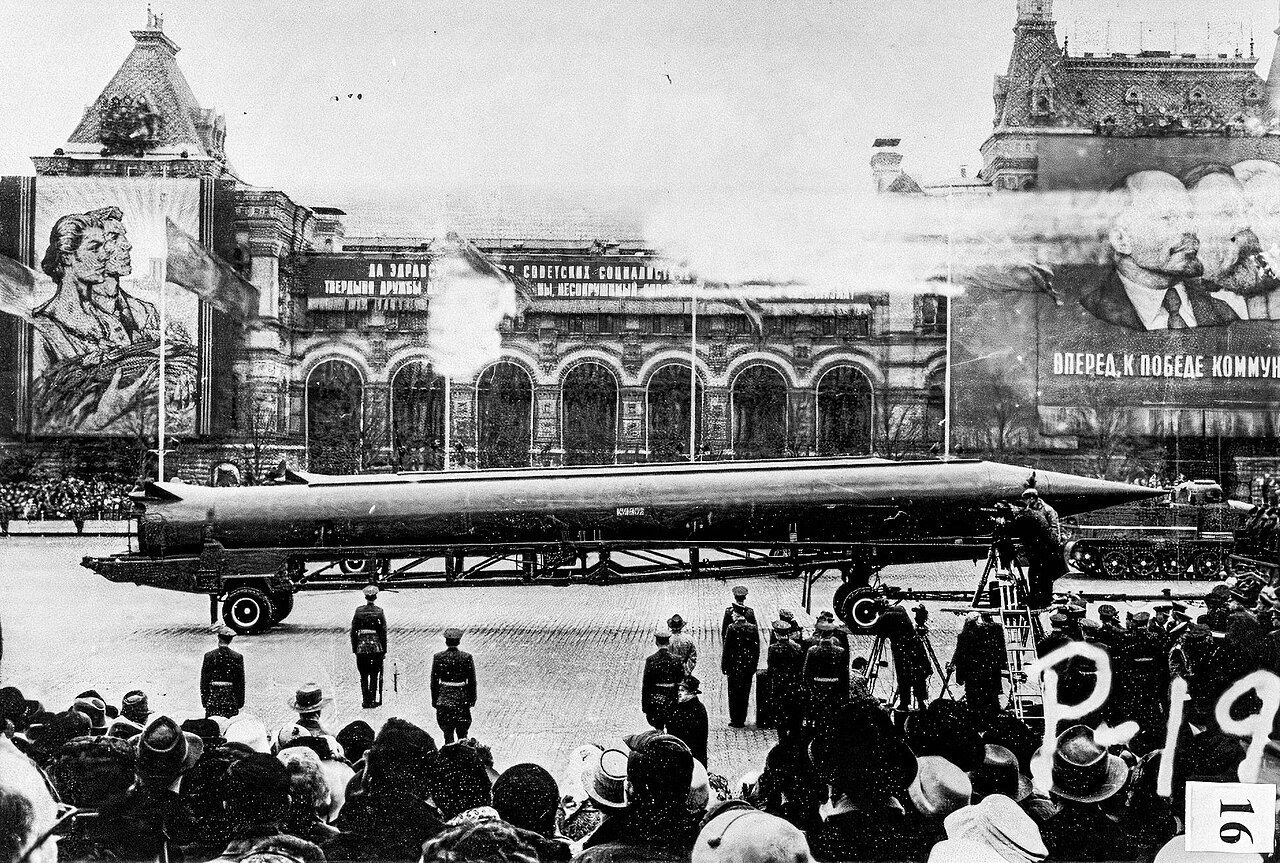
Spy planes found Soviet nuclear missiles ninety miles from Florida, and for thirteen days two superpowers edged towards a war neither wanted. The Cuban Missile Crisis is the story of how they climbed down — just barely, and partly in secret.
At a Glance
- Dates
- 16–28 October 1962 (quarantine lifted 20 November)
- Principals
- United States (President John F. Kennedy) and Soviet Union (Nikita Khrushchev), with Fidel Castro's Cuba
- Trigger
- US U-2 photographs, 14 October 1962, of Soviet missile sites in Cuba
- US response
- A naval 'quarantine' of Cuba, announced 22 October 1962
- Settlement
- Soviet missiles withdrawn; US pledged not to invade Cuba and secretly agreed to remove Jupiter missiles from Turkey
- Direct death
- US U-2 pilot Major Rudolf Anderson, shot down over Cuba on 27 October
- Aftermath
- Moscow–Washington hotline (1963) and the Partial Nuclear Test Ban Treaty (1963)
Introduction
For thirteen days in October 1962, the world waited. The John F. Kennedy Presidential Library's own account puts it simply: a United States spy plane had secretly photographed nuclear missile sites being built by the Soviet Union on the island of Cuba, ninety miles from Florida, and President John F. Kennedy met in secret with his advisers while the two superpowers moved towards a confrontation neither could afford to lose. Encyclopaedia Britannica calls it the major confrontation that brought the United States and the Soviet Union close to war, and historians generally regard it as the closest the world has ever come to nuclear war.
The crisis is remembered as a duel of nerve between Kennedy and the Soviet premier, Nikita Khrushchev. But it was also a crisis of slow communications and incomplete information — a Soviet submarine officer refusing to fire, an American spy plane straying over Siberia, another shot down over Cuba.
Background
The missiles were not sent on a whim. Khrushchev had promised in May 1960 to defend Cuba with Soviet arms, and after the failed American-backed Bay of Pigs invasion of April 1961, Fidel Castro's Cuba had every reason to fear a full United States invasion. Britannica records that Khrushchev assumed Washington would take no steps to prevent the installation of Soviet medium- and intermediate-range ballistic missiles in Cuba — a shortcut to redress the strategic imbalance, since American Jupiter missiles already stood in Turkey, within range of Soviet cities, and the United States led in intercontinental weapons. In July 1962 Khrushchev and Castro agreed to place the missiles secretly; construction began that summer.
The secret held until 14 October, when a U-2 reconnaissance aircraft photographed the sites under construction. Kennedy was briefed on 16 October and convened the Executive Committee of the National Security Council — ExComm — which debated the options in secret for days: an air strike on the sites, a full invasion of Cuba, diplomacy, or a blockade. Kennedy chose the middle course. On the evening of 22 October he told the American public what had been found, announced a naval 'quarantine' of Cuba — the word chosen because a blockade is, in international law, an act of war — and warned that any missile launched from Cuba would be treated as a Soviet attack requiring full retaliation.
Timeline
- April 1961
The Bay of Pigs invasion of Cuba by US-backed exiles fails, deepening Cuban and Soviet fears of an American invasion.
- July 1962
Khrushchev and Castro secretly agree to station Soviet nuclear missiles in Cuba; construction of launch sites begins.
- 14 October 1962
A US U-2 spy plane photographs Soviet medium-range ballistic missile sites under construction in Cuba.
- 16 October 1962
Kennedy is briefed and convenes ExComm; secret deliberations begin on air strike, invasion, diplomacy or blockade.
- 22 October 1962
Kennedy addresses the nation, reveals the missiles and announces a naval quarantine of Cuba, effective two days later.
- 24 October 1962
The quarantine takes effect; Soviet ships approaching the line slow or turn away, avoiding the first direct confrontation.
- 26 October 1962
Khrushchev's first letter offers a deal: missiles withdrawn if the United States pledges not to invade Cuba.
- 27 October 1962
'Black Saturday': a second Soviet letter adds the Turkish missiles; a U-2 is shot down over Cuba and its pilot killed, and another strays over Siberia.
- 28 October 1962
Khrushchev announces on Radio Moscow that the missiles will be dismantled and returned to the Soviet Union; the crisis ends.
- 20 November 1962
With Soviet bombers also withdrawn, the United States lifts the quarantine; the crisis is formally over.
- 1963
The Moscow–Washington hotline is established, and the superpowers sign the Partial Nuclear Test Ban Treaty.
Significance
The public settlement was asymmetrical in appearance: the Soviets withdrew their missiles under the eyes of the world, and the United States pledged not to invade Cuba. The secret codicil — Kennedy's promise to withdraw the Jupiter missiles from Turkey within months — was concealed even from much of his own government, and Britannica notes that the humiliation in Cuba contributed both to Khrushchev's fall from power in October 1964 and to a Soviet determination never again to negotiate from nuclear inferiority. The Soviet buildup that followed achieved parity by the end of the decade, which is one reason there was never a second crisis quite like this one.
The crisis also taught both capitals the same lesson: that in a nuclear confrontation, events can outrun intentions. On 27 October alone, the shooting down of Major Rudolf Anderson's U-2 over Cuba and the depth-charging of a Soviet submarine carrying a nuclear torpedo each came within one officer's judgement of catastrophe. The hotline and the 1963 test-ban treaty were direct institutional answers: mechanisms to slow a crisis down.
Legacy
The Cuban Missile Crisis became the founding parable of crisis management: studied in war colleges, dramatised in Robert Kennedy's posthumous memoir Thirteen Days, and invoked in every later confrontation between nuclear powers. Its vocabulary — brinkmanship, quarantine, back channel — entered the language, and its central finding, that two rational governments could still stumble towards annihilation through misperception and machinery, shaped arms control for the rest of the Cold War.
Later revelations deepened rather than softened the story. Only decades afterwards did the full facts emerge in the West: that Soviet forces in Cuba already had tactical nuclear weapons, and how close the submarine B-59 came to firing its nuclear torpedo on 27 October.
Sources
- John F. Kennedy Presidential Library and Museum — Presidential Press Office lesson plan (Cuban Missile Crisis background)
- Encyclopaedia Britannica — Cuban missile crisis
- National Archives Foundation — Seven Minutes to Midnight (Cuban Missile Crisis records)
- Encyclopaedia Britannica — Cold War
The facts on this page were checked against these sources on 19 November 2026. The History Trail's permanent pages are researched and written for this site; the live profiles elsewhere on The History Trail are assembled automatically from Wikipedia and Wikidata.
About the Author
Researched and written by the The History Trail Editorial Team — the accountable editorial function behind this site's permanent story pages. The team works from the published sources cited on each page; it does not invent historians, reviewers or credentials, and it corrects errors openly.
Fact Check
Every load-bearing fact on this page traces to one of the sources listed above, and significant claims link to their source in the text. Our checking method is described on the methodology page; errors can be reported via the corrections page.
Sources & Citations
Cite this page as: The History Trail Editorial Team, The History Trail — this article's title, publication and update dates are shown beneath its headline. The full source list appears under Sources above; the site's source standards are on the sources page.