
On This Day
August 25 in History
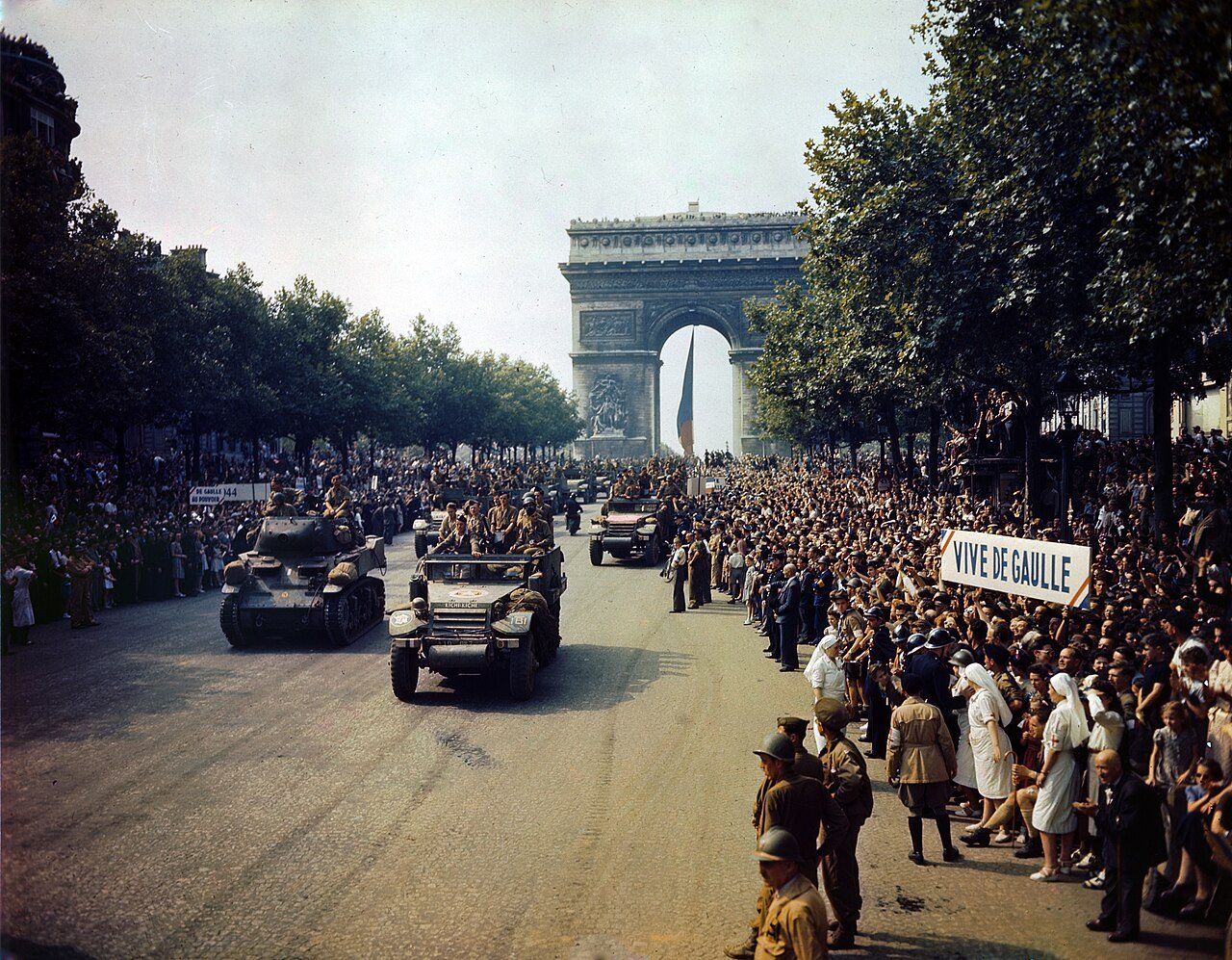
On 25 August 1944 Paris was liberated after four years of German occupation, as the French 2nd Armoured Division and the Resistance forced the surrender of the German garrison and Charles de Gaulle walked to the Hotel de Ville. August 25 is also the day of the Great Moon Hoax, the first Channel swim, and Voyager 1's entry into interstellar space.
Choose another date: open the On This Day calendar to browse events, births and deaths for any day of the year.
At a Glance
- The occupation
- Paris had been under German control since June 1940
- The uprising
- The Paris Resistance rose on 19 August 1944, building barricades across the city
- The entry
- Captain Raymond Dronne's company of Leclerc's 2nd Armoured Division reached the Hotel de Ville on the evening of 24 August
- The surrender
- German commander Dietrich von Choltitz signed the surrender on 25 August, disobeying orders to leave Paris in ruins
- The speech
- De Gaulle at the Hotel de Ville refused to proclaim a new republic: Paris liberated by its own people and the armies of France
- The cost
- An estimated 1,500 Resistance fighters and civilians died in the fighting for the city
Events on this day
- 1825Uruguay declares independence from the Brazilian Empire, a step toward the sovereign state recognised three years later.
- 1835The New York Sun begins the Great Moon Hoax, a series of fake reports of life on the Moon that becomes a media sensation.
- 1875Captain Matthew Webb becomes the first person to swim the English Channel unaided, taking 21 hours 45 minutes.
- 1916The United States creates the National Park Service to manage its growing system of national parks.
- 1939The Wizard of Oz opens in American cinemas, weeks before Judy Garland's Dorothy becomes a permanent part of film history.
- 1944Paris is liberated as the German garrison surrenders to Free French forces — the featured story above.
- 1958Momofuku Ando launches Chicken Ramen in Japan, the first mass-market instant noodles.
- 2005Hurricane Katrina makes its first landfall in Florida before turning toward the Gulf Coast.
- 2012NASA announces that Voyager 1 has crossed the heliopause, the first human-made object to enter interstellar space.
Born on this day
- 1530Ivan the Terrible — first tsar of Russia, whose reign mixed reform with terror.
- 1744Johann Gottfried Herder — German philosopher who shaped ideas of culture and national identity.
- 1918Leonard Bernstein — American conductor and composer of West Side Story.
- 1927Althea Gibson — American tennis pioneer, the first Black player to win Grand Slam titles.
- 1930Sean Connery — Scottish actor who defined James Bond for a generation.
- 1958Tim Burton — American film director of Edward Scissorhands and The Nightmare Before Christmas.
Died on this day
- 1776David Hume — Scottish philosopher, the great sceptic of the Enlightenment, dead at 65.
- 1867Michael Faraday — English scientist whose work on electromagnetism made the electric age possible.
- 1900Friedrich Nietzsche — German philosopher, dead at 55 in Weimar after a decade of mental collapse.
- 1984Truman Capote — American author of In Cold Blood, dead at 59.
- 2009Edward M. Kennedy — United States senator for 47 years and the liberal lion of his era, dead at 77.
- 2012Neil Armstrong — American astronaut, the first person to walk on the Moon, dead at 82.
The featured story: Paris is liberated, 25 August 1944
For four years Paris had lived under occupation: swastikas over the Hotel de Ville, German signposts at the junctions, and queues for rationed food in streets emptied of cars. The Allied plan after Normandy had been to bypass the capital and avoid a battle inside it. The Parisians decided otherwise. On 19 August 1944 the Resistance rose, police and railway workers struck, and barricades of cobblestones, sandbags and burned-out cars went up across the city. Fighting the garrison street by street, the insurgents held perhaps a third of Paris and were running out of ammunition when their envoys reached the Allied lines with a simple message: come now, or come to a massacre.
General Leclerc's French 2nd Armoured Division, with the U.S. 4th Infantry Division beside it, turned for the capital. On the evening of 24 August a small vanguard under Captain Raymond Dronne, its tanks crewed largely by Spanish Republican exiles, slipped through the southern suburbs and reached the Hotel de Ville, where the bells of Notre Dame began to ring for the first time in four years. The main force fought its way in the next morning against snipers and pockets of resistance.
The German commander, General Dietrich von Choltitz, had orders from Hitler to hold Paris and leave it a field of ruins, with its bridges and monuments mined. On the afternoon of 25 August, his headquarters at the Hotel Meurice overrun, Choltitz signed the surrender instead, an act of disobedience for which he later cast himself, not entirely accurately, as the saviour of Paris. That evening Charles de Gaulle entered the city and spoke from the Hotel de Ville, refusing the suggestion that he proclaim the Republic: it had never ceased to exist, he said, and Paris had been liberated by its own people, with the armies of France.
The next day de Gaulle walked down the Champs-Elysees through enormous crowds while snipers still fired from rooftops, a procession that announced the restoration of the French state as much as the end of the occupation. Militarily, Paris mattered less than the ports and the road to Germany; symbolically, it mattered enormously. France re-entered the war's endgame as a victor rather than a victim, and the images of August 1944, of a capital that rose before its liberators arrived, shaped the country's memory of itself for generations.
Why this date matters
August 25 pairs liberation with imagination. Its centrepiece is a real city freeing itself; around it sit a newspaper inventing life on the Moon, a sea captain proving a channel could be swum, a film about a road of yellow brick opening in cinemas, and a space probe leaving the Sun's bubble altogether in 2012. The day's pattern is escape: from occupation, from gravity, from the limits of what editors, swimmers and engineers were supposed to attempt. Even its instant noodles were an escape from hunger in a ruined Japan.
Sources
- Encyclopaedia Britannica — On This Day: August 25
- HISTORY — What Happened on August 25
- The Free Library — On This Weekend, August 25/26: the liberation of Paris
- Franklin D. Roosevelt Presidential Library — Liberation of Paris photograph, 25 August 1944
- Wikimedia Commons — Paris 1944, Champs-Elysees after the liberation

The facts on this page were checked against these sources on 19 November 2026. The History Trail's permanent pages are researched and written for this site; the live profiles elsewhere on The History Trail are assembled automatically from Wikipedia and Wikidata.
About the Author
Researched and written by the The History Trail Editorial Team — the accountable editorial function behind this site's permanent story pages. The team works from the published sources cited on each page; it does not invent historians, reviewers or credentials, and it corrects errors openly.
Fact Check
Every load-bearing fact on this page traces to one of the sources listed above, and significant claims link to their source in the text. Our checking method is described on the methodology page; errors can be reported via the corrections page.
Sources & Citations
Cite this page as: The History Trail Editorial Team, The History Trail — this article's title, publication and update dates are shown beneath its headline. The full source list appears under Sources above; the site's source standards are on the sources page.