
On This Day
August 24 in History
On 24 August 79 CE, by the traditional dating, Mount Vesuvius erupted and buried the Roman cities of Pompeii and Herculaneum, preserving them under ash for seventeen centuries. August 24 is also the day of the St Bartholomew's Day Massacre, the burning of Washington, and Pluto's demotion to dwarf planet.
Choose another date: open the On This Day calendar to browse events, births and deaths for any day of the year.
At a Glance
- The date
- Traditionally 24 August 79 CE, from Pliny the Younger's letters; some modern evidence points to October
- The cities
- Pompeii buried under pumice and ash; Herculaneum under pyroclastic surges and mud; Stabiae also destroyed
- The witness
- Pliny the Younger, whose two letters to Tacitus are the classic account of the eruption
- The famous victim
- Pliny the Elder, the naturalist and admiral, who died at Stabiae during a rescue mission
- The rediscovery
- Pompeii was systematically excavated from the eighteenth century, founding modern archaeology
- The toll
- Unknown in total; an estimated 2,000 died at Pompeii alone, of perhaps 20,000 inhabitants
Events on this day
- 79 CEMount Vesuvius erupts, burying Pompeii, Herculaneum and Stabiae — the featured story above.
- 410Alaric's Visigoths complete the sack of Rome, the first fall of the city to a foreign enemy in eight centuries.
- 1572The St Bartholomew's Day Massacre begins in Paris, as Catholic mobs kill thousands of Huguenot Protestants across France.
- 1814British troops burn Washington, D.C., including the White House and the Capitol, during the War of 1812.
- 1821The Treaty of Cordoba is signed, recognising Mexico's independence from Spain.
- 1932Amelia Earhart takes off from Los Angeles and lands in Newark the next day, the first woman to fly solo nonstop across the United States.
- 1949The North Atlantic Treaty takes effect, bringing NATO formally into existence.
- 1991Ukraine declares independence from the Soviet Union, a decisive step in the USSR's dissolution.
- 1995Microsoft releases Windows 95, the launch that brought the personal computer's Start button to the world.
- 2006Astronomers meeting in Prague vote to reclassify Pluto as a dwarf planet.
Born on this day
- 1899Jorge Luis Borges — Argentine writer whose labyrinths and libraries remade world literature.
- 1929Yasser Arafat — Palestinian leader, PLO chairman and Nobel Peace Prize laureate, believed born this day in Cairo.
- 1942Karen Uhlenbeck — American mathematician, the first woman to win the Abel Prize.
- 1957Stephen Fry — English actor, writer and broadcaster.
- 1965Marlee Matlin — American actress who won an Oscar for Children of a Lesser God.
Died on this day
- 79 CEPliny the Elder — Roman naturalist and fleet commander, who died at Stabiae sailing to the rescue during Vesuvius's eruption.
- 1954Getulio Vargas — dominant Brazilian president of his era, who shot himself as a political crisis closed in.
- 1967Henry J. Kaiser — American industrialist whose shipyards and steelworks armed the United States in the Second World War.
- 2004Elisabeth Kubler-Ross — Swiss-American psychiatrist who described the five stages of grief.
The featured story: Vesuvius erupts and Pompeii is buried, 24 August 79 CE
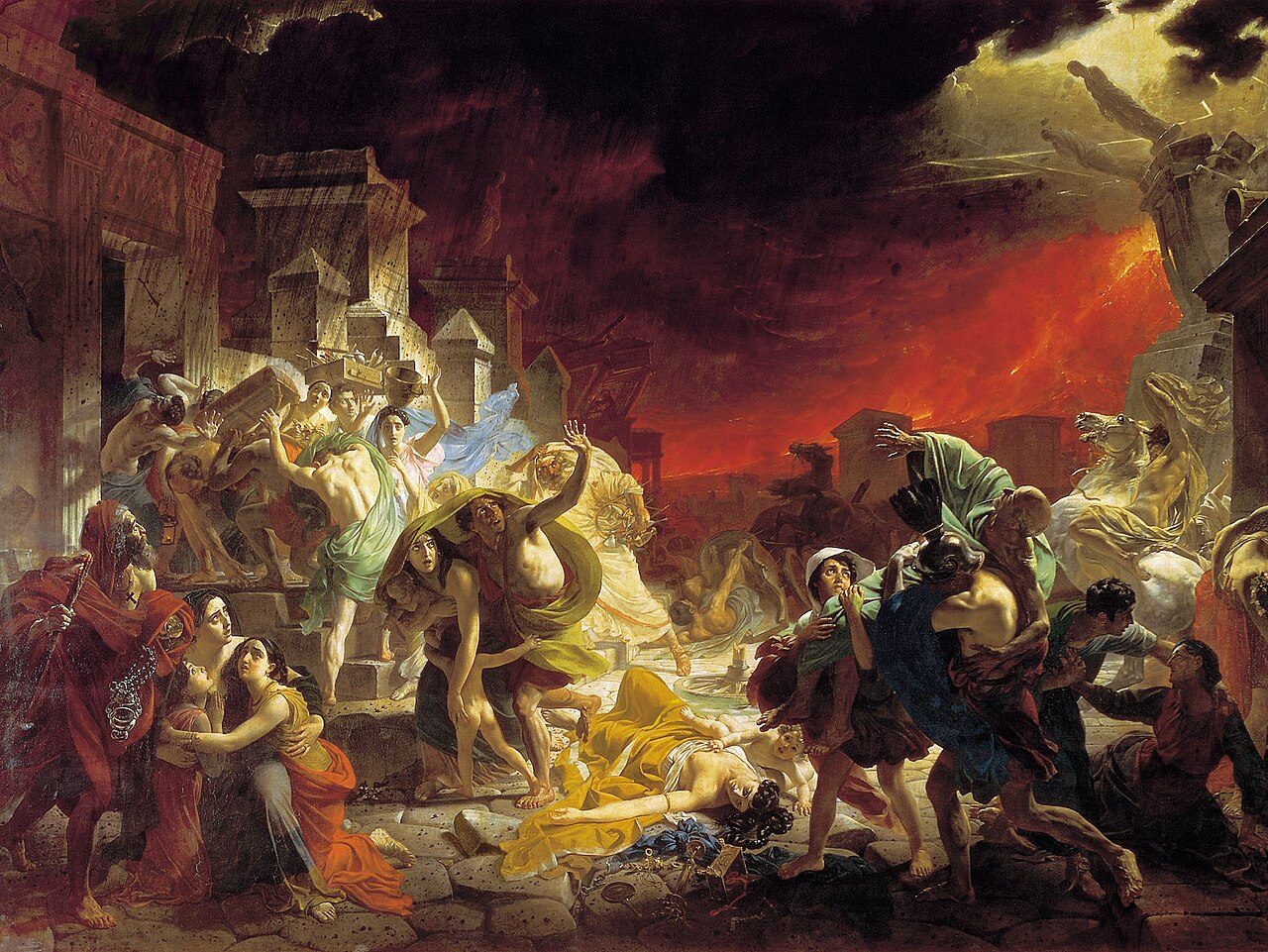
Shortly after midday, by the traditional dating on 24 August 79 CE, the top of Mount Vesuvius blew apart. A column of ash and pumice rose miles into the sky in the shape, as Pliny the Younger wrote, of a pine tree. Pompeii, a prosperous town of perhaps 20,000 people a few miles south-east of the volcano, lay directly under the fall. Through the afternoon and night pumice rained down at a rate roofs could not bear; people fled with pillows tied over their heads, or died in collapsing buildings, while the sea withdrew and the sky turned to night at noon.
Herculaneum, the smaller, wealthier resort town on the coast to the west, escaped the pumice but not the volcano. In the early hours of the following morning the eruption column collapsed, sending pyroclastic surges, clouds of superheated gas and ash, racing down the slopes. Herculaneum was buried under some twenty metres of material that hardened like concrete; for centuries it was assumed its people had escaped, until excavations in the 1980s found hundreds of skeletons crowded in the boat sheds on its shore.
The best witness was seventeen years old. Pliny the Younger watched from Misenum, across the bay, where his uncle, Pliny the Elder, commanded the Roman fleet. The elder Pliny sailed toward the eruption to rescue friends, dictated observations as ash fell on his ship, and died at Stabiae, apparently overcome by fumes. His nephew's two letters to the historian Tacitus, written years later, remain the founding text of volcanology: the type of eruption he described is still called Plinian.
The cities were never rebuilt and were gradually forgotten, until tunnelling and then systematic excavation in the eighteenth century brought them back, preserved to a degree no other ancient site matches: streets, bakeries with loaves still in the ovens, election slogans on walls, and, from the 1860s, Giuseppe Fiorelli's plaster casts of the voids left by bodies in the ash. A note of caution belongs with the date itself: Pliny's manuscripts and some finds, including autumn fruits and a coin struck later in 79, have led many scholars to argue the eruption actually came in October. The 24th of August remains the traditional anniversary, not a certain one.
Why this date matters
August 24 is the calendar's catastrophe day, and unusually honest about it. Its centrepiece destroyed two cities in a day, yet preserved them for two thousand years; its other entries run from the sack of Rome and a massacre of Protestants to the burning of a young republic's capital. But the day also builds: a treaty recognising Mexico, an alliance that anchored the post-war West, a woman flying a continent alone, and a software launch that put a computer on the world's desks. Destruction gets the headlines; the date keeps both ledgers. Vesuvius itself has not retired: it remains one of the most closely watched volcanoes on Earth, brooding over a modern Naples metropolitan area of some three million people, with evacuation plans rehearsed against the day the mountain repeats the performance that made it famous.
Sources
- Encyclopaedia Britannica — On This Day: August 24
- HISTORY — What Happened on August 24
- OnThisDay — Historical Events on August 24
- Wikimedia Commons — Karl Briullov, The Last Day of Pompeii

The facts on this page were checked against these sources on 19 November 2026. The History Trail's permanent pages are researched and written for this site; the live profiles elsewhere on The History Trail are assembled automatically from Wikipedia and Wikidata.
About the Author
Researched and written by the The History Trail Editorial Team — the accountable editorial function behind this site's permanent story pages. The team works from the published sources cited on each page; it does not invent historians, reviewers or credentials, and it corrects errors openly.
Fact Check
Every load-bearing fact on this page traces to one of the sources listed above, and significant claims link to their source in the text. Our checking method is described on the methodology page; errors can be reported via the corrections page.
Sources & Citations
Cite this page as: The History Trail Editorial Team, The History Trail — this article's title, publication and update dates are shown beneath its headline. The full source list appears under Sources above; the site's source standards are on the sources page.