
On This Day
August 26 in History
On 26 August 1920 the Nineteenth Amendment was certified into the United States Constitution, guaranteeing women the right to vote after a seventy-year campaign. August 26 is also the day of the Battle of Crecy, the Declaration of the Rights of Man, and the patenting of the first synthetic dye.
Choose another date: open the On This Day calendar to browse events, births and deaths for any day of the year.
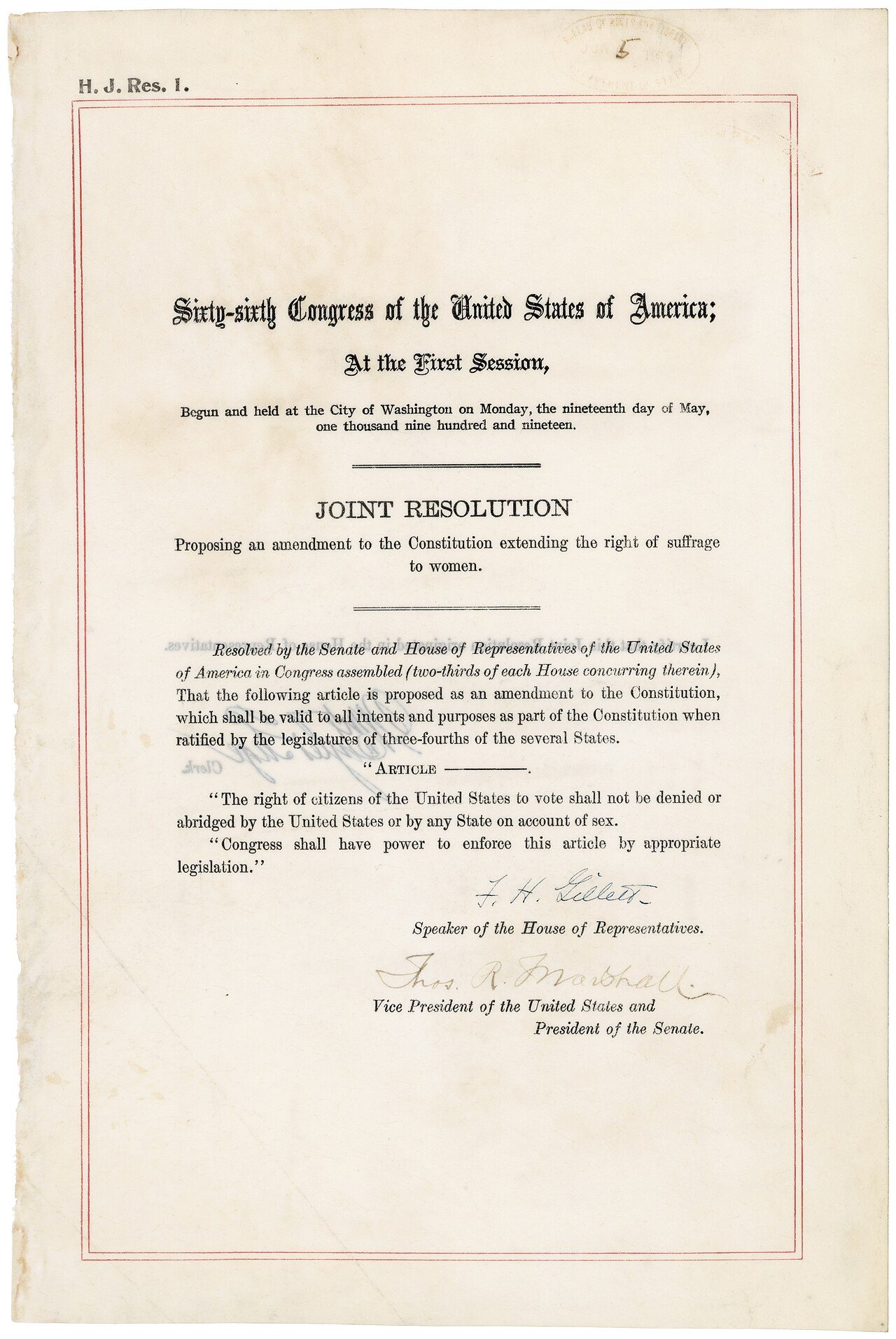
At a Glance
- The text
- The right to vote shall not be denied or abridged on account of sex
- The path
- First introduced in Congress in 1878; passed by Congress in June 1919
- The deciding state
- Tennessee, the 36th state to ratify, on 18 August 1920, by a single vote in its lower house
- The certification
- Secretary of State Bainbridge Colby signed the proclamation on 26 August 1920
- The scale
- Some 26 million American women became eligible to vote in the 1920 presidential election
- The commemoration
- 26 August is marked in the United States as Women's Equality Day
Events on this day
- 1071Seljuk Turks defeat the Byzantines at the Battle of Manzikert, opening Anatolia to Turkish settlement.
- 1346English longbowmen destroy French chivalry at the Battle of Crecy, an early landmark of the Hundred Years' War.
- 1789France's National Assembly approves the Declaration of the Rights of Man and of the Citizen.
- 1856Teenage chemist William Henry Perkin patents mauveine, the first synthetic dye, discovered while seeking a malaria cure.
- 1883Krakatoa's eruption enters its final stage, a day before the island destroys itself in one of history's greatest explosions.
- 1914The Battle of Tannenberg begins in East Prussia, ending in a catastrophic Russian defeat.
- 1920The Nineteenth Amendment is certified, guaranteeing American women the right to vote — the featured story above.
- 1957The Soviet Union announces a successful intercontinental ballistic missile test, alarming the United States.
- 1978Cardinal Albino Luciani is elected Pope John Paul I; his reign lasts only 33 days.
- 2016Quarterback Colin Kaepernick remains seated during the national anthem before an NFL preseason game, igniting a national debate.
Born on this day
- 1676Robert Walpole — Britain's first prime minister in all but name, who held power for two decades.
- 1743Antoine Lavoisier — French chemist, the father of modern chemistry, executed in the Revolution.
- 1880Guillaume Apollinaire — French poet who coined the word surrealism.
- 1906Albert Sabin — Polish-American researcher who developed the oral polio vaccine.
- 1910Mother Teresa — Albanian-Indian nun, founder of the Missionaries of Charity and Nobel Peace Prize laureate.
- 1918Katherine Johnson — NASA mathematician whose calculations carried American astronauts into orbit.
- 1980Macaulay Culkin — American actor who became a child star in Home Alone.
Died on this day
- 1666Frans Hals — Dutch Golden Age portrait painter, dead in Haarlem at about 84.
- 1910William James — American philosopher and psychologist, a founder of pragmatism.
- 1974Charles Lindbergh — American aviator of the first solo nonstop Atlantic flight, dead at 72 in Hawaii.
- 2018Neil Simon — American playwright of The Odd Couple and Barefoot in the Park, dead at 91.
The featured story: the Nineteenth Amendment is certified, 26 August 1920
On the morning of 26 August 1920, Secretary of State Bainbridge Colby signed a proclamation at his home in Washington, without ceremony and without inviting the women who had fought for it, certifying that the Nineteenth Amendment had become part of the United States Constitution. With that signature the long legal campaign ended: the right of citizens to vote could no longer be denied on account of sex. Some 26 million women were eligible to vote in a presidential election for the first time that November.
The road had taken seventy-two years. The demand had been written into the Declaration of Sentiments at Seneca Falls in 1848; the amendment itself, drafted by Susan B. Anthony and Elizabeth Cady Stanton, was first introduced in Congress in 1878 and reintroduced, and voted down, for four decades. A new generation, Alice Paul's National Woman's Party among them, added pickets outside the White House, arrests, hunger strikes and forced feedings. State by state the map changed first: by 1919 women in many states already voted in some or all elections, which made the federal amendment a matter of finishing the job.
Congress passed the amendment in June 1919. Ratification then moved through the states until it stalled at thirty-five, one short. The decision fell to Tennessee in August 1920, where the state senate approved and the house split until Harry Burn, at twenty-four the youngest member, changed his vote after reading a letter from his mother urging him to be a good boy and help put the rat in ratification. Tennessee ratified on 18 August; challenges and attempted rescissions followed for a week before Colby's certification made it final on the 26th.
The amendment's promise was real but incomplete. Black women in the Jim Crow South faced the same poll taxes, literacy tests and violence that disenfranchised Black men, and many Native American and Asian immigrant women were barred by citizenship law. The vote in full waited for the Voting Rights Act of 1965 and later reforms. Still, 26 August 1920 remains the hinge: the largest single expansion of the American electorate in its history, won not by gift but by three generations of organised pressure. Since 1971 the date has been marked as Women's Equality Day.
Why this date matters
August 26 is a day of formal words with long consequences. A declaration of the rights of man in 1789, a patent for a purple dye in 1856 that launched the chemical industry, and in 1920 a one-paragraph amendment that doubled the American electorate: the date specialises in documents that outgrow their paper. Around them stand the older world's violence, Crecy and Manzikert and Tannenberg, and the new world's opening tremors, a Soviet missile announcement in 1957 and an athlete's silent protest in 2016, both of which set arguments running for years. The date's other lives underline the theme of capability recognised late: on it were born both Lavoisier, who rebuilt chemistry from first principles, and Katherine Johnson, whose mathematics NASA trusted enough to double-check its first computers by hand.
Sources
- Encyclopaedia Britannica — On This Day: August 26
- HISTORY — What Happened on August 26
- National Archives — 19th Amendment to the U.S. Constitution: Women's Right to Vote (1920)
- Wikimedia Commons — The 19th Amendment

The facts on this page were checked against these sources on 19 November 2026. The History Trail's permanent pages are researched and written for this site; the live profiles elsewhere on The History Trail are assembled automatically from Wikipedia and Wikidata.
About the Author
Researched and written by the The History Trail Editorial Team — the accountable editorial function behind this site's permanent story pages. The team works from the published sources cited on each page; it does not invent historians, reviewers or credentials, and it corrects errors openly.
Fact Check
Every load-bearing fact on this page traces to one of the sources listed above, and significant claims link to their source in the text. Our checking method is described on the methodology page; errors can be reported via the corrections page.
Sources & Citations
Cite this page as: The History Trail Editorial Team, The History Trail — this article's title, publication and update dates are shown beneath its headline. The full source list appears under Sources above; the site's source standards are on the sources page.