
Years
1962 in History
1962 is the year the world looked into the abyss: for thirteen days in October, Soviet nuclear missiles in Cuba and an American naval quarantine brought the superpowers to the edge of nuclear war, before Khrushchev withdrew the missiles. The same year made John Glenn the first American to orbit the Earth, began Nelson Mandela's twenty-seven years in prison, and opened the Second Vatican Council.
At a Glance
- Defining event
- The Cuban Missile Crisis of October, ending on 28 October with Khrushchev's announcement that the missiles would be withdrawn
- America's orbit
- John Glenn circles the Earth three times aboard Friendship 7 on 20 February, the first American to orbit
- A record that stands
- Wilt Chamberlain scores 100 points in a single game on 2 March — still the NBA record
- Decolonisation
- Algeria wins independence on 5 July after an eight-year war; Jamaica follows on 6 August and Uganda on 9 October
- A long imprisonment begins
- Nelson Mandela is arrested on 5 August; he spends twenty-seven years in prison before his release in February 1990
- The Church renews
- The Second Vatican Council opens on 11 October, the first ecumenical council in 92 years
The defining story: the Cuban Missile Crisis
The year that brought the world closest to nuclear war began with the Cold War's rituals of exchange and rivalry. On 10 February the United States and the Soviet Union swapped captured spies — U-2 pilot Francis Gary Powers for Rudolf Abel — on the Glienicke Bridge in Berlin. Ten days later John Glenn became the first American to orbit the Earth, circling the planet three times aboard Friendship 7 in 4 hours and 55 minutes, through a scare in which a faulty switch wrongly signalled that his heat shield had loosened. On 2 March Wilt Chamberlain scored 100 points in a single basketball game, a record that still stands. In July, Algeria's independence from France was proclaimed, ending a war of eight years and 132 years of French rule, and on 5 August Nelson Mandela was arrested near Howick after seventeen months on the run — the start of an imprisonment that would last twenty-seven years.
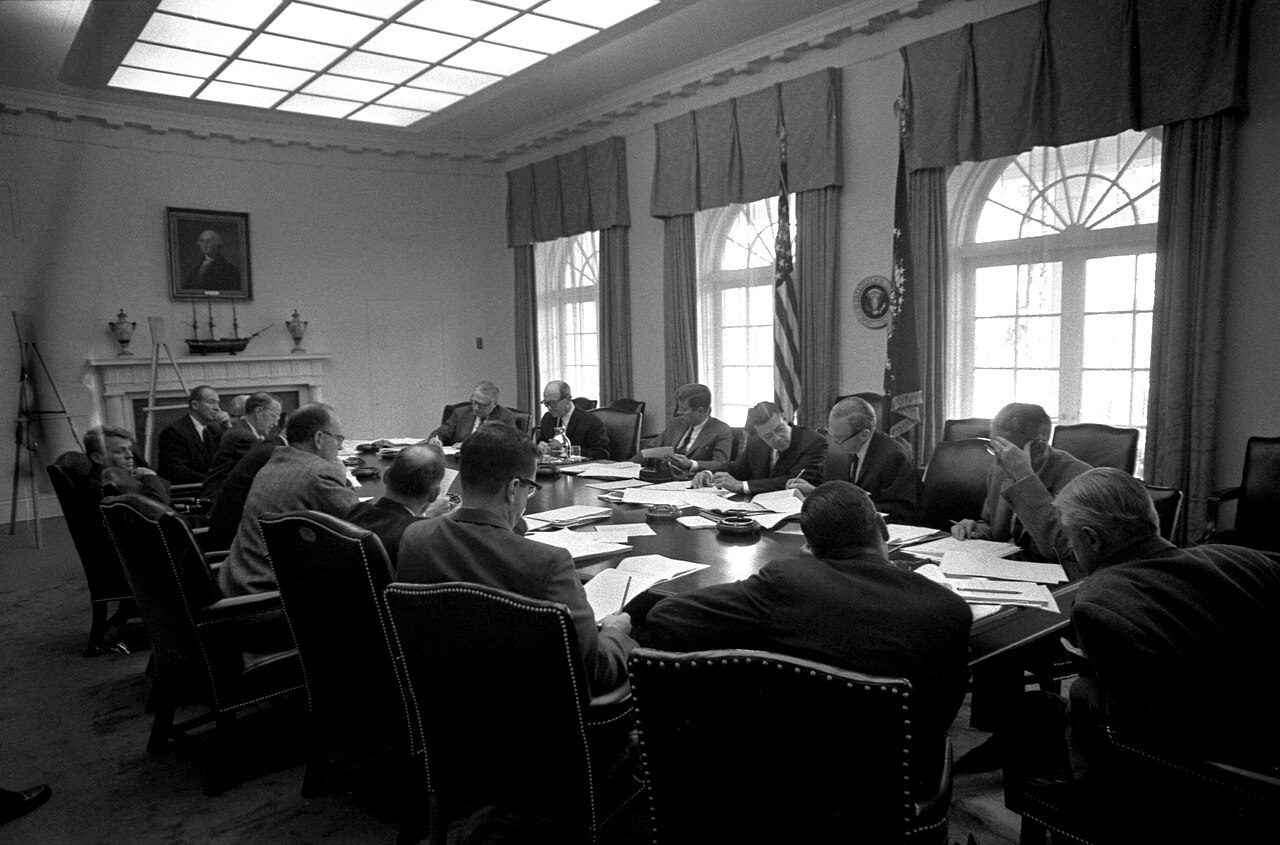
The crisis came in October, and it began in secret. On 14 October a US U-2 spy plane photographed Soviet nuclear missile sites under construction in Cuba; the pictures were shown to President Kennedy two days later. For almost a week the gravest confrontation of the Cold War was managed entirely in secret by a handful of men, while ordinary life in America went on in complete ignorance. On 22 October Kennedy addressed the nation on television and announced a naval 'quarantine' of Cuba: ships carrying offensive weapons would be stopped and turned back, and any nuclear missile launched from Cuba would be treated as a Soviet attack on the United States.
The week that followed was the most dangerous of the nuclear age. On 25 October, at the United Nations, US ambassador Adlai Stevenson confronted the Soviet envoy with reconnaissance photographs of the missiles. On 27 October, at the height of the crisis, Soviet naval officer Vasili Arkhipov refused to consent to firing a nuclear torpedo from submarine B-59, and is credited with helping avert a nuclear launch. The same month, far from the Caribbean, Pope John XXIII opened the Second Vatican Council on 11 October — the Roman Catholic Church's first ecumenical council in 92 years, before some 2,400 council fathers, under the watchword aggiornamento, 'bringing up to date'.
On 28 October the crisis ended: Nikita Khrushchev announced that the Soviet missiles in Cuba would be dismantled and withdrawn. The world stepped back. The year's other reachings outward were peaceful ones — Telstar 1, launched on 10 July, relayed the first live transatlantic television pictures, Mariner 2 was launched on 27 August to become the first spacecraft to fly by another planet, Venus, and Rachel Carson's Silent Spring, published on 27 September, launched the modern environmental movement's argument against indiscriminate pesticide use.
Timeline of 1962
- 10 February
The United States and the Soviet Union exchange spies Powers and Abel on the Glienicke Bridge in Berlin.
- 20 February
John Glenn becomes the first American to orbit the Earth, circling it three times aboard Friendship 7.
- 2 March
Wilt Chamberlain scores 100 points in a single game for the Philadelphia Warriors against the New York Knicks.
- 31 May
Adolf Eichmann is hanged in Israel after his trial in Jerusalem.
- 5 July
Algeria's independence from France is proclaimed, ending a war of eight years and 132 years of French rule.
- 10 July
Telstar 1 is launched, the first active communications satellite, relaying live transatlantic television.
- 5 August
Nelson Mandela is arrested near Howick after seventeen months on the run.
- 27 August
NASA launches Mariner 2, the first spacecraft to fly by another planet, Venus.
- 27 September
Rachel Carson's Silent Spring is published in the United States.
- 5 October
The first James Bond film, Dr. No, premieres in London, and the Beatles release their first single, Love Me Do, the same day.
- 11 October
Pope John XXIII opens the Second Vatican Council, the Church's first ecumenical council in 92 years.
- 14 October
A US U-2 spy plane photographs Soviet nuclear missile sites under construction in Cuba.
- 22 October
President Kennedy announces a naval quarantine of Cuba on television.
- 28 October
The Cuban Missile Crisis ends as Khrushchev announces the Soviet missiles will be withdrawn.
Why 1962 still matters
The missile crisis remains the benchmark for how close the nuclear powers have come to the edge — and for how they stepped back. Its machinery of secret deliberation, public ultimatum and negotiated withdrawal became the template studied by every crisis manager since, and its most sobering lesson is the one supplied by Vasili Arkhipov: that on 27 October the difference between peace and a nuclear launch included one officer's refusal aboard a submarine. The confrontation also completed the education begun at the Bay of Pigs the year before: the prisoners of that failed invasion were ransomed in December 1962 for $53 million in food and medicine, the record notes, closing the account.
Mandela's arrest began the other long story. The record traces the road from the Howick roadblock through the Rivonia Trial to a life sentence, and counts the cost at twenty-seven years in prison before his release in February 1990 — the imprisonment that made him the world's most famous political prisoner and, in time, his country's president.
The year's renewals ran quietly on. Vatican II, opened that October, sat in four autumn sessions until 1965 and issued 16 documents, including the constitution on the liturgy and the declaration on religious freedom, remaking the Catholic Church's relationship with the modern world. And in science, Glenn's orbit, Telstar's pictures and Mariner 2's flight to Venus made 1962 the year spaceflight became routine infrastructure as well as adventure.
1962 on The History Trail
The year's biggest stories have full pages of their own on The History Trail.
- February 20 in History — John Glenn orbits the Earth three times aboard Friendship 7.
- March 2 in History — Wilt Chamberlain scores 100 points in a single game.
- August 5 in History — Nelson Mandela is arrested near Howick after seventeen months on the run.
- October 11 in History — Pope John XXIII opens the Second Vatican Council.
- October 22 in History — Kennedy announces the naval quarantine of Cuba.
- Cuban Missile Crisis — the thirteen days of October 1962 that brought the world to the brink.
Sources
- NASA — 60 Years Ago: John Glenn, the First American to Orbit the Earth Aboard Friendship 7
- Encyclopaedia Britannica — On This Day: February 20
- Encyclopaedia Britannica — On This Day: March 2
- Encyclopaedia Britannica — On This Day podcast: July 5
- Nelson Mandela Foundation — The Arrest of Madiba and the Austin Westminster Story
- Encyclopaedia Britannica — On This Day: August 5
The facts on this page were checked against these sources on 19 November 2026. The History Trail's permanent pages are researched and written for this site; the live profiles elsewhere on The History Trail are assembled automatically from Wikipedia and Wikidata.
About the Author
Researched and written by the The History Trail Editorial Team — the accountable editorial function behind this site's permanent story pages. The team works from the published sources cited on each page; it does not invent historians, reviewers or credentials, and it corrects errors openly.
Fact Check
Every load-bearing fact on this page traces to one of the sources listed above, and significant claims link to their source in the text. Our checking method is described on the methodology page; errors can be reported via the corrections page.
Sources & Citations
Cite this page as: The History Trail Editorial Team, The History Trail — this article's title, publication and update dates are shown beneath its headline. The full source list appears under Sources above; the site's source standards are on the sources page.