
On This Day
October 22 in History
On 22 October 1962 President John F. Kennedy announced a naval quarantine of Cuba, revealing that Soviet nuclear missiles had been secretly installed on the island — the public opening of the thirteen days that brought the world closest to nuclear war. October 22 is also the day of the first notable parachute jump, Sartre's refusal of the Nobel Prize, and the landing of Venera 9 on Venus.
Choose another date: open the On This Day calendar to browse events, births and deaths for any day of the year.
At a Glance
- The discovery
- U-2 photographs taken on 14 October 1962 showed Soviet medium-range missile sites under construction in Cuba
- The announcement
- Kennedy addressed the nation on television on the evening of 22 October, after six days of secret deliberation
- The measure
- A naval 'quarantine' of Cuba — ships carrying offensive weapons would be stopped and turned back
- The warning
- Any nuclear missile launched from Cuba would be treated as a Soviet attack on the United States
- The outcome
- On 28 October Khrushchev agreed to dismantle the sites and withdraw the missiles
Events on this day
- 1797André-Jacques Garnerin makes the first parachute jump of note, descending from a hydrogen balloon some 3,200 feet over Paris.
- 1836Sam Houston is inaugurated as the first elected president of the Republic of Texas.
- 1934FBI agents shoot and kill the bank robber Charles 'Pretty Boy' Floyd near East Liverpool, Ohio.
- 1957Thirteen American military personnel are wounded in bombings in Saigon — the first U.S. casualties of the Vietnam conflict.
- 1962President Kennedy announces a naval quarantine of Cuba after U-2 photographs reveal Soviet nuclear missile sites on the island — the featured story above.
- 1964Jean-Paul Sartre is awarded the Nobel Prize in Literature — and declines it, refusing all official honours.
- 1965President Lyndon B. Johnson signs the Highway Beautification Act, championed by Lady Bird Johnson to limit billboards and junkyards along America's highways.
- 1966The Soviet Union launches Luna 12, an uncrewed probe that goes into orbit around the Moon and photographs its surface.
- 1975The Soviet probe Venera 9 lands on Venus and sends back the first photographs taken from the surface of another planet.
- 2008India launches Chandrayaan-1, its first uncrewed lunar probe, joining the small club of nations to send a mission to the Moon.
- 2010WikiLeaks releases hundreds of thousands of classified U.S. documents relating to the wars in Iraq and Afghanistan.
- 2012Cyclist Lance Armstrong is stripped of his seven Tour de France titles and banned from the sport for life over doping.
Born on this day
- 1811Franz Liszt — Hungarian composer and the most celebrated piano virtuoso of the nineteenth century.
- 1844Sarah Bernhardt — French actress, the 'Divine Sarah', the most famous stage performer of her era.
- 1943Catherine Deneuve — French actress, star of Belle de Jour and Indochine.
- 1952Jeff Goldblum — American actor of Jurassic Park and The Fly.
Died on this day
- 741Charles Martel — Frankish leader whose victory at Tours in 732 halted Muslim expansion into western Europe.
- 1906Paul Cézanne — French Post-Impressionist painter whose work laid the foundations of modern art.
- 1973Pablo Casals — Catalan cellist, conductor and composer, among the greatest cellists of all time.
The featured story: Kennedy announces the Cuba quarantine, 22 October 1962
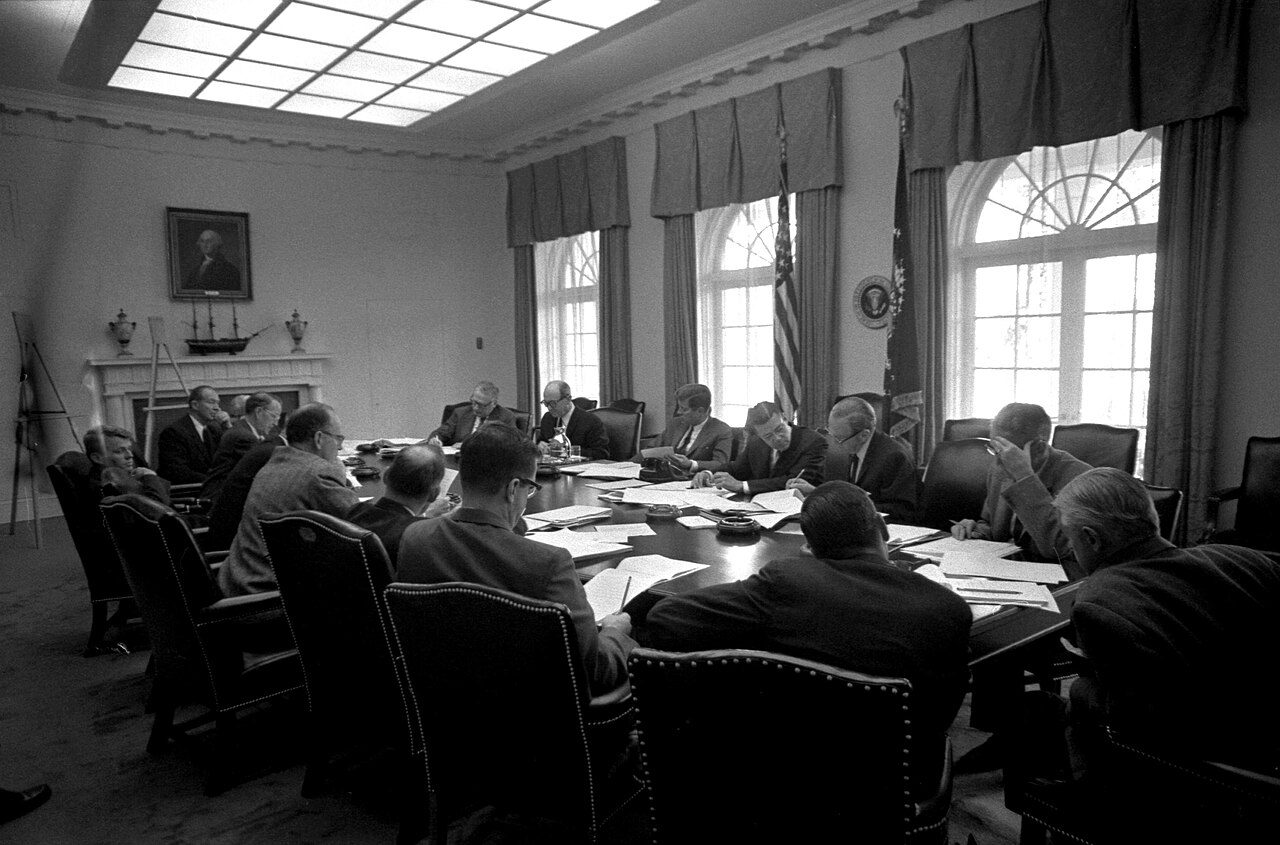
On the evening of 22 October 1962, President John F. Kennedy went on American television and told the world something it had not known for a week: the Soviet Union was secretly building nuclear missile sites in Cuba, ninety miles from Florida. Photographs taken by a U-2 spy plane on 14 October, and analysed the following day, showed medium-range ballistic missiles being installed — weapons that could strike much of the eastern United States with almost no warning. For six days Kennedy and a small circle of advisers, the Executive Committee, had debated in total secrecy what to do: an air strike, an invasion, diplomacy, or something in between.
Kennedy chose the middle course and announced it with care. The United States would impose a naval 'quarantine' on Cuba: American warships would stop and search vessels bound for the island and turn back any carrying offensive weapons. He called on Soviet leader Nikita Khrushchev to halt the shipments and withdraw the missiles already there, and he warned that any nuclear missile launched from Cuba would be treated as a Soviet attack on the United States itself, requiring a full retaliatory response. The word 'quarantine' was chosen deliberately — a blockade, in international law, is an act of war, and Kennedy was trying to coerce without firing the first shot.
What followed was the most dangerous week of the Cold War. Soviet ships steamed toward the quarantine line while the world watched; some stopped or turned away. American forces went to a heightened state of readiness, and invasion forces gathered in Florida. Behind the public confrontation, secret exchanges between Washington and Moscow searched for an exit. On 28 October, Khrushchev announced that the missile sites would be dismantled and the weapons withdrawn, in return for an American pledge not to invade Cuba and a quiet understanding about U.S. missiles in Turkey.
The thirteen days of the Cuban Missile Crisis are generally reckoned the closest the world has come to nuclear war. The crisis changed the superpowers' behaviour: within a year Washington and Moscow had installed a direct communications hotline and signed a treaty banning atmospheric nuclear tests. But on the night of 22 October, none of that was knowable. What the world heard was a young president calmly explaining that nuclear missiles had been planted on America's doorstep — and that ships were already moving to stop more from arriving.
Why this date matters
October 22 is a date of descents and disclosures. Garnerin trusted his life to a parachute over Paris in 1797; Soviet and Indian probes descended toward the Moon and Venus; and in 1962 the world's most dangerous secret was disclosed on live television, converting a hidden arms build-up into a public test of nerve between two nuclear powers. The day also has a quieter theme of refusals: Sartre refusing the Nobel Prize in 1964, and, in 2012, cycling refusing to let its greatest champion keep his titles. Again and again, this is a date on which something hidden — under a balloon, on the Moon, in Cuba — is brought into the open.
Sources
- Encyclopaedia Britannica — On This Day: October 22
- HISTORY — What Happened on October 22
- Wikipedia — Luna 12
- Wikipedia — Venera 9
The facts on this page were checked against these sources on 19 November 2026. The History Trail's permanent pages are researched and written for this site; the live profiles elsewhere on The History Trail are assembled automatically from Wikipedia and Wikidata.
About the Author
Researched and written by the The History Trail Editorial Team — the accountable editorial function behind this site's permanent story pages. The team works from the published sources cited on each page; it does not invent historians, reviewers or credentials, and it corrects errors openly.
Fact Check
Every load-bearing fact on this page traces to one of the sources listed above, and significant claims link to their source in the text. Our checking method is described on the methodology page; errors can be reported via the corrections page.
Sources & Citations
Cite this page as: The History Trail Editorial Team, The History Trail — this article's title, publication and update dates are shown beneath its headline. The full source list appears under Sources above; the site's source standards are on the sources page.