
On This Day
October 21 in History
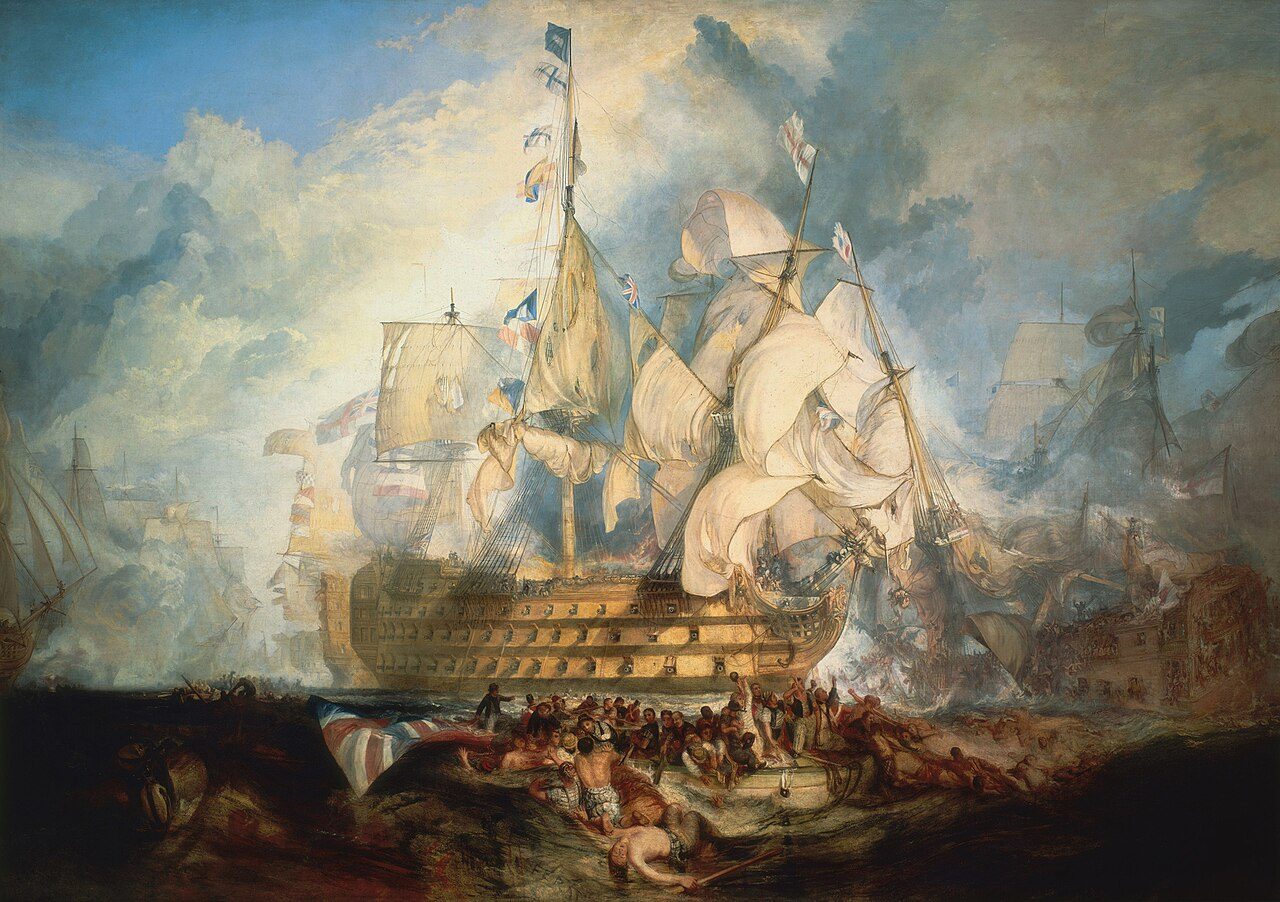
On 21 October 1805, off Cape Trafalgar in Spain, Admiral Lord Nelson's fleet destroyed the combined French and Spanish fleet in the decisive naval battle of the Napoleonic Wars — and Nelson himself was killed in the moment of victory. October 21 is also the day the USS Constitution was launched, the Guggenheim Museum opened, and a coal tip slid down onto the Welsh village of Aberfan.
Choose another date: open the On This Day calendar to browse events, births and deaths for any day of the year.
At a Glance
- The opposing fleets
- 27 British ships of the line against 33 French and Spanish ships, off Cape Trafalgar, Spain
- The result
- 22 allied ships captured or destroyed; Britain lost not one ship of the line
- Nelson's death
- Shot by a French marksman aboard HMS Victory, Nelson died below deck as the battle was being won
- British casualties
- Put at 449 killed and 1,214 wounded
- What it settled
- The victory ended Napoleon's realistic hope of invading Britain and confirmed British command of the seas
Events on this day
- 1520Ferdinand Magellan becomes the first European to find a sea route from the Atlantic to the Pacific, entering the strait at the tip of South America that now bears his name.
- 1797The 44-gun frigate USS Constitution is launched in Boston Harbor after two unsuccessful attempts; she will earn the nickname 'Old Ironsides' in the War of 1812.
- 1805At the Battle of Trafalgar, Nelson's British fleet destroys the combined French and Spanish fleet off Spain, losing no ship of the line — but Nelson himself is killed — the featured story above.
- 1861Union forces suffer a humiliating defeat at the Battle of Ball's Bluff on the Potomac River in Virginia, early in the American Civil War.
- 1940Ernest Hemingway's novel of the Spanish Civil War, For Whom the Bell Tolls, is published.
- 1959The Guggenheim Museum opens in New York, in its striking new spiral building on Fifth Avenue.
- 1960John F. Kennedy and Richard Nixon meet in New York for the fourth and final televised debate of their presidential campaign.
- 1966A coal-waste tip slides down onto the Welsh village of Aberfan, engulfing homes and a school; more than 140 people are killed, most of them children.
Born on this day
- 1772Samuel Taylor Coleridge — English poet of The Rime of the Ancient Mariner and Kubla Khan, a founder of the Romantic movement.
- 1833Alfred Nobel — Swedish chemist and industrialist who invented dynamite and used his fortune to endow the Nobel Prizes.
- 1912Georg Solti — Hungarian-born conductor, one of the defining orchestral figures of the postwar era.
- 1917Dizzy Gillespie — American jazz trumpeter who, with Charlie Parker, created bebop.
- 1956Carrie Fisher — American actress and writer, Princess Leia in the Star Wars films.
Died on this day
- 1805Horatio Nelson — British admiral, shot aboard HMS Victory at Trafalgar in the moment of his greatest victory.
- 1984François Truffaut — French director of The 400 Blows and a founder of the French New Wave, dead at 52.
- 2012George McGovern — U.S. senator and the Democratic Party's presidential nominee in 1972, an outspoken critic of the Vietnam War.
The featured story: Nelson wins and dies at Trafalgar, 21 October 1805
On 21 October 1805, off Cape Trafalgar on the south-western coast of Spain, the Royal Navy fought the battle that settled command of the sea for a generation. Britain and Napoleonic France had been at war, with one short peace, since 1793, and in 1805 Napoleon still dreamed of invading England. To do it he needed control of the Channel, and the combined fleet of France and Spain — thirty-three ships of the line — had taken refuge at Cádiz. Watching them was a British fleet of twenty-seven ships of the line under Vice-Admiral Lord Nelson, the most celebrated fighting sailor of the age, who was determined that when the enemy came out, they would not get back.
When the combined fleet put to sea, Nelson did not form the traditional parallel line and trade broadsides at a distance. Instead he divided his fleet into two columns and drove them straight at the enemy line, accepting raking fire on the approach in order to break through, throw the allied formation into confusion and destroy it ship by ship at close quarters. His flagship, HMS Victory, led one column into the heart of the action. The gamble worked completely: in a few hours of brutal close fighting, twenty-two French and Spanish ships were captured or destroyed. Not one British ship of the line was lost.
The victory cost Britain its admiral. Nelson paced Victory's quarterdeck in full uniform, his decorations visible, and was picked out by a French marksman firing from the rigging of the French ship Redoutable. The ball struck him in the shoulder and lodged in his spine. Carried below, he lived long enough to learn that the battle was won, and died in the cockpit of his flagship as the fighting ended. British casualties were put at 449 killed and 1,214 wounded — heavy, but the combined fleet's losses in ships, men and prisoners were far greater, and its power as a fighting force was broken.
Trafalgar did not end the Napoleonic Wars, which ran for another decade, but it ended any realistic French hope of invading Britain and confirmed a British command of the seas that lasted, in essence, for a century. Nelson's body was brought home preserved in spirits, and he was given a state funeral at St Paul's Cathedral in London. The battle has been remembered ever since as the supreme example of a commander staking everything on one audacious plan — and of a victory so complete that it was bought with the victor's own life.
Why this date matters
October 21 is a day on which the sea keeps taking centre stage. Magellan found the passage between two oceans on it in 1520; the USS Constitution slid into Boston Harbor on it in 1797; and in 1805 it produced the most famous naval victory in British history, complete at the cost of its architect's life. Yet the date also holds one of the sea's cruellest counterpoints on land: at Aberfan in 1966 the waste of a coal mine came down a Welsh hillside like a black tide and buried a school. Triumph and disaster, separated by a century and a half, share the same square of the calendar.
Sources
- Encyclopaedia Britannica — On This Day: October 21
- HISTORY — What Happened on October 21
- War History — Trafalgar, 21 October 1805
- Wikipedia — Battle of Trafalgar
The facts on this page were checked against these sources on 19 November 2026. The History Trail's permanent pages are researched and written for this site; the live profiles elsewhere on The History Trail are assembled automatically from Wikipedia and Wikidata.
About the Author
Researched and written by the The History Trail Editorial Team — the accountable editorial function behind this site's permanent story pages. The team works from the published sources cited on each page; it does not invent historians, reviewers or credentials, and it corrects errors openly.
Fact Check
Every load-bearing fact on this page traces to one of the sources listed above, and significant claims link to their source in the text. Our checking method is described on the methodology page; errors can be reported via the corrections page.
Sources & Citations
Cite this page as: The History Trail Editorial Team, The History Trail — this article's title, publication and update dates are shown beneath its headline. The full source list appears under Sources above; the site's source standards are on the sources page.