
On This Day
October 24 in History
On 24 October 1945 the United Nations Charter entered into force, bringing the UN into legal existence — the world's second attempt at a parliament of nations. October 24 is also the day the Treaty of Westphalia ended the Thirty Years' War, the transcontinental telegraph was completed, and Concorde flew its last commercial flight.
Choose another date: open the On This Day calendar to browse events, births and deaths for any day of the year.
At a Glance
- The Charter signed
- 26 June 1945 at San Francisco, by 50 countries
- The legal condition
- Under Article 110 the Charter required ratification by China, France, the USSR, the UK and the US, plus a majority of other signatories
- Entry into force
- 24 October 1945 — the date still celebrated as United Nations Day
- The structure
- A Security Council with five permanent, veto-holding members, and a General Assembly of all member states
- The purpose
- In the preamble's words, 'to save succeeding generations from the scourge of war'
Events on this day
- 1648The Treaty of Westphalia is signed, ending the Thirty Years' War and reshaping the map and statecraft of Europe.
- 1861The first transcontinental telegraph line is completed at Salt Lake City by Western Union, linking America's coasts — and effectively ending the Pony Express.
- 1901Annie Edson Taylor, a 63-year-old schoolteacher, becomes the first person to survive going over Niagara Falls in a barrel.
- 1916French troops recapture Fort Douaumont, the great fortress lost at the start of the Battle of Verdun.
- 1917The Battle of Caporetto begins on the Italian front, ending in a catastrophic Italian defeat by Austro-German forces.
- 1921At Châlons-sur-Marne in France, an American officer selects the body that will become America's Unknown Soldier.
- 1929'Black Thursday': panic selling on the New York Stock Exchange opens the Wall Street Crash of 1929.
- 1931The George Washington Bridge, then the longest suspension bridge in the world at 4,760 feet, is dedicated by President Franklin D. Roosevelt.
- 1945The United Nations Charter enters into force, bringing the UN into legal existence — the featured story above.
- 1951President Truman proclaims that the state of war between the United States and Germany is officially over.
- 1962James Brown records Live at the Apollo in Harlem, one of the greatest live albums ever made.
- 1964Northern Rhodesia becomes independent from Britain as the Republic of Zambia.
- 1973President Nixon vetoes the War Powers Resolution; Congress will override him the following month.
- 2003Concorde makes its final commercial flight, from New York's JFK to London Heathrow, ending supersonic passenger travel.
Born on this day
- 1632Antonie van Leeuwenhoek — Dutch draper and scientist who built his own microscopes and first observed bacteria and other microorganisms.
- 1925Luciano Berio — Italian composer, a leading figure of the postwar avant-garde.
- 1936Bill Wyman — English bassist, the Rolling Stones' bass player from 1962 to 1993.
- 1939F. Murray Abraham — American actor who won an Oscar playing Salieri in Amadeus.
- 1947Kevin Kline — American actor of A Fish Called Wanda and Sophie's Choice.
Died on this day
- 1537Jane Seymour — third queen of Henry VIII, dead twelve days after giving birth to the future Edward VI.
- 1945Vidkun Quisling — Norwegian collaborationist leader, executed for treason; his surname became a synonym for traitor.
- 1957Christian Dior — French fashion designer whose 'New Look' reshaped postwar women's fashion.
- 1972Jackie Robinson — the Brooklyn Dodgers star who broke baseball's colour barrier in 1947, dead at 53.
- 2005Rosa Parks — American civil rights figure whose refusal to give up her bus seat in Montgomery in 1955 ignited a movement, dead in Detroit at 92.
The featured story: the United Nations Charter enters into force, 24 October 1945
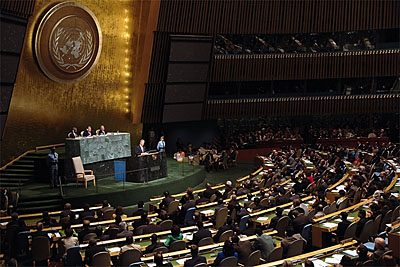
On 24 October 1945, the United Nations legally came into existence. Its Charter — the constitution of the new world organisation — had been negotiated and signed at San Francisco on 26 June 1945 by fifty countries, in the last weeks of the Second World War. But signing was not enough. Under Article 110, the Charter would only take effect once it had been ratified by the five states named as permanent members of the Security Council — China, France, the Soviet Union, the United Kingdom and the United States — and by a majority of the other signatories. Through the summer and autumn of 1945 the ratifications came in, and on 24 October the threshold was crossed. The United Nations was born.
The organisation was a deliberate second attempt. Its predecessor, the League of Nations, founded after the First World War, had failed to prevent the second: it lacked the United States as a member, lacked an enforcement arm, and lacked the means to make its decisions stick. The UN's founders tried to build differently. The great powers were locked in as permanent, veto-holding members of a Security Council charged with maintaining peace and security; a General Assembly gave every member state a voice; and the Charter committed members to settle disputes peacefully and to refrain from the threat or use of force against one another. 'We the peoples of the United Nations', the preamble began — determined, this time, 'to save succeeding generations from the scourge of war'.
The world the UN inherited was in ruins and already dividing. Within a few years the Cold War would freeze the Security Council, and the organisation's peacekeeping role had to be improvised in the gaps the Charter's authors had not foreseen. Yet the UN endured and grew: decolonisation brought dozens of new states into the General Assembly, and around the political core grew the agencies — for refugees, children, health, food — that became the working machinery of international cooperation. Its headquarters rose on the East River in New York, on land bought with a donation from John D. Rockefeller Jr.
Eighty years on, the Charter of 1945 remains the nearest thing the world has to a constitution, and 24 October is still marked each year as United Nations Day. The organisation is perpetually criticised — for its vetoes, its bureaucracy, its failures to stop wars — but the date it began marks a genuine turning point: the moment when, for the second and so far the last time, the nations of the world tried to outlaw the chaos that had just consumed them, and built an institution meant to outlast the victory that created it.
Why this date matters
October 24 is diplomacy's favourite date. In 1648 the Treaty of Westphalia invented much of the modern states system on it; in 1945 the United Nations Charter gave that system its permanent parliament. Twice, three centuries apart, exhausted nations used this date to write rules meant to stop the next war before it started. The rest of the day fits the pattern of endings and thresholds: the Pony Express rendered obsolete by a wire in 1861, a world war proclaimed over in 1951, Concorde's era closed in 2003 — and, in 1929, the first tremor of the crash that would test everything the peacemakers later built.
Sources
- Encyclopaedia Britannica — On This Day: October 24
- HISTORY — The United Nations is born
- Wikipedia — Rosa Parks
- Wikimedia — On This Day feed: October 24
The facts on this page were checked against these sources on 19 November 2026. The History Trail's permanent pages are researched and written for this site; the live profiles elsewhere on The History Trail are assembled automatically from Wikipedia and Wikidata.
About the Author
Researched and written by the The History Trail Editorial Team — the accountable editorial function behind this site's permanent story pages. The team works from the published sources cited on each page; it does not invent historians, reviewers or credentials, and it corrects errors openly.
Fact Check
Every load-bearing fact on this page traces to one of the sources listed above, and significant claims link to their source in the text. Our checking method is described on the methodology page; errors can be reported via the corrections page.
Sources & Citations
Cite this page as: The History Trail Editorial Team, The History Trail — this article's title, publication and update dates are shown beneath its headline. The full source list appears under Sources above; the site's source standards are on the sources page.