
On This Day
October 25 in History
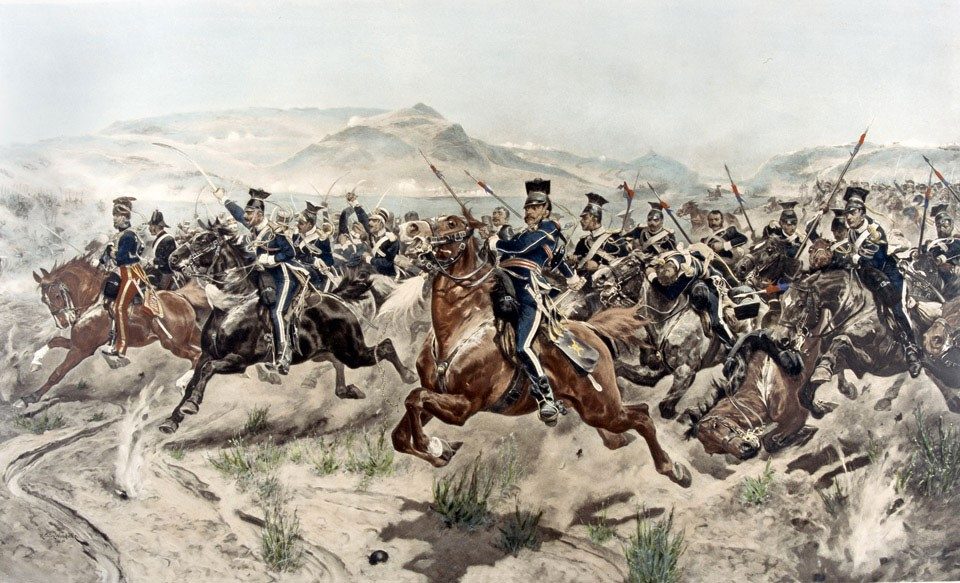
On 25 October 1854, at Balaklava in the Crimea, the Light Brigade charged a mile and a half into massed Russian guns because an order had been misunderstood — and rode into legend. October 25 is also the day of Agincourt, the first kamikaze attacks, Picasso's birth, and China's seating at the United Nations.
Choose another date: open the On This Day calendar to browse events, births and deaths for any day of the year.
At a Glance
- The setting
- The Battle of Balaklava, 25 October 1854, during the Crimean War
- The commander
- The Earl of Cardigan led the Light Brigade; the fatal order came from Lord Raglan via Lord Lucan
- The strength
- About 673 men rode down the North Valley against massed Russian artillery
- The cost
- About 260 killed or wounded — roughly forty per cent — and 475 horses lost, per the National Army Museum
- The cause
- A vaguely worded order, misunderstood: the brigade charged the wrong guns
- The memorial
- Tennyson published 'The Charge of the Light Brigade' within weeks of the news reaching London
Events on this day
- 1415At the Battle of Agincourt, Henry V's outnumbered English army, its longbowmen decisive, destroys the French nobility; French dead are estimated at between 6,000 and 10,000, English losses in the hundreds.
- 1760George III ascends the British throne on the death of his grandfather, George II, beginning a reign of sixty years.
- 1764John Adams, future second president of the United States, marries Abigail Smith in Weymouth, Massachusetts.
- 1854The Light Brigade charges Russian artillery at Balaklava after a misunderstood order, losing some forty per cent of its men — the featured story above.
- 1920King Alexander of Greece dies aged 27, weeks after being bitten by a pet monkey at the palace of Tatoi.
- 1944Japanese pilots fly the first organised kamikaze attacks, deliberately crashing their aircraft into American warships at the Battle of Leyte Gulf.
- 1962At the United Nations, U.S. ambassador Adlai Stevenson confronts the Soviet envoy with reconnaissance photographs of Soviet missiles in Cuba.
- 1971The United Nations votes to seat the People's Republic of China and expel the Nationalist government of Taiwan from China's seat.
Born on this day
- 1811Évariste Galois — French mathematician who founded group theory and died at twenty after a duel.
- 1825Johann Strauss II — Austrian composer, the 'Waltz King' of The Blue Danube.
- 1838Georges Bizet — French composer of the opera Carmen.
- 1881Pablo Picasso — Spanish artist born in Málaga, co-founder of Cubism and the defining painter of the twentieth century.
- 1984Katy Perry — American singer, born Katheryn Hudson in Santa Barbara, California.
Died on this day
- 1154Stephen — king of England whose reign was consumed by the civil war known as the Anarchy.
- 1400Geoffrey Chaucer — English poet of The Canterbury Tales, the first poet buried in Westminster Abbey's Poets' Corner.
- 1760George II — king of Great Britain, the last British monarch to lead his troops in battle, at Dettingen.
- 1920Terence MacSwiney — Irish nationalist and lord mayor of Cork, dead in Brixton Prison after a 74-day hunger strike.
- 2002Richard Harris — Irish actor and singer, Albus Dumbledore in the first two Harry Potter films.
- 2004John Peel — English disc jockey whose Radio 1 shows championed generations of new music, dead at 65.
The featured story: the Charge of the Light Brigade, 25 October 1854
On 25 October 1854, during the Battle of Balaklava in the Crimean War, some 670 British light cavalrymen rode down a valley into the muzzles of Russian artillery — not because their commander had lost his mind, but because an order had been misunderstood. The Light Brigade, under the Earl of Cardigan, was stationed near Balaklava, the supply port of the British army besieging Sevastopol. That morning Russian forces attacked the allied positions around the port, and from his vantage point on the heights the British commander, Lord Raglan, could see Russian troops beginning to carry off captured guns from redoubts on the Causeway Heights. He issued an order for the cavalry to prevent the enemy carrying away the guns.
The order was written in haste and carried downhill by a young officer, Captain Nolan. What Raglan could see from above, the cavalry below could not: from the valley floor, the only guns in sight were the massed Russian battery at the far end of the North Valley, a mile and a half away, with more guns and riflemen on the heights to either side. When Lord Lucan, the cavalry commander, questioned the order, Nolan gestured vaguely down the valley. Lucan passed the command to Cardigan, who protested that it meant certain destruction — and then, obeying, led his brigade straight at the guns. Nolan, who may have realised the mistake too late, was among the first killed.
The brigade rode the length of the valley under fire from front and both flanks, reached the Russian guns, sabred the gunners and briefly broke through the battery before survivors had to fight their way back the same way. Of the roughly 673 men who rode out, the National Army Museum puts about 260 as killed or wounded — around forty per cent — and 475 horses were lost. Militarily the charge achieved nothing that could justify its cost. But within weeks Alfred, Lord Tennyson, reading newspaper reports in London, had written the poem that fixed it forever in the imagination: 'The Charge of the Light Brigade', with its refrain of the six hundred riding into the valley of death.
The disaster became the defining scandal of the Crimean War — a war already notorious for administrative collapse — and a permanent parable of what happens when ambiguous orders meet unquestioning obedience. Cardigan was fêted as a hero at home; Raglan, Lucan and the dead Nolan were argued over for decades. The brigade itself, the regiments shattered and re-formed, passed into legend. Every army since has studied Balaklava, not for how to win a battle, but for how a single badly worded sentence can send brave men to be killed for nothing.
Why this date matters
October 25 is a day of battles decided by the weapon of the age. At Agincourt in 1415 the longbow cut down the flower of French chivalry; at Balaklava in 1854 rifled artillery and confusion destroyed the most famous cavalry brigade in history; at Leyte Gulf in 1944 the aeroplane itself became the weapon, flown deliberately into ships. Across five centuries the date traces war's long shift from muscle to machinery. Yet it also holds gentler turning points — a royal marriage in Massachusetts in 1764 that produced a famous partnership of letters, and Picasso's birth in 1881, the start of art's own revolution.
Sources
- Encyclopaedia Britannica — On This Day: October 25
- HISTORY — Charge of the Light Brigade
- National Army Museum — The Battle of Balaklava
- Wikimedia — On This Day feed: October 25
The facts on this page were checked against these sources on 19 November 2026. The History Trail's permanent pages are researched and written for this site; the live profiles elsewhere on The History Trail are assembled automatically from Wikipedia and Wikidata.
About the Author
Researched and written by the The History Trail Editorial Team — the accountable editorial function behind this site's permanent story pages. The team works from the published sources cited on each page; it does not invent historians, reviewers or credentials, and it corrects errors openly.
Fact Check
Every load-bearing fact on this page traces to one of the sources listed above, and significant claims link to their source in the text. Our checking method is described on the methodology page; errors can be reported via the corrections page.
Sources & Citations
Cite this page as: The History Trail Editorial Team, The History Trail — this article's title, publication and update dates are shown beneath its headline. The full source list appears under Sources above; the site's source standards are on the sources page.