
Years
1961 in History
1961 is the year humanity left the Earth: on 12 April Yuri Gagarin became the first human in space, orbiting the planet in 108 minutes. John F. Kennedy took office, answered with a promise to land a man on the Moon, and failed at the Bay of Pigs; the Berlin Wall divided a city, and the largest bomb ever tested lit up the Arctic.
At a Glance
- Defining event
- Yuri Gagarin orbits the Earth in Vostok 1 on 12 April — one orbit in 108 minutes, the first human in space
- A presidency begins
- John F. Kennedy is inaugurated on 20 January, delivering the 'ask not' address
- A warning
- Eisenhower's farewell of 17 January warns against the military-industrial complex
- Cold War failure
- The Bay of Pigs invasion is defeated within days of 17 April; more than 1,100 exiles are captured
- A city divided
- East Germany seals West Berlin's border on 13 August; the Berlin Wall divides the city for 28 years
- The biggest bomb
- Tsar Bomba, 30 October — Soviet figures put the yield at about 50 megatons, Western estimates at 55 to 58
The defining story: the first human in space
The year turned on a changing of the guard. On 17 January, President Eisenhower delivered his farewell address, warning Americans to guard against 'the acquisition of unwarranted influence, whether sought or unsought, by the military-industrial complex' — the drafts had named a 'military-industrial-congressional complex' before the third word was dropped. Three days later John F. Kennedy was inaugurated as the 35th president, the youngest elected president and the first Roman Catholic, and delivered the 'ask not' address: 'Ask not what your country can do for you — ask what you can do for your country.'
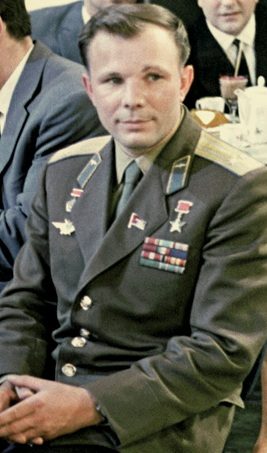
On 12 April the Soviet Union won the space race's greatest prize. Yuri Gagarin, a 27-year-old air force lieutenant chosen from twenty trainee cosmonauts, was launched from Baikonur Cosmodrome aboard Vostok 1 at 9:07 a.m. Moscow time and completed one orbit of the Earth in 108 minutes, reaching about 327 kilometres above the surface. He ejected from the capsule at about 7 kilometres and parachuted to the ground near Saratov, as planned. The flight had been kept so secret that Moscow prepared three versions of the announcement — for success, for a failed return, and for a crash — and Gagarin's own mother learned her son had been in space from the radio. His instant worldwide fame was a propaganda triumph for the Soviet Union.
America's answer came in stages. On 5 May Alan Shepard flew Freedom 7 on a 15-minute suborbital flight, the first American in space. On 25 May Kennedy asked Congress to commit the United States to landing a man on the Moon and returning him safely before the decade ended, requesting $531 million for the coming year and an estimated $7–9 billion more over five years — a goal Apollo 11 would achieve on 20 July 1969.
The Cold War's other fronts were harsher. On 17 April the Bay of Pigs invasion began: Brigade 2506, about 1,400 Cuban exiles trained by the CIA, landed on Cuba's southern coast, but the air strikes meant to destroy Castro's small air force had failed, and the brigade was defeated by 19–20 April, with more than 1,100 men captured. On 13 August East Germany sealed the border around West Berlin in the night of 'Barbed Wire Sunday'; the wire was soon replaced by the Berlin Wall, which divided the city for 28 years. On 30 October the Soviet Union detonated Tsar Bomba over Novaya Zemlya, the largest nuclear weapon ever tested — Soviet figures put the yield at about 50 megatons, Western estimates at 55 to 58. In Jerusalem, meanwhile, the trial of Adolf Eichmann had opened on 11 April, and on 15 December he was sentenced to death.
Timeline of 1961
- 3 January
The United States severs diplomatic relations with Cuba, two years after Castro's revolution.
- 17 January
President Eisenhower delivers his farewell address, warning of the military-industrial complex.
- 20 January
John F. Kennedy is inaugurated as the 35th president and delivers the 'ask not' address.
- 1 March
President Kennedy signs the executive order establishing the Peace Corps.
- 11 April
The trial of Adolf Eichmann opens in Jerusalem.
- 12 April
Yuri Gagarin becomes the first human in space, orbiting the Earth in Vostok 1.
- 17 April
The Bay of Pigs invasion begins, as Cuban exiles land on Cuba's southern coast.
- 4 May
The first Freedom Ride leaves Washington, D.C., testing desegregation on southern buses.
- 5 May
Alan Shepard flies Freedom 7, becoming the first American in space.
- 25 May
Kennedy asks Congress to commit the United States to landing a man on the Moon before the decade ends.
- 28 May
Amnesty International is founded in London to campaign for prisoners of conscience.
- 13 August
East Germany seals the border around West Berlin; the Berlin Wall soon divides the city.
- 30 October
The Soviet Union detonates Tsar Bomba, the largest nuclear weapon ever tested.
- 15 December
Adolf Eichmann is sentenced to death by an Israeli court in Jerusalem.
Why 1961 still matters
Gagarin's 108 minutes changed what humanity believed was possible, and Kennedy's response six weeks later set the decade's destination: the Moon goal he announced on 25 May was achieved by Apollo 11 on 20 July 1969, with five months to spare. The space race that began as propaganda became the century's great technological project; the record notes that exactly twenty years after Gagarin's flight, on 12 April 1981, NASA launched Columbia on the first space shuttle mission.
The year's failures hardened the Cold War's geography. The Bay of Pigs disaster, in the record's verdict, drove Castro closer to Moscow — setting up the missile crisis of the following year — and the Berlin Wall, thrown up in August, stood for 28 years as the confrontation's concrete symbol. Tsar Bomba demonstrated a weapon too large to use, its yield still argued over between Soviet figures of about 50 megatons and Western estimates of 55 to 58.
Against those, 1961 also founded the era's conscience: Amnesty International in London, the Peace Corps in Washington, and the Freedom Rides rolling south from the capital. Eisenhower's warning about the military-industrial complex, delivered by a career soldier on his way out, has been quoted ever since by every side of every defence argument — the farewell that outlasted the presidency it closed.
1961 on The History Trail
The year's biggest stories have full pages of their own on The History Trail.
- January 17 in History — Eisenhower's farewell address warns of the military-industrial complex.
- January 20 in History — John F. Kennedy is inaugurated and delivers the 'ask not' address.
- April 12 in History — Yuri Gagarin becomes the first human in space.
- April 17 in History — the Bay of Pigs invasion begins in Cuba.
- May 25 in History — Kennedy commits the United States to landing a man on the Moon.
- NASA — the agency that answered Gagarin's flight with Shepard's, then Apollo.
- Cold War — the confrontation that built the Berlin Wall in August 1961.
Sources
- National Archives — President Dwight D. Eisenhower's Farewell Address
- John F. Kennedy Presidential Library — Inaugural Address, 20 January 1961
- Encyclopaedia Britannica — On This Day: April 12
- Encyclopaedia Britannica — Yuri Gagarin
- Encyclopaedia Britannica — On This Day: April 17
- HISTORY — What Happened on January 20
The facts on this page were checked against these sources on 19 November 2026. The History Trail's permanent pages are researched and written for this site; the live profiles elsewhere on The History Trail are assembled automatically from Wikipedia and Wikidata.
About the Author
Researched and written by the The History Trail Editorial Team — the accountable editorial function behind this site's permanent story pages. The team works from the published sources cited on each page; it does not invent historians, reviewers or credentials, and it corrects errors openly.
Fact Check
Every load-bearing fact on this page traces to one of the sources listed above, and significant claims link to their source in the text. Our checking method is described on the methodology page; errors can be reported via the corrections page.
Sources & Citations
Cite this page as: The History Trail Editorial Team, The History Trail — this article's title, publication and update dates are shown beneath its headline. The full source list appears under Sources above; the site's source standards are on the sources page.