
On This Day
October 11 in History
On 11 October 1962 Pope John XXIII opened the Second Vatican Council — Vatican II — in St Peter's Basilica, beginning the Roman Catholic Church's first ecumenical council in 92 years and the gathering that would reshape Catholic worship, doctrine and relations with other faiths. October 11 is also the day Apollo 7 carried the first crewed Apollo crew into orbit, the AIDS Memorial Quilt was first unfolded in Washington, and Eleanor Roosevelt was born.
Choose another date: open the On This Day calendar to browse events, births and deaths for any day of the year.
At a Glance
- Announced
- 25 January 1959 — John XXIII announces a council barely three months after his election
- Opened
- 11 October 1962 in St Peter's Basilica, Vatican City, before some 2,400 council fathers
- The watchword
- Aggiornamento — Italian for 'bringing up to date': renewal of the church for the modern world
- Sessions
- Four autumn sessions, 1962–65; John XXIII presided over the first, Paul VI over the last three
- Closed
- 8 December 1965, having issued 16 documents, including the constitution on the liturgy and the declaration on religious freedom
- A first
- The first council at which women were permitted to attend an assembly of Catholic bishops, as auditors in later sessions
Events on this day
- 1138A massive earthquake strikes Aleppo in Syria; medieval figures for the dead are enormous but disputed, and it remains ranked among the deadliest earthquakes in recorded history.
- 1531At the Battle of Kappel, the Catholic cantons of Switzerland defeat the Protestant forces of Zurich; the reformer Huldrych Zwingli is killed on the field.
- 1776At the Battle of Valcour Island on Lake Champlain, a British fleet destroys Benedict Arnold's American flotilla — but the delay helps postpone a British advance until the following year.
- 1899The Second Boer War begins in South Africa between Britain and the Boer republics of the Transvaal and the Orange Free State.
- 1910Theodore Roosevelt becomes the first U.S. president, sitting or former, to fly in an aeroplane, taking a short flight at St Louis, Missouri.
- 1958NASA launches Pioneer 1, the new agency's first space probe; it fails to reach the Moon but returns valuable data on Earth's radiation belts.
- 1962Pope John XXIII opens the Second Vatican Council, the Roman Catholic Church's first ecumenical council in 92 years — the featured story above.
- 1968Apollo 7 lifts off from Cape Kennedy with Wally Schirra, Donn Eisele and Walter Cunningham — the first crewed Apollo mission, flown 21 months after the Apollo 1 fire.
- 1975Saturday Night Live is broadcast for the first time on NBC, hosted by George Carlin, beginning one of television's longest-running comedy institutions.
- 1984Aboard the shuttle Challenger, Kathryn Sullivan becomes the first American woman to walk in space.
- 1987The AIDS Memorial Quilt is displayed for the first time, on the National Mall in Washington, D.C., with 1,920 panels each the size of a grave.
- 1991Law professor Anita Hill testifies before the Senate Judiciary Committee, accusing Supreme Court nominee Clarence Thomas of sexual harassment; he is confirmed 52–48.
- 2002Former U.S. president Jimmy Carter is awarded the Nobel Peace Prize for decades of work promoting peace, democracy and human rights.
- 2002Congress grants President George W. Bush broad authority to use military force against Iraq, the legal basis later used for the 2003 invasion.
Born on this day
- 1844Henry J. Heinz — American food manufacturer who built the H. J. Heinz Company and its '57 varieties'.
- 1884Eleanor Roosevelt — American first lady, diplomat and humanitarian who chaired the drafting of the Universal Declaration of Human Rights.
- 1885François Mauriac — French novelist and Nobel laureate, author of Thérèse Desqueyroux.
- 1902Jayaprakash Narayan — Indian independence activist and political leader, known as Lok Nayak, who led the opposition movement of the 1970s.
- 1919Art Blakey — American jazz drummer and bandleader whose Jazz Messengers trained generations of musicians.
- 1925Elmore Leonard — American novelist and screenwriter famed for crime stories such as Get Shorty.
- 1937Bobby Charlton — English footballer, survivor of the Munich air disaster and a World Cup winner in 1966.
- 1942Amitabh Bachchan — Indian film actor, the defining star of Bollywood's 'angry young man' era.
Died on this day
- 1531Huldrych Zwingli — Swiss reformer of Zurich, killed at the Battle of Kappel fighting the Catholic cantons.
- 1779Casimir Pulaski — Polish cavalry officer who fought for American independence and died of wounds received at Savannah.
- 1809Meriwether Lewis — American explorer who co-led the Lewis and Clark expedition, dead on the Natchez Trace in disputed circumstances.
- 1889James Prescott Joule — English physicist whose work on heat and energy gave its name to the unit of energy, the joule.
- 1896Anton Bruckner — Austrian composer of monumental symphonies and choral works.
- 1965Dorothea Lange — American documentary photographer whose 'Migrant Mother' became the defining image of the Great Depression.
The featured story: the Second Vatican Council opens, 11 October 1962
When Angelo Roncalli was elected Pope John XXIII in October 1958, at the age of 76, he was widely expected to be a quiet caretaker. Instead, less than three months later, on 25 January 1959, he startled his own cardinals by announcing an ecumenical council — a general gathering of the world's Catholic bishops — the first since Vatican I in 1869–70. His word for its purpose was aggiornamento, 'bringing up to date': the church was to renew itself spiritually and to search for unity with Christians separated from Rome.
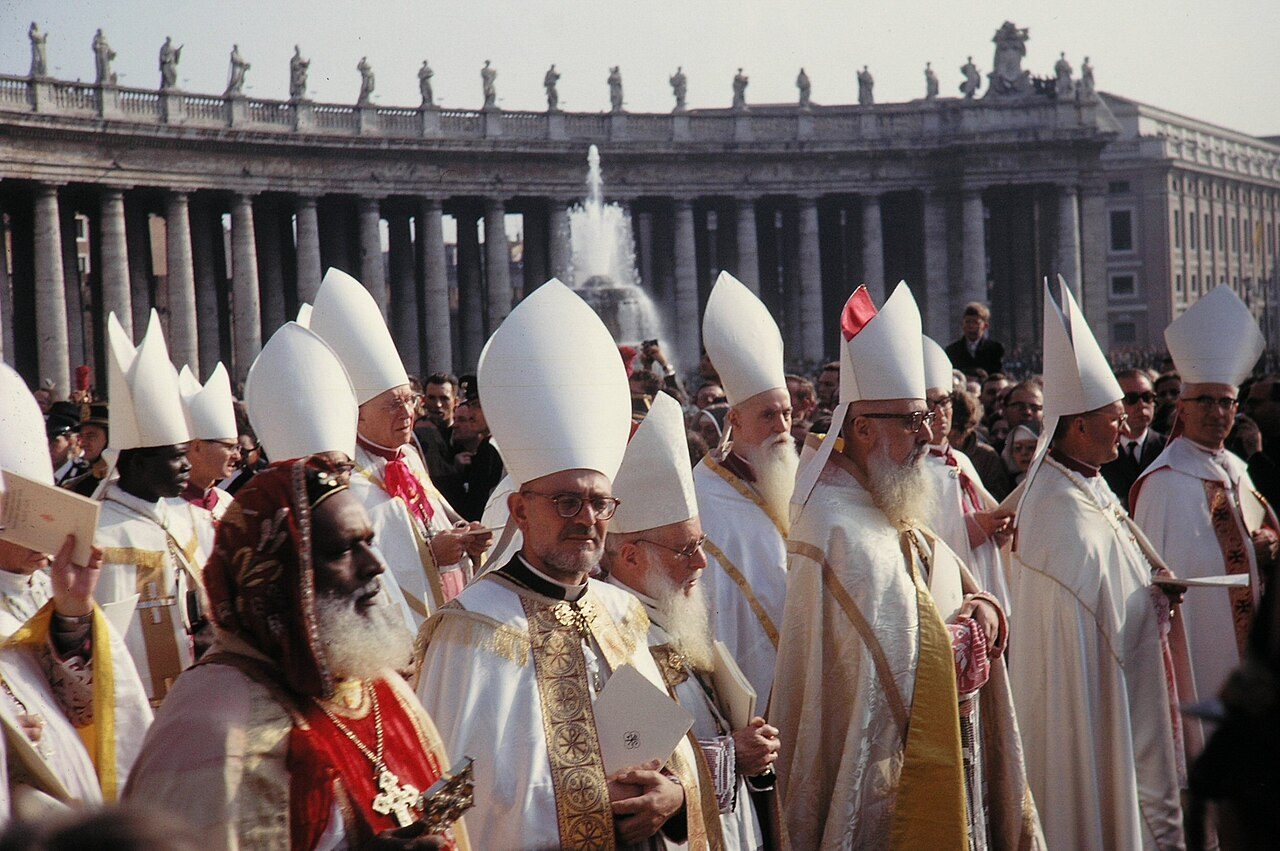
After more than three years of preparation by commissions in Rome, the council opened on 11 October 1962. Some 2,400 council fathers processed into St Peter's Basilica, watched by observers from other Christian churches and representatives of 86 governments and international bodies — an unprecedented guest list for a Catholic council. In his opening address, Gaudet Mater Ecclesia ('Mother Church Rejoices'), John XXIII set the tone: the church, he said, should use 'the medicine of mercy rather than that of severity', and he rebuked the 'prophets of gloom' who saw only calamity in the modern world.
The first session, which ran until 8 December 1962, already showed that the assembled bishops would not simply rubber-stamp drafts prepared for them: they rejected the prepared lists of candidates for the council's commissions and insisted on electing their own. John XXIII did not live to see his council finish. Diagnosed with cancer in 1962, he died on 3 June 1963; his successor, Paul VI, reconvened the council and presided over its remaining three autumn sessions, steering its documents to completion.
Vatican II closed on 8 December 1965, having produced 16 documents. Among them were Sacrosanctum Concilium, which opened the way to Mass in local languages rather than Latin alone; Lumen Gentium, on the nature of the church; Nostra Aetate, which transformed Catholic relations with Judaism and other religions; and Dignitatis Humanae, affirming religious freedom. Few events of the twentieth century changed the daily experience of so many people — the words heard in church each week, and by whom — as directly as the council that opened on this day.
Why this date matters
October 11 keeps returning to acts of collective self-examination. A church gathers its bishops from every continent to ask how it should change; a space agency, 21 months after losing three astronauts on the launch pad, trusts a crew to fly again; a quilt made of graves is unfolded on the National Mall to make a nation look at an epidemic. Even the day's smaller entries share the mood: a president takes to the air in a fragile new machine, and a young republic's navy fights a losing battle that buys it time. It is a date for institutions deciding, in public, what they are for.
Sources
- Encyclopaedia Britannica — On This Day: October 11
- HISTORY — What Happened on October 11
- Encyclopaedia Britannica — Second Vatican Council
- HISTORY — Apollo 7 launched
- Wikimedia — On This Day feed: October 11
The facts on this page were checked against these sources on 19 November 2026. The History Trail's permanent pages are researched and written for this site; the live profiles elsewhere on The History Trail are assembled automatically from Wikipedia and Wikidata.
About the Author
Researched and written by the The History Trail Editorial Team — the accountable editorial function behind this site's permanent story pages. The team works from the published sources cited on each page; it does not invent historians, reviewers or credentials, and it corrects errors openly.
Fact Check
Every load-bearing fact on this page traces to one of the sources listed above, and significant claims link to their source in the text. Our checking method is described on the methodology page; errors can be reported via the corrections page.
Sources & Citations
Cite this page as: The History Trail Editorial Team, The History Trail — this article's title, publication and update dates are shown beneath its headline. The full source list appears under Sources above; the site's source standards are on the sources page.