
On This Day
October 12 in History
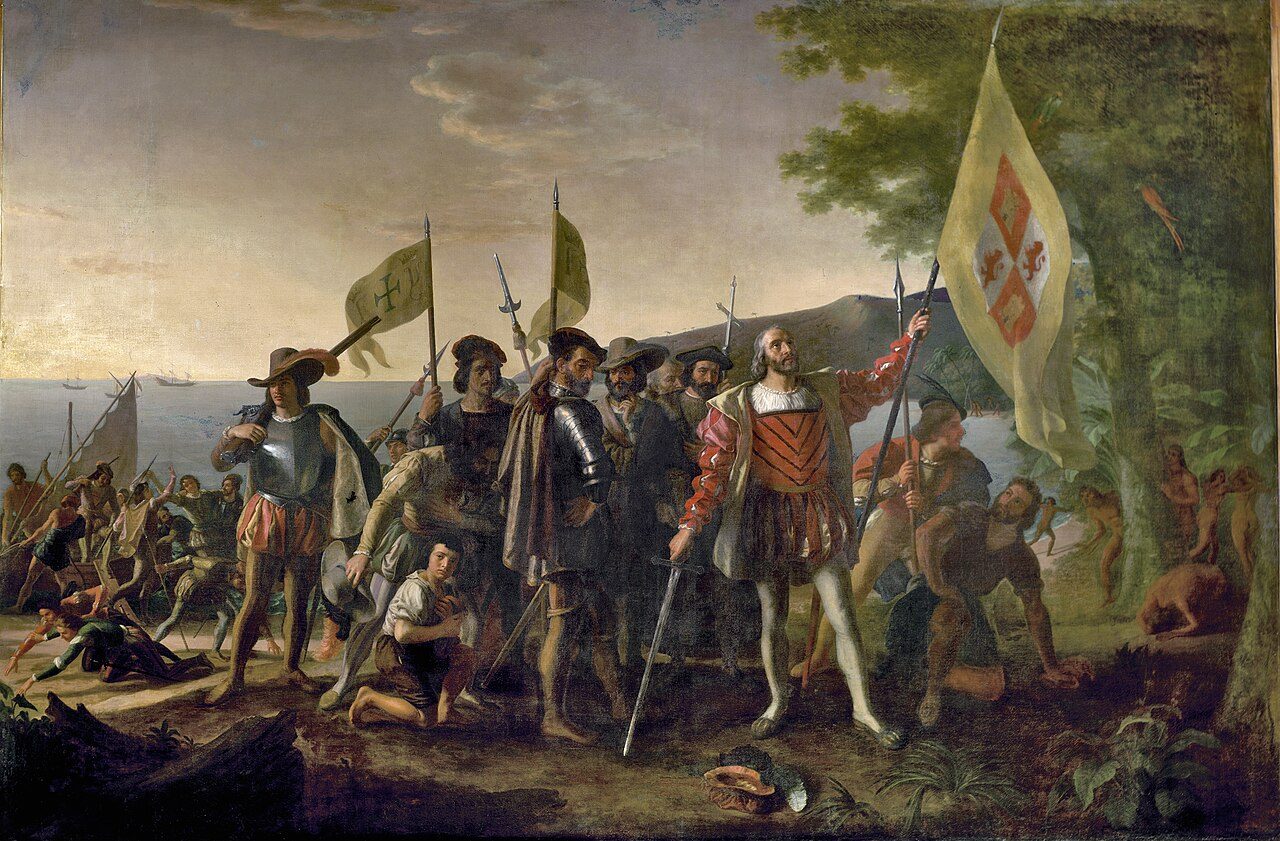
In the early hours of 12 October 1492, after more than two months at sea, lookouts on Christopher Columbus's little fleet sighted land: an island in the Bahamas whose Taíno inhabitants called it Guanahani and which Columbus renamed San Salvador, claiming it for Spain. The landfall began sustained contact between Europe and the Americas, with consequences that transformed both. October 12 is also the day Oktoberfest began, the USS Cole was bombed, and Luciano Pavarotti was born.
Choose another date: open the On This Day calendar to browse events, births and deaths for any day of the year.
At a Glance
- Sailed
- 3 August 1492 from Palos, Spain, with the Santa María, the Pinta and the Niña
- Land sighted
- 12 October 1492, in the Bahamas; the island's Indigenous name was Guanahani, renamed San Salvador by Columbus
- Who was already there
- The Lucayan Taíno, part of societies that had inhabited the Americas for thousands of years
- What Columbus believed
- That he had reached islands off Asia — he died in 1506 still framing his voyages as a route to the Indies
- The voyages
- Four in all, 1492–1504; the first European crossings since the Norse voyages of around the year 1000
- The commemoration
- Columbus Day, a U.S. federal holiday since 1937; many places now mark Indigenous Peoples' Day instead or as well
Events on this day
- 1492Christopher Columbus's expedition makes landfall in the Bahamas, on an island the Taíno called Guanahani — the featured story above.
- 1810Bavarian Crown Prince Ludwig marries Princess Therese of Saxe-Hildburghausen; Munich's citizens celebrate on the meadows outside the gates — the origin of Oktoberfest.
- 1822Pedro I is proclaimed the first emperor of an independent Brazil, weeks after declaring separation from Portugal.
- 1901President Theodore Roosevelt officially renames the Executive Mansion in Washington the White House.
- 1915British nurse Edith Cavell is executed by a German firing squad in Brussels for helping Allied soldiers escape occupied Belgium.
- 1945Desmond Doss, a conscientious objector serving as a medic, becomes the first of his kind to receive the U.S. Medal of Honor.
- 1960Soviet leader Nikita Khrushchev, protesting a Philippine speech at the United Nations, brandishes or bangs his shoe — accounts of the famous incident still differ.
- 1968Equatorial Guinea wins independence from Spain, the last Spanish colony in mainland Africa to be let go.
- 1979Typhoon Tip, churning in the Pacific, becomes the largest and most intense tropical cyclone ever measured.
- 1998Matthew Shepard, a gay American student beaten and left tied to a fence in Wyoming days earlier, dies; his murder spurs expanded U.S. hate-crime law.
- 1999General Pervez Musharraf seizes power in Pakistan in a bloodless coup, overthrowing Prime Minister Nawaz Sharif.
- 2000Al-Qaeda suicide bombers in a small boat blast the destroyer USS Cole as she refuels at Aden, Yemen, killing 17 American sailors and wounding 39.
- 2007Former vice president Al Gore and the UN's Intergovernmental Panel on Climate Change share the Nobel Peace Prize for spreading knowledge of human-made climate change.
Born on this day
- 1537Edward VI — king of England, the only legitimate son of Henry VIII, who succeeded him at nine and died at fifteen.
- 1866Ramsay MacDonald — Scottish journalist who became the first Labour prime minister of the United Kingdom.
- 1875Aleister Crowley — English occultist and writer whose notoriety made him a fixture of British popular culture.
- 1891Edith Stein — German philosopher and Carmelite nun of Jewish birth, murdered at Auschwitz and later canonised.
- 1935Luciano Pavarotti — Italian tenor whose voice and personality carried opera to a worldwide popular audience.
- 1968Hugh Jackman — Australian actor and singer, on screen as Wolverine and on stage in musical theatre.
Died on this day
- 1924Anatole France — French novelist and Nobel laureate, the sceptical man of letters of the Third Republic.
- 1971Gene Vincent — American rockabilly singer whose 'Be-Bop-A-Lula' influenced a generation of rock musicians.
- 1997John Denver — American singer-songwriter of 'Take Me Home, Country Roads', killed when the light aircraft he was piloting crashed into the sea off California.
- 1999Wilt Chamberlain — American basketball giant, the only player to score 100 points in an NBA game.
The featured story: Columbus reaches the Americas, 12 October 1492
Columbus, a Genoese sailor sailing for Ferdinand and Isabella of Spain, had spent years arguing that Asia could be reached by crossing the Atlantic westward. Educated Europeans knew the Earth was round; the argument was about its size, and Columbus's estimate was far too small. Granted his commission after the fall of Granada, he sailed from Palos on 3 August 1492 with three small ships — the Santa María, the Pinta and the Niña — and a crew increasingly doubtful that land lay within reach of their supplies.
Land was sighted from the Pinta in the early hours of 12 October — traditionally credited to the lookout Rodrigo de Triana — and at dawn Columbus went ashore on a low, green island in the Bahamas. Its people, Lucayan Taíno, called it Guanahani; Columbus named it San Salvador, 'Holy Saviour', and formally claimed it for Spain. The Taíno swam out to the ships with gifts of parrots, cotton and spears; Columbus's journal praised their generosity in one passage and, in another, calculated how easily they might be subjugated — the two impulses that would define the encounter.
In the weeks that followed, the expedition reached Cuba, which Columbus took for mainland Asia, and Hispaniola, which he thought might be Japan; the wrecked Santa María supplied the timbers for La Navidad, a fort left with 39 men — the first European settlement of the era in the Americas, and one that would not survive. Columbus returned to Spain in 1493 to acclaim, and made three further voyages. He died in 1506 without grasping the scale of what he had done: he had not found a new route to Asia, but had opened a permanent sea-road between two worlds that had developed in isolation for millennia.
The consequences ran in both directions and were catastrophic for one side. The Columbian Exchange carried crops, animals and technologies across the Atlantic — and carried European diseases to peoples with no immunity, devastating Indigenous populations across the Americas, while conquest and colonisation followed within a generation. How to mark 12 October is still argued over: celebrated as Columbus Day in the United States since 1937 and as Spain's national day, it is also observed as Indigenous Peoples' Day or a day of Indigenous resistance in a growing number of places — a reminder that the same landfall reads as discovery from one shore and as invasion from the other.
Why this date matters
October 12 is the calendar's great hinge between worlds. Its featured landfall joined two hemispheres that had been apart for millennia, and the day has kept staging encounters ever since: a Bavarian wedding that becomes the world's biggest folk festival, a nurse executed for smuggling soldiers across a frontier, a Soviet shoe raised in the parliament of nations, a destroyer bombed in a foreign harbour. Even its weather joins in — the largest storm ever measured formed on this date. Few days hold so much of the modern world's making, and its arguments, in one square of the calendar.
Sources
- Encyclopaedia Britannica — On This Day: October 12
- HISTORY — What Happened on October 12
- HISTORY — Columbus reaches the “New World”
- Wikimedia — On This Day feed: October 12
The facts on this page were checked against these sources on 19 November 2026. The History Trail's permanent pages are researched and written for this site; the live profiles elsewhere on The History Trail are assembled automatically from Wikipedia and Wikidata.
About the Author
Researched and written by the The History Trail Editorial Team — the accountable editorial function behind this site's permanent story pages. The team works from the published sources cited on each page; it does not invent historians, reviewers or credentials, and it corrects errors openly.
Fact Check
Every load-bearing fact on this page traces to one of the sources listed above, and significant claims link to their source in the text. Our checking method is described on the methodology page; errors can be reported via the corrections page.
Sources & Citations
Cite this page as: The History Trail Editorial Team, The History Trail — this article's title, publication and update dates are shown beneath its headline. The full source list appears under Sources above; the site's source standards are on the sources page.