
On This Day
October 14 in History
On 14 October 1066, on a ridge near Hastings, Duke William of Normandy defeated and killed King Harold II of England at the Battle of Hastings — the victory that began the Norman Conquest and remade England's language, laws and ruling class. October 14 is also the day Chuck Yeager broke the sound barrier, Martin Luther King Jr. won the Nobel Peace Prize, and Dwight D. Eisenhower was born.
Choose another date: open the On This Day calendar to browse events, births and deaths for any day of the year.
At a Glance
- The claimants
- Harold Godwinson, crowned king in January 1066, against William of Normandy, who claimed Edward the Confessor had promised him the throne
- The landing
- William's invasion fleet landed at Pevensey on 28 September 1066, while Harold was in the north defeating a Norwegian invasion
- The battle
- 14 October 1066, fought from morning to dusk around Senlac Hill near the modern town of Battle, East Sussex
- The armies
- Modern estimates put each side at roughly 5,000–7,000 men — an English shield wall against Norman cavalry, archers and infantry
- The outcome
- Harold and his brothers Gyrth and Leofwine were killed; the English army broke at dusk
- The coronation
- William was crowned king of England at Westminster Abbey on Christmas Day 1066
Events on this day
- 1066At the Battle of Hastings, William of Normandy defeats and kills King Harold II, beginning the Norman Conquest of England — the featured story above.
- 1322Robert the Bruce defeats Edward II of England at Old Byland in Yorkshire, strengthening Scotland's fight for independence.
- 1586Mary, Queen of Scots goes on trial at Fotheringhay for her alleged part in the Babington Plot to assassinate Elizabeth I.
- 1806Napoleon crushes Prussia in the twin battles of Jena and Auerstedt, shattering the Prussian state within weeks.
- 1912Former president Theodore Roosevelt is shot in the chest in Milwaukee while campaigning — and delivers his scheduled speech before seeking treatment.
- 1926A. A. Milne's Winnie-the-Pooh is published, introducing Christopher Robin and the animals of the Hundred Acre Wood.
- 1939The German U-boat U-47 penetrates the naval anchorage at Scapa Flow and sinks the battleship HMS Royal Oak with heavy loss of life.
- 1943Prisoners at the Sobibor extermination camp in occupied Poland rise in revolt; some 300 escape, and the camp is closed and demolished by the Germans.
- 1947Captain Chuck Yeager flies the rocket-powered Bell X-1 past Mach 1 over California, the first person to break the sound barrier in level flight.
- 1962A U.S. U-2 spy plane photographs Soviet nuclear missile sites under construction in Cuba; shown to President Kennedy two days later, the pictures open the Cuban Missile Crisis.
- 1964Martin Luther King Jr. is awarded the Nobel Peace Prize for his nonviolent campaign against racial segregation.
- 1964Nikita Khrushchev is removed as leader of the Soviet Union by his own Presidium, ending his turbulent decade in power.
- 2012Felix Baumgartner jumps from a balloon capsule some 39 kilometres above New Mexico, freefalling faster than the speed of sound to a safe landing.
Born on this day
- 1644William Penn — English Quaker who founded Pennsylvania as a refuge of religious toleration.
- 1890Dwight D. Eisenhower — American general who commanded the Allied forces in Europe and became the 34th U.S. president.
- 1894E. E. Cummings — American poet of radical punctuation and tender lyric verse.
- 1906Hannah Arendt — German-American political philosopher, author of The Origins of Totalitarianism.
- 1927Roger Moore — English actor, the third and longest-serving James Bond of the film series.
- 1939Ralph Lauren — American fashion designer who built a global brand on an idealised American style.
- 1940Cliff Richard — Indian-born British singer, among the best-selling British recording artists of all time.
Died on this day
- 1944Erwin Rommel — German field marshal, the 'Desert Fox', forced to take his own life for his links to the plot against Hitler.
- 1977Bing Crosby — American singer and actor whose crooning defined popular music between the wars.
- 1990Leonard Bernstein — American conductor and composer of West Side Story, dead on the day he had been due to conduct in Boston.
The featured story: the Battle of Hastings, 14 October 1066
England in 1066 had three kings in a single year. Edward the Confessor died childless in January, and Harold Godwinson, the kingdom's most powerful earl, was crowned the next day. Across the Channel, William, duke of Normandy, insisted Edward had promised him the succession and that Harold had sworn to support his claim; in the north, Harald Hardrada of Norway pressed a claim of his own and invaded first. Harold marched his army the length of England, destroyed the Norwegians at Stamford Bridge on 25 September — and then, learning that William had landed at Pevensey on 28 September, turned and marched straight back south to face a second invasion on an empty stomach of rest.
The armies met on 14 October on a ridge near Hastings, at the place now called, simply, Battle. Harold's exhausted English fought on foot in a dense shield wall along the ridge; William's Normans, Bretons and French attacked uphill with cavalry, archers and infantry. For a medieval battle it lasted extraordinarily long — from morning until dusk — a measure of how evenly matched the sides were. Norman attacks broke against the wall; a rumour that William had been killed nearly broke his own army, until the duke raised his helmet and showed his face. Feigned retreats, whether planned or improvised, drew English pursuers downhill and thinned the wall.
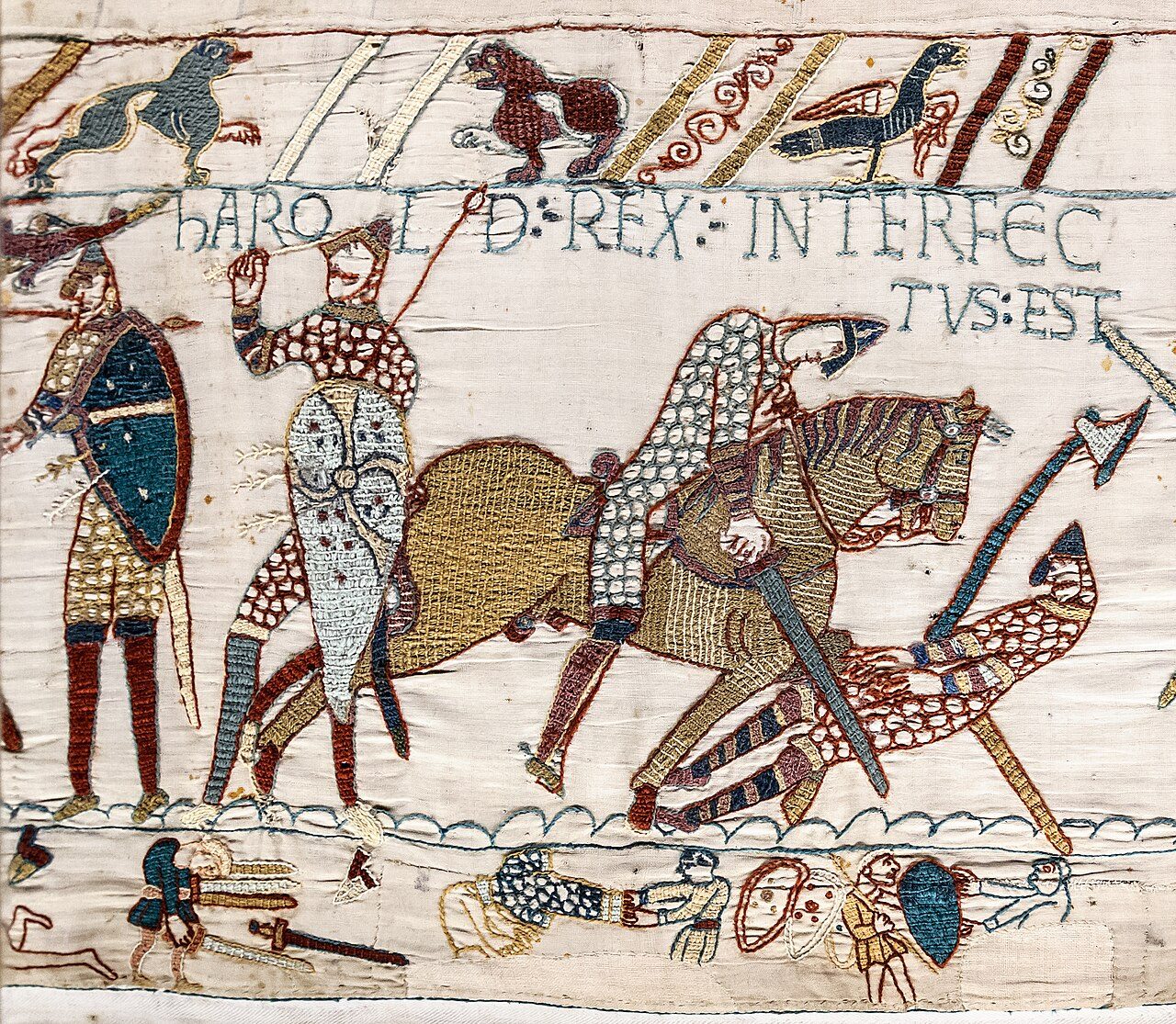
Late in the day Harold was killed. The Bayeux Tapestry, the great embroidered record of the conquest, shows his death beneath the words 'Here King Harold has been killed' — but the caption spans two figures, one clutching a shaft near his face and another cut down by a Norman knight, and scholars still debate which, if either, is the king, and whether the famous arrow in the eye is history or a later restorer's alteration. His brothers Gyrth and Leofwine also fell. Leaderless, the English line collapsed in the dusk, and the road to London lay open.
William was crowned in Westminster Abbey on Christmas Day 1066. What followed was a conquest in depth: within a generation England's native aristocracy had been almost entirely dispossessed, its church restaffed, its landscape studded with castles, and its language flooded with the French vocabulary that still marks English law, government and cuisine. English Heritage, which cares for the battlefield, calls Hastings one of the most famous battles ever fought on English soil; William built Battle Abbey on the ridge, with its high altar, by tradition, on the spot where Harold fell.
Why this date matters
October 14 is a day on which worlds turn over in a matter of hours. A kingdom changes hands between dawn and dusk in 1066; Prussia's old order is broken in a morning in 1806; a former president, bleeding from a bullet wound, insists on speaking for an hour and a half. The twentieth century keeps the tempo: the sound barrier falls in minutes, missile photographs are developed that will bring the world to the edge of nuclear war, and a skydiver steps out of a capsule at the edge of space. Again and again the date compresses a whole era's change into a single day's span.
Sources
- Encyclopaedia Britannica — On This Day: October 14
- HISTORY — What Happened on October 14
- Encyclopaedia Britannica — Today in History: October 14, the Battle of Hastings
- English Heritage — Battlefield Report: Hastings 1066
- Wikimedia — On This Day feed: October 14
The facts on this page were checked against these sources on 19 November 2026. The History Trail's permanent pages are researched and written for this site; the live profiles elsewhere on The History Trail are assembled automatically from Wikipedia and Wikidata.
About the Author
Researched and written by the The History Trail Editorial Team — the accountable editorial function behind this site's permanent story pages. The team works from the published sources cited on each page; it does not invent historians, reviewers or credentials, and it corrects errors openly.
Fact Check
Every load-bearing fact on this page traces to one of the sources listed above, and significant claims link to their source in the text. Our checking method is described on the methodology page; errors can be reported via the corrections page.
Sources & Citations
Cite this page as: The History Trail Editorial Team, The History Trail — this article's title, publication and update dates are shown beneath its headline. The full source list appears under Sources above; the site's source standards are on the sources page.