
On This Day
October 15 in History
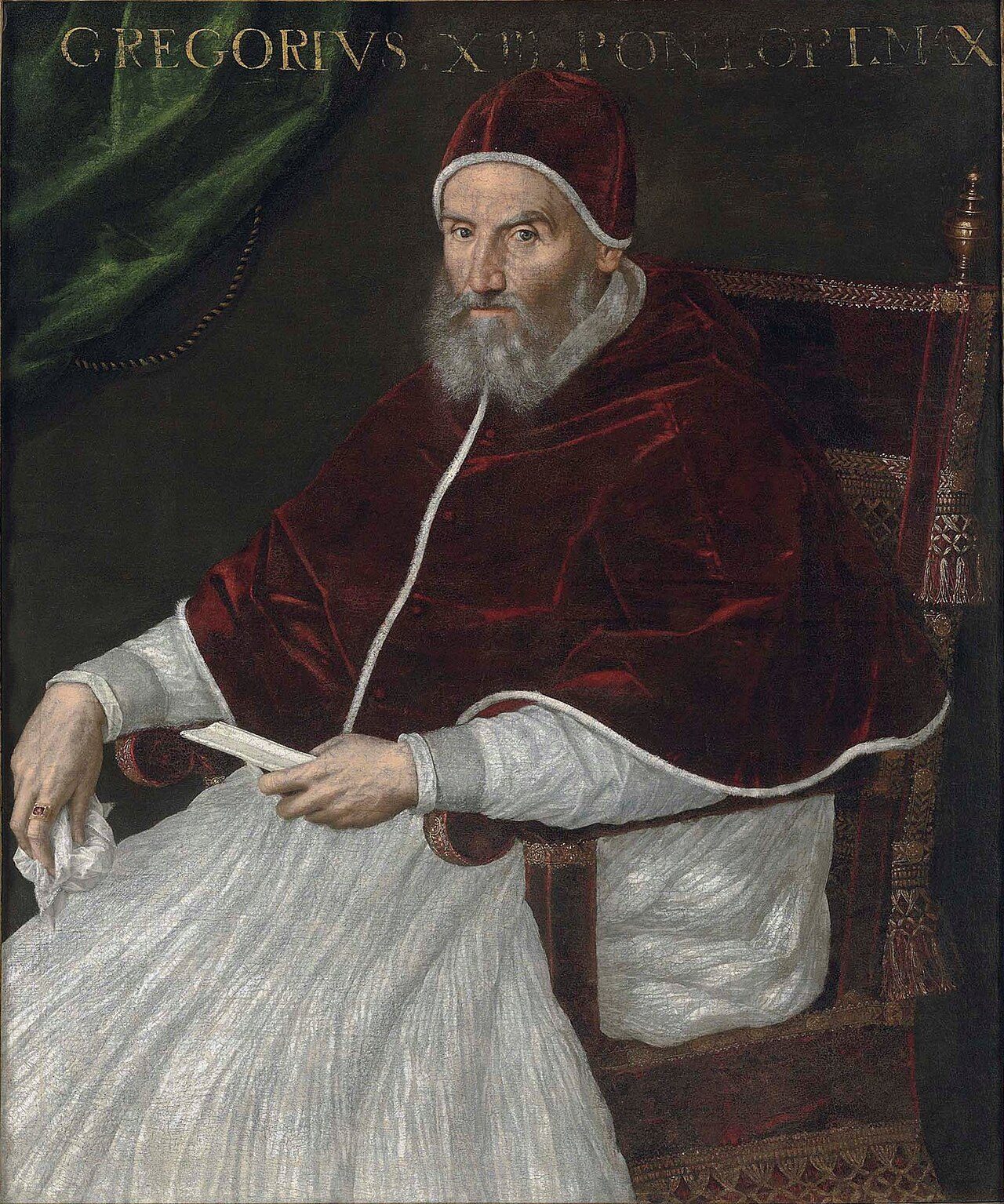
Friday 15 October 1582 was a date that, in a sense, should not have existed: in Italy, Spain, Portugal and Poland it followed Thursday 4 October directly, as Pope Gregory XIII's reformed calendar deleted ten days at a stroke to pull the drifted Julian calendar back into line with the seasons. The Gregorian calendar born that morning is the one the world still uses. October 15 is also the day the first contraceptive hormone was synthesised, I Love Lucy premiered, and Friedrich Nietzsche was born.
Choose another date: open the On This Day calendar to browse events, births and deaths for any day of the year.
At a Glance
- The problem
- The Julian year of 365¼ days runs about 11 minutes too long; by 1582 the spring equinox had drifted from 21 March to 11 March
- The decree
- Pope Gregory XIII's bull Inter gravissimas, February 1582, based on the work of Luigi Lilio and Christopher Clavius
- The jump
- Thursday 4 October 1582 was followed by Friday 15 October in the first adopting countries — 5–14 October never occurred there
- The new rule
- Century years are leap years only if divisible by 400: 1600 and 2000 were leap years, 1700, 1800 and 1900 were not
- The holdouts
- Protestant and Orthodox countries refused a pope's calendar: Britain and its colonies waited until 1752, Greece until 1923
- The result
- The Gregorian calendar is now the civil calendar of effectively the whole world, drifting by about a day in 7,700 years
Events on this day
- 1582The Gregorian calendar takes effect in the first adopting countries; Thursday 4 October is followed directly by Friday 15 October — the featured story above.
- 1783Jean-François Pilâtre de Rozier makes the first human ascent in a Montgolfier hot-air balloon, rising tethered above Paris.
- 1815Napoleon Bonaparte arrives on the remote South Atlantic island of St Helena to begin the exile from which he never returns.
- 1863The Confederate submarine H. L. Hunley sinks during a demonstration in Charleston harbour, drowning her inventor Horace Hunley and seven crew.
- 1928The airship Graf Zeppelin completes its first transatlantic crossing, landing at Lakehurst, New Jersey.
- 1945Pierre Laval, head of government in Vichy France, is executed by firing squad for treason.
- 1951Mexican chemist Luis Miramontes synthesises norethindrone, the compound that makes the oral contraceptive pill possible.
- 1951I Love Lucy premieres on CBS, inventing much of the grammar of the television situation comedy.
- 1956FORTRAN, the first widely used high-level computer programming language, is first shared with the computing community.
- 1966Huey Newton and Bobby Seale found the Black Panther Party in Oakland, California.
- 1990Soviet leader Mikhail Gorbachev is awarded the Nobel Peace Prize for his part in ending the Cold War confrontation.
- 1997NASA's Cassini spacecraft launches from Cape Canaveral on its seven-year journey to Saturn.
- 2003Yang Liwei orbits the Earth aboard Shenzhou 5, becoming the first person sent into space by China's space programme.
Born on this day
- 70 BCVirgil — Roman poet of the Aeneid, the epic that gave Rome its founding myth.
- 1844Friedrich Nietzsche — German philosopher whose assaults on conventional morality reshaped modern thought.
- 1881P. G. Wodehouse — English comic novelist, creator of Jeeves and Bertie Wooster.
- 1926Michel Foucault — French philosopher and historian of power, madness and punishment.
- 1931A. P. J. Abdul Kalam — Indian aerospace scientist who became the 11th president of India.
- 1938Fela Kuti — Nigerian musician and activist who created Afrobeat and defied military governments.
Died on this day
- 1564Andreas Vesalius — Flemish anatomist whose De humani corporis fabrica founded the modern study of human anatomy.
- 1817Tadeusz Kościuszko — Polish engineer and soldier who fought for both Polish and American independence.
- 1917Mata Hari — Dutch dancer executed by a French firing squad as a German spy, in a case historians still dispute.
- 1946Hermann Göring — Hitler's designated successor, who cheated the Nuremberg gallows by suicide hours before his execution.
- 1964Cole Porter — American composer and songwriter of Anything Goes and Kiss Me, Kate.
- 1987Thomas Sankara — president of Burkina Faso, assassinated in the coup that brought Blaise Compaoré to power.
The featured story: the Gregorian calendar takes effect, 15 October 1582
The calendar Julius Caesar had imposed in 45 BC was very nearly right — but not quite. Its year of 365 days and a quarter overran the true solar year by about 11 minutes, a trifle that compounded, century by century, into days. By the 1500s the spring equinox, fixed by the Church at 21 March for the calculation of Easter, was actually falling on 11 March, and the drift embarrassed astronomers and theologians alike. Pope Gregory XIII appointed a commission; its design came chiefly from the Calabrian astronomer Luigi Lilio, refined by the Jesuit mathematician Christopher Clavius, and in February 1582 the bull Inter gravissimas made it law.
The reform had two parts. For the future, the leap-year rule was tightened: century years would be leap years only when divisible by 400, cutting three leap days in every four centuries. For the past, the accumulated error had to be deleted in a single cut. October was chosen for the surgery precisely because it held few major feasts. So in the states that adopted at once — Italy, Spain, Portugal and the Polish-Lithuanian Commonwealth among them — people went to bed on Thursday 4 October 1582 and woke on Friday 15 October. The days 5 to 14 October 1582 simply never existed in those countries; rents, wages and saints' days all had to be argued out afterwards.
Much of Europe wanted nothing to do with a pope's arithmetic. Protestant states suspected a Catholic plot and kept the Julian calendar for generations — Britain and its American colonies until 1752, when the correction had grown to eleven days; Sweden contrived to drift out of step with everyone; Orthodox countries held out longest of all, Greece not adopting the Gregorian calendar for civil use until 1923, by which time the gap was thirteen days. For centuries, travellers crossing Europe crossed dates as well as borders, and historians still write 'Old Style' and 'New Style' against the birthdays of the early modern world.
Yet the reform won, because it worked. The Gregorian calendar tracks the solar year so closely that it gains roughly a day in 7,700 years, and it is now the civil calendar of the entire planet — the shared framework inside which every other date on this page is written. The ten days deleted in October 1582 are the most successful act of collective time-travel in history: everybody agreed to pretend, together, and the pretence became true.
Why this date matters
October 15 is the day time itself was edited. Its featured event is a deletion — ten days struck out of the calendar by decree — and the rest of the date keeps the theme of human beings seizing control of frameworks: a chemist synthesises the hormone that puts reproduction under personal control, programmers receive a language that lets them command machines in words, activists found a party to reorder American politics, and a prisoner-emperor is deposited on the loneliest island on earth. It is a date about who gets to set the rules by which everyone else lives.
Sources
- Encyclopaedia Britannica — On This Day: October 15
- HISTORY — What Happened on October 15
- Encyclopaedia Britannica — Gregorian calendar
- Encyclopaedia Britannica — Ten Days That Vanished: The Switch to the Gregorian Calendar
- Wikimedia — On This Day feed: October 15
The facts on this page were checked against these sources on 19 November 2026. The History Trail's permanent pages are researched and written for this site; the live profiles elsewhere on The History Trail are assembled automatically from Wikipedia and Wikidata.
About the Author
Researched and written by the The History Trail Editorial Team — the accountable editorial function behind this site's permanent story pages. The team works from the published sources cited on each page; it does not invent historians, reviewers or credentials, and it corrects errors openly.
Fact Check
Every load-bearing fact on this page traces to one of the sources listed above, and significant claims link to their source in the text. Our checking method is described on the methodology page; errors can be reported via the corrections page.
Sources & Citations
Cite this page as: The History Trail Editorial Team, The History Trail — this article's title, publication and update dates are shown beneath its headline. The full source list appears under Sources above; the site's source standards are on the sources page.