
Years
1929 in History
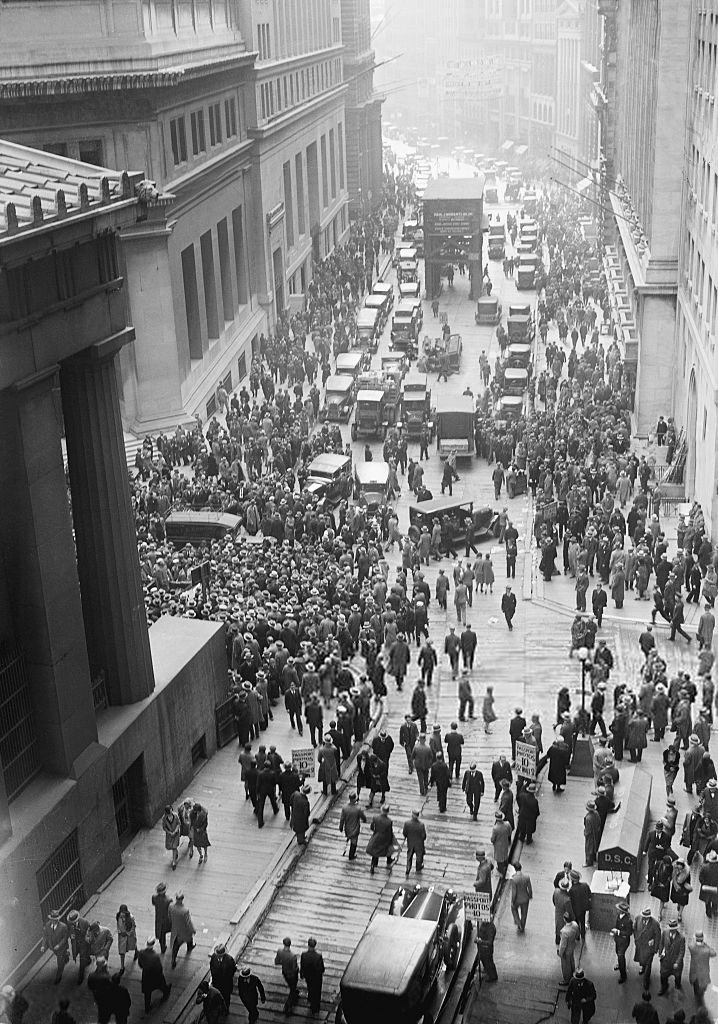
1929 is remembered for the Wall Street Crash, when panic selling on Black Tuesday, 29 October, ended the Roaring Twenties and opened the road to the Great Depression. Yet most of the year ran the other way: the Lateran Treaty created Vatican City, Hollywood held its first Academy Awards, and colour television was publicly demonstrated for the first time.
At a Glance
- Defining event
- The Wall Street Crash, climaxing on Black Tuesday, 29 October 1929
- Black Tuesday volume
- Some 16.4 million shares traded in panic selling on the New York Stock Exchange
- New state
- Vatican City becomes independent under the Lateran Treaty, in force 7 June
- First Oscars
- The first Academy Awards are presented in Hollywood, 16 May
- Born this year
- Martin Luther King Jr. (15 January) and Anne Frank (12 June)
- Closed the year
- Richard E. Byrd makes the first flight over the South Pole, 29 November
The defining story: the Wall Street Crash
For most of 1929 the boom still looked permanent. Through the decade the American stock market had climbed almost without pause: the Dow Jones Industrial Average rose from 63 in 1921 to a peak of 381 in September 1929, and share ownership had spread far beyond Wall Street to millions of ordinary Americans, many of them buying on margin, with borrowed money, in the belief that prices could only rise. The year's other news fitted the mood of a world settling down. In February Italy and the Holy See signed the Lateran Treaty, and when it came into force on 7 June, Vatican City existed as the world's smallest independent state. In May Hollywood presented its first Academy Awards, and in June engineers at Bell Laboratories gave the first public demonstration of colour television, between New York and Washington.
The crack came in the autumn. Prices slid through October, and on Thursday 24 October, Black Thursday, panic selling was only steadied when a pool of leading bankers conspicuously bought shares to calm the market. The calm lasted one weekend. On Monday 28 October the market fell again, by about 12.8 per cent, and on Tuesday 29 October the dam broke. From the opening bell the selling was frantic and indiscriminate, the ticker tape ran hours behind the trading it was supposed to report, and by the close a record figure of some 16.4 million shares had changed hands. The Dow fell about 11.7 per cent on the day, to close at 230.07. Outside the exchange, crowds gathered in the street in a strange quiet, watching the windows for news, while inside, brokers and clerks worked around the clock to process the avalanche of sell orders and margin calls.
The value wiped out on Black Tuesday alone has been put at around 14 billion dollars, and across the weeks of the crash losses are estimated by some reckonings at 25 billion to 30 billion dollars. Fortunes assembled over a decade were extinguished in hours, and people who had been rich on paper in September owed their brokers money in November. The year's violence had already shown a darker face in February, when gunmen posing as police shot seven members of Bugs Moran's gang in a Chicago garage in the St. Valentine's Day Massacre, the peak of the Capone-Moran gang war, for which no one was ever convicted. A month after the crash, on 29 November, Richard E. Byrd and three companions made the first flight over the South Pole, an eighteen-hour round trip from the Ross Ice Shelf, as if to prove the age of heroic firsts was not over. Economically, it was.
Timeline of 1929
- 13 January
Wyatt Earp, frontier lawman of Tombstone and the O.K. Corral, dies in Los Angeles at 80.
- 15 January
Martin Luther King Jr., the future leader of the American civil rights movement, is born in Atlanta.
- 11 February
The Lateran Treaty between Italy and the Holy See creates Vatican City as an independent state within Rome.
- 14 February
Seven men of the Moran gang are shot dead in a Chicago garage in the St. Valentine's Day Massacre.
- 16 May
The first Academy Awards are presented in Hollywood; Wings wins best production.
- 7 June
The Lateran Treaty comes into force and Vatican City becomes an independent state.
- 27 June
Bell Laboratories engineers give the first public demonstration of colour television, between New York and Washington.
- 11 August
Babe Ruth becomes the first baseball player to hit 500 career home runs.
- 3 October
The Kingdom of the Serbs, Croats and Slovenes is renamed the Kingdom of Yugoslavia under King Alexander.
- 24 October
Black Thursday: panic selling on the New York Stock Exchange opens the Wall Street Crash.
- 29 October
Black Tuesday: some 16.4 million shares are traded in panic selling as the crash reaches its climax.
- 29 November
Richard E. Byrd and three companions make the first flight over the South Pole.
Why 1929 still matters
The crash did not by itself cause the Great Depression: that catastrophe was built over the following three years by bank failures, collapsing demand, drought and policy error. But Black Tuesday was its unmistakable overture, the day the era's faith in permanent prosperity visibly died, and the market would not regain its 1929 peak for a quarter of a century. The disaster also set in motion the reforms that still govern American finance, beginning with federal securities regulation, because the crash exposed how much of the boom had rested on borrowed money and unchecked speculation.
The year matters for quieter reasons too. Vatican City, created in 1929, remains the world's smallest independent state and the Holy See's territorial guarantee. The Academy Awards, presented for the first time that May, became cinema's defining ritual. And the year's births bookend the century's moral history: Martin Luther King Jr., born in January, would lead the movement that remade American civil rights, while Anne Frank, born in June, would leave the diary that became a classic of war literature after the world the crash destabilised collapsed into war. The gangland massacre in February and the crash in October were the same story told twice: a decade's excesses, in liquor and in shares, coming due at once.
1929 on The History Trail
Three of 1929's days carry featured stories on The History Trail, from a Chicago garage to the floor of the New York Stock Exchange.
- February 14 in History — Seven Moran gang men are shot dead in the St. Valentine's Day Massacre in Chicago.
- June 7 in History — The Lateran Treaty comes into force and Vatican City becomes an independent state.
- October 24 in History — Black Thursday opens the Wall Street Crash with panic selling in New York.
- October 29 in History — Black Tuesday brings the crash to its climax with 16.4 million shares traded.
- Pasta — A permanent page from the site's collection, published among the stories this year touches.
Sources
- Encyclopaedia Britannica — On This Day: October 29
- Encyclopaedia Britannica — On This Day: October 24
- HISTORY — What Happened on February 14
- Encyclopaedia Britannica — On This Day: June 7
- Encyclopaedia Britannica — Lateran Treaty
The facts on this page were checked against these sources on 19 November 2026. The History Trail's permanent pages are researched and written for this site; the live profiles elsewhere on The History Trail are assembled automatically from Wikipedia and Wikidata.
About the Author
Researched and written by the The History Trail Editorial Team — the accountable editorial function behind this site's permanent story pages. The team works from the published sources cited on each page; it does not invent historians, reviewers or credentials, and it corrects errors openly.
Fact Check
Every load-bearing fact on this page traces to one of the sources listed above, and significant claims link to their source in the text. Our checking method is described on the methodology page; errors can be reported via the corrections page.
Sources & Citations
Cite this page as: The History Trail Editorial Team, The History Trail — this article's title, publication and update dates are shown beneath its headline. The full source list appears under Sources above; the site's source standards are on the sources page.