
Years
1922 in History
1922 is remembered above all for the opening of Tutankhamun's tomb in Egypt's Valley of the Kings, the only intact pharaoh's burial ever found. It was also the year insulin first saved a dying diabetic boy in Toronto, Mussolini seized power in Italy, the BBC was founded in London and, in the year's last days, the Soviet Union was formally created in Moscow.
At a Glance
- Defining event
- Howard Carter's discovery and opening of the tomb of Tutankhamun, November 1922
- Medical breakthrough
- First insulin injection given to a human being, Toronto, 11 January 1922
- Opened the year
- Ernest Shackleton dies aboard ship off South Georgia, 5 January
- New power in Italy
- Mussolini takes control after the March on Rome, 28 October, and becomes prime minister on 31 October
- New broadcaster
- The British Broadcasting Company, the future BBC, founded in London, 18 October
- Closed the year
- The USSR is formally established in Moscow, 30 December
The defining story: the opening of Tutankhamun's tomb
The year opened with endings and beginnings in roughly equal measure. On 5 January the Antarctic explorer Ernest Shackleton died of a heart attack aboard ship off South Georgia, on what became his final expedition. Six days later, in Toronto, a fourteen-year-old boy named Leonard Thompson, dying of diabetes, received the first insulin injection ever given to a human being. The first extract was too crude and raised a sterile abscess, but a purified preparation tried on 23 January brought his blood sugar down to normal, and a disease that had always killed became one that could be survived. Elsewhere the post-war map was still being redrawn: Egypt proclaimed its independence in February, ending the British protectorate imposed in 1914, though Britain kept control of the Suez Canal and of defence, and in India a British court sentenced Mohandas Gandhi to six years in prison for civil disobedience, of which he served two.
Autumn brought two seizures of power that shaped the century. On 3 April Joseph Stalin became general secretary of the Soviet Communist Party, quietly acquiring the power base from which his dictatorship would grow. In Italy, Benito Mussolini took control of the government in the March on Rome on 28 October and became prime minister three days later, beginning more than two decades of Fascist rule. Between those events, on 18 October, a consortium of radio manufacturers in London founded the British Broadcasting Company, the future BBC, and in Ireland the revolutionary leader Michael Collins was shot dead in an ambush at Beal na Blath, County Cork, in August, during the Irish Civil War.
The year's immortal moment came in Egypt in November. Howard Carter had spent years searching the Valley of the Kings for the tomb of the boy pharaoh Tutankhamun, and on 4 November his workmen uncovered the first step of a staircase cut into the rock. Clearing it exposed a sealed doorway. Three weeks of careful excavation followed before, on 26 November, Carter breached the sealed entrance to the burial rooms and looked inside by candlelight. What he saw was a chamber crowded with gold and funerary treasure, untouched where it lay: this was the only intact pharaoh's tomb ever found, and its discovery began the most famous excavation in the history of archaeology.
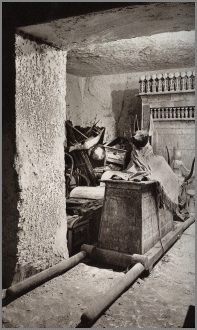
The clearance that followed was documented almost object by object by the photographer Harry Burton, seconded from the Metropolitan Museum of Art, whose 1922 photograph of the gilded funerary goods inside the tomb accompanies this page. The year then closed in Moscow, where on 30 December the First All-Union Congress of Soviets approved the treaty creating the Union of Soviet Socialist Republics from the Russian, Ukrainian, Byelorussian and Transcaucasian republics. A tomb sealed for more than three thousand years had been opened, and a new state built to last had been founded, within five weeks of each other.
Timeline of 1922
- 5 January
Ernest Shackleton, the Antarctic explorer, dies of a heart attack aboard ship off South Georgia on his final expedition.
- 11 January
Leonard Thompson receives the first insulin injection given to a human being, at Toronto General Hospital.
- 2 February
James Joyce's Ulysses is published in Paris, on its author's fortieth birthday.
- 28 February
Egypt proclaims its independence, ending the British protectorate imposed in 1914, though Britain keeps the Suez Canal and defence.
- 18 March
A British court in India sentences Mohandas Gandhi to six years in prison for civil disobedience; he serves two.
- 3 April
Joseph Stalin becomes general secretary of the Soviet Communist Party, acquiring the base from which his dictatorship grows.
- 22 August
Irish leader Michael Collins is killed in an ambush at Beal na Blath, County Cork, during the Irish Civil War.
- 18 October
The British Broadcasting Company, the future BBC, is founded in London by a consortium of radio manufacturers.
- 28 October
Benito Mussolini takes control of Italy's government in the March on Rome, beginning more than two decades of Fascist rule.
- 4 November
Howard Carter's workmen find the first step of the staircase leading down to Tutankhamun's tomb.
- 26 November
Carter first looks inside Tutankhamun's tomb and sees, by candlelight, a chamber full of gold.
- 30 December
The Union of Soviet Socialist Republics is formally established by the First All-Union Congress of Soviets in Moscow.
Why 1922 still matters
Few single years contain so many beginnings whose consequences are still running. Insulin turned type 1 diabetes from a death sentence into a condition managed for life, and everyone living with the disease today lives inside the extra time that began in that Toronto ward. The Soviet Union founded on 30 December 1922 endured for most of the twentieth century and defined the Cold War world that followed the Second World War, while Stalin's appointment that April set its internal course toward dictatorship. Mussolini's March on Rome gave Europe its first Fascist government and a model that others, above all in Germany, studied closely.
The quieter foundings lasted just as long. The broadcasting company created by radio manufacturers in October 1922 became the BBC, one of the world's defining media institutions. And Tutankhamun's tomb changed archaeology's place in public life for good: never before had an excavation been followed, photographed and argued over by a worldwide audience, and the boy king's gold became the standard against which every later discovery is still measured. The year also gave the century some of its defining imaginations, among them the writers Kurt Vonnegut, born on 11 November, and José Saramago, born on 16 November, and the cartoonist Charles Schulz, born on the very day Carter peered into the tomb.
1922 on The History Trail
Four of 1922's days carry featured stories on The History Trail, and two of its institutions have pages of their own.
- January 11 in History — Leonard Thompson receives the first insulin injection given to a human being.
- November 4 in History — Carter's workmen uncover the first step of the staircase to Tutankhamun's tomb.
- November 26 in History — Carter first looks inside the tomb and sees a chamber full of gold by candlelight.
- December 30 in History — The USSR is formally established by the First All-Union Congress of Soviets.
- BBC — The broadcasting institution founded as the British Broadcasting Company in October 1922.
- Russian Revolution — The upheaval whose outcome was formalised in December 1922 as the Soviet Union.
Sources
- Encyclopaedia Britannica — On This Day: November 4
- Griffith Institute, University of Oxford — Tutankhamun: 1st Season (1922–1923)
- University of Toronto, Thomas Fisher Rare Book Library — Leonard Thompson
- HISTORY — First human receives insulin injection to treat diabetes
- Encyclopaedia Britannica — On This Day: October 28
- Encyclopaedia Britannica — On This Day: April 3
- Encyclopaedia Britannica — On This Day: October 18
The facts on this page were checked against these sources on 19 November 2026. The History Trail's permanent pages are researched and written for this site; the live profiles elsewhere on The History Trail are assembled automatically from Wikipedia and Wikidata.
About the Author
Researched and written by the The History Trail Editorial Team — the accountable editorial function behind this site's permanent story pages. The team works from the published sources cited on each page; it does not invent historians, reviewers or credentials, and it corrects errors openly.
Fact Check
Every load-bearing fact on this page traces to one of the sources listed above, and significant claims link to their source in the text. Our checking method is described on the methodology page; errors can be reported via the corrections page.
Sources & Citations
Cite this page as: The History Trail Editorial Team, The History Trail — this article's title, publication and update dates are shown beneath its headline. The full source list appears under Sources above; the site's source standards are on the sources page.