
On This Day
October 29 in History
On 29 October 1929 — Black Tuesday — panic selling of some 16.4 million shares brought the Wall Street Crash to its climax and ended the Roaring Twenties. October 29 is also the day the Republic of Turkey was proclaimed, ARPANET sent its first message, John Glenn returned to space at 77, and Don Giovanni was premiered.
Choose another date: open the On This Day calendar to browse events, births and deaths for any day of the year.
At a Glance
- The peak
- The Dow Jones Industrial Average climbed from 63 in 1921 to 381 in September 1929
- Black Thursday
- 24 October 1929: panic selling of 12.9 million shares, temporarily steadied by a bankers' buying pool
- Black Monday
- 28 October: the market falls about 12.8 per cent
- Black Tuesday
- 29 October: a record 16.4 million shares traded; the Dow falls about 11.7 per cent, 30.57 points, to 230.07
- The losses
- Around $14 billion in value lost on Black Tuesday alone; estimates for the whole crash run to $25–30 billion
Events on this day
- 1618Sir Walter Raleigh, Elizabethan courtier, explorer and writer, is beheaded at the Old Palace Yard, Westminster, after his failed expedition to Guiana revives his old treason sentence.
- 1787Mozart's opera Don Giovanni, with a libretto by Lorenzo Da Ponte, is premiered at the Estates Theatre in Prague, conducted by the composer.
- 1923The Grand National Assembly proclaims the Republic of Turkey, with Mustafa Kemal — later Atatürk — as its first president.
- 1929Black Tuesday: some 16.4 million shares are traded in panic selling on the New York Stock Exchange as the Wall Street Crash reaches its climax — the featured story above.
- 1956Israel invades Egypt's Sinai Peninsula, opening the military phase of the Suez Crisis.
- 1969The first host-to-host message is sent on ARPANET: UCLA student Charley Kline attempts to type 'login' to a computer at Stanford Research Institute, but the system crashes after two letters — 'lo'.
- 1991NASA's Galileo spacecraft flies past the asteroid 951 Gaspra, the first close visit to an asteroid.
- 1998John Glenn, at 77, returns to orbit aboard the space shuttle Discovery, becoming the oldest person to fly in space, thirty-six years after he first orbited the Earth.
Born on this day
- 1740James Boswell — Scottish lawyer and diarist, the biographer of Samuel Johnson.
- 1897Joseph Goebbels — German Nazi politician, Hitler's minister of propaganda.
- 1929Yevgeny Primakov — Russian politician and diplomat, prime minister of Russia in 1998–99.
- 1947Richard Dreyfuss — American actor of Jaws and Close Encounters of the Third Kind.
Died on this day
- 1618Sir Walter Raleigh — English courtier, soldier, explorer and poet, executed for treason under James I.
- 1950Lawrence C. F. Horle — American electrical engineer.
- 1959Edith Clarke — American electrical engineer.
The featured story: Black Tuesday — Wall Street crashes, 29 October 1929
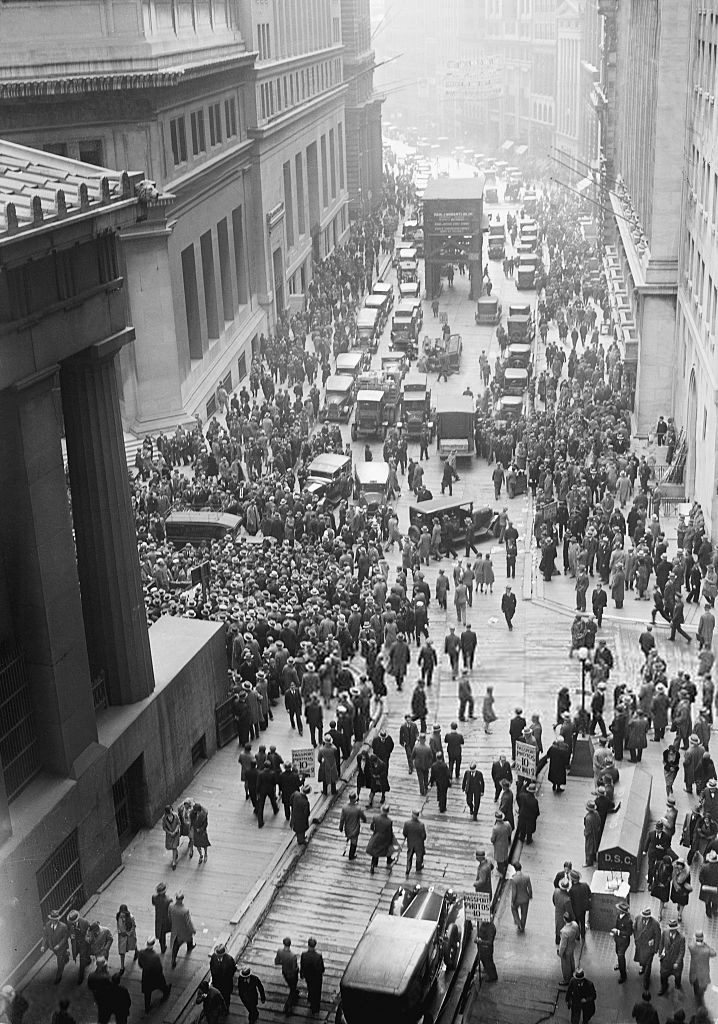
On 29 October 1929 — Black Tuesday — the New York Stock Exchange suffered the most devastating day in its history, and the Roaring Twenties ended in a roar of ticker tape. Through the decade the market had climbed almost without pause: the Dow Jones Industrial Average rose from 63 in 1921 to a peak of 381 in September 1929, and share ownership had spread far beyond Wall Street to millions of ordinary Americans, many buying on margin — with borrowed money — in the belief that prices could only rise. In the autumn of 1929 the belief began to crack. Prices slid through October, and on Thursday 24 October, 'Black Thursday', panic selling was only steadied when a pool of leading bankers conspicuously bought shares to calm the market.
The calm lasted one weekend. On Monday 28 October the market fell again, by about 12.8 per cent, and on Tuesday the 29th the dam broke. From the opening bell the selling was frantic and indiscriminate: great blocks of stock were dumped at whatever price they would fetch, the ticker tape ran hours behind the trading it was supposed to report, and by the close a record figure of some 16.4 million shares had changed hands — a volume that overwhelmed the exchange's machinery. The Dow fell about 11.7 per cent on the day, 30.57 points, to close at 230.07. The value wiped out on Black Tuesday alone has been put at around $14 billion; across the weeks of the crash, losses are estimated by some reckonings at $25 billion to $30 billion.
Outside the exchange, crowds gathered in the street in a strange quiet, watching the windows for news. Inside, brokers and clerks worked around the clock for days, trying to process the avalanche of sell orders and margin calls; fortunes assembled over a decade were extinguished in hours, and men who had been rich on paper in September owed their brokers money in November. Legend later filled the sidewalks with jumping stockbrokers — in fact, as the figures show, suicides in New York did not rise in the crash's aftermath — but the true damage was slower and wider: shattered confidence, ruined savers, and a banking system left dangerously exposed.
The crash did not, by itself, cause the Great Depression: that catastrophe was built over the following three years by bank failures, collapsing demand, drought and policy error. But Black Tuesday was its unmistakable overture — the day the era's faith in permanent prosperity visibly died. The market would not regain its 1929 peak for a quarter of a century, and the disaster set in motion the reforms that still govern American finance, from federal securities regulation to deposit insurance. Every crash since, in 1987, in 2008 and beyond, has been measured against the standard set on 29 October 1929.
Why this date matters
October 29 is famous for an ending, but its deeper pattern is beginnings disguised inside the noise. A republic was proclaimed in Ankara on it in 1923, on the ruins of an empire; the internet's first word — the accidental 'lo' of a crashed login — was spoken on it in 1969; and in 1998 a 77-year-old man flew into orbit on it, beginning the age of the elderly astronaut. Even the day's great catastrophe was, in time, a beginning: of the Depression, yes, but also of the regulated financial order that replaced the casino of the twenties. Prague heard Don Giovanni for the first time on this date in 1787. Endings get the headlines; 29 October keeps quietly starting things.
Sources
- Encyclopaedia Britannica — On This Day: October 29
- HISTORY — What Happened on October 29
- Digital History (University of Houston) — The Stock Market Crash of 1929
- Encyclopaedia Britannica — Turkey: Declaration of the Turkish Republic
- Historic Royal Palaces — Sir Walter Raleigh
- NewsNation — October 29 in History: Black Tuesday, ARPANET and Turkey
- Wikimedia — On This Day feed: October 29
The facts on this page were checked against these sources on 19 November 2026. The History Trail's permanent pages are researched and written for this site; the live profiles elsewhere on The History Trail are assembled automatically from Wikipedia and Wikidata.
About the Author
Researched and written by the The History Trail Editorial Team — the accountable editorial function behind this site's permanent story pages. The team works from the published sources cited on each page; it does not invent historians, reviewers or credentials, and it corrects errors openly.
Fact Check
Every load-bearing fact on this page traces to one of the sources listed above, and significant claims link to their source in the text. Our checking method is described on the methodology page; errors can be reported via the corrections page.
Sources & Citations
Cite this page as: The History Trail Editorial Team, The History Trail — this article's title, publication and update dates are shown beneath its headline. The full source list appears under Sources above; the site's source standards are on the sources page.