
Years
1975 in History
1975 is remembered for 30 April, when North Vietnamese forces captured Saigon, South Vietnam's president surrendered unconditionally and the Vietnam War ended. Around that ending came beginnings: Bill Gates and Paul Allen founded Microsoft on 4 April, an American Apollo and a Soviet Soyuz docked in orbit in July, and in November the death of General Franco opened Spain's road to democracy.
At a Glance
- Defining event
- The fall of Saigon, 30 April — the Vietnam War ends
- Cambodia
- Phnom Penh falls to the Khmer Rouge, 17 April; the ensuing genocide kills an estimated 1.7 million people
- Founded
- Microsoft, founded 4 April in Albuquerque by Bill Gates and Paul Allen
- Space détente
- Apollo–Soyuz docking, 17 July — the first joint U.S.–Soviet space mission
- Spain
- General Franco dies, 20 November, after 36 years as dictator
- Culture
- Jaws invents the summer blockbuster; Bohemian Rhapsody is released on 31 October
The defining story: the fall of Saigon
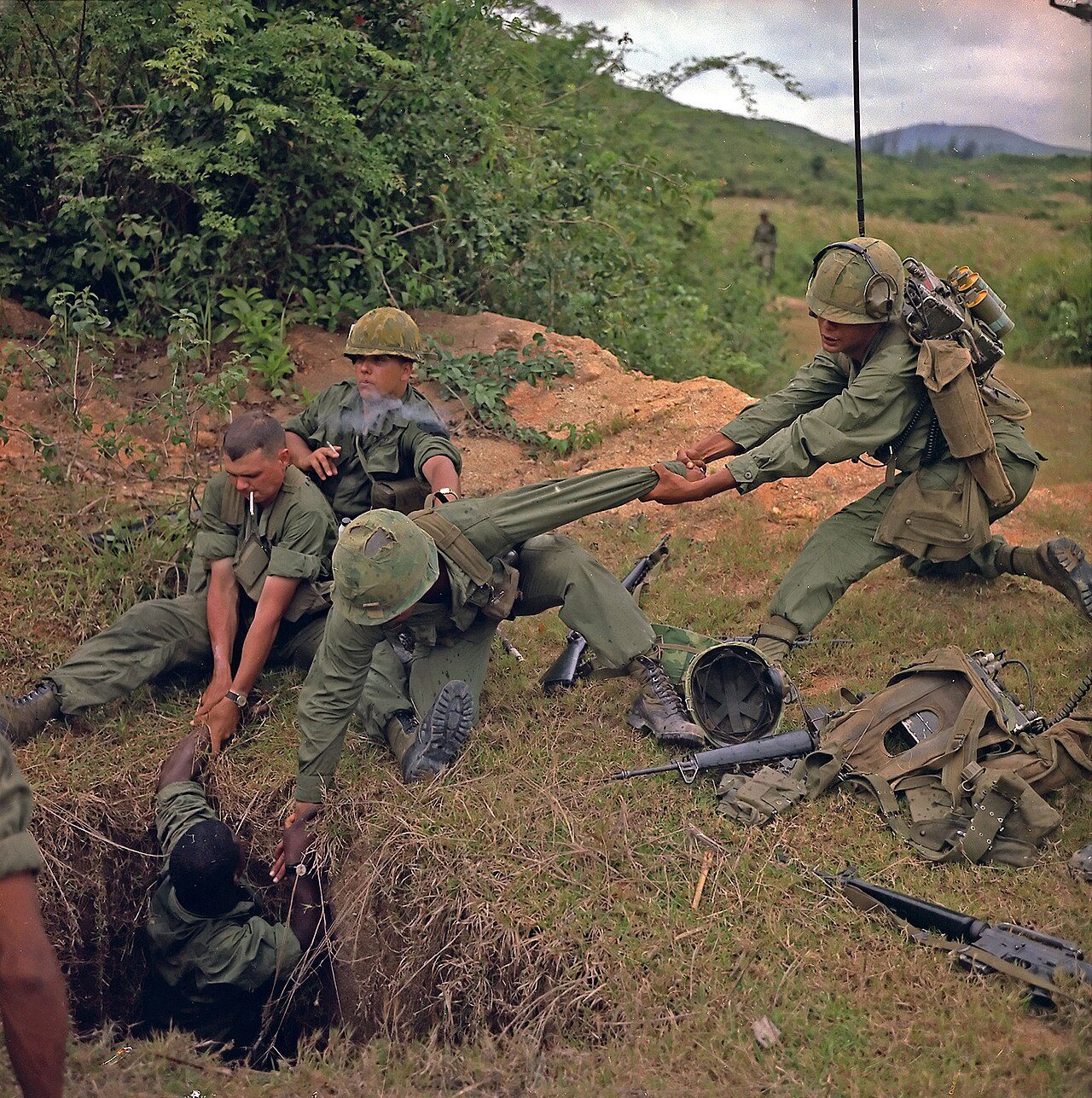
The war that had dominated a generation ended in a fortnight. On 17 April Phnom Penh fell to the Khmer Rouge, and the evacuation of Cambodia's capital began a genocide that killed an estimated 1.7 million people. Thirteen days later, on 30 April, North Vietnamese forces captured Saigon; South Vietnam's president surrendered unconditionally, and the Vietnam War — the conflict that had grown out of French colonial rule, become a central Cold War struggle and divided the United States more deeply than any war of its century — was over. North Vietnam's aim since defeating France in 1954, to unify the country under a single communist regime, had been achieved by invasion two years after American combat troops went home.
The ending had been prepared by the Paris Peace Accords of January 1973, which withdrew the United States but left the two Vietnams facing each other. When the northern offensive came in 1975 the southern state collapsed with a speed that stunned its former allies. In Vietnam the conflict is called the American War, in full the Resistance War Against America; by its official estimate, released in 1995, as many as two million civilians on both sides and some 1.1 million North Vietnamese and Viet Cong fighters died in the wider war, alongside more than 58,200 Americans. The fall of Saigon fixed the war's final image and its lesson: a superpower could be defeated by endurance.
Yet 1975 was also a year of deliberate bridge-building. On 5 June the Suez Canal reopened to shipping for the first time since the Six-Day War closed it eight years earlier. On 17 July an American Apollo capsule and a Soviet Soyuz docked in orbit — the first joint U.S.–Soviet space mission, sealed with a handshake in space at the height of détente. On 1 August the Helsinki Final Act was signed by the United States, the Soviet Union and the nations of Europe. And in Spain the old order literally died: Prince Juan Carlos became acting head of state on 30 October as Franco's health failed, and on 20 November Franco was dead, 36 years a dictator, his death opening Spain's transition to democracy.
The future was being founded in quieter rooms. On 4 April, in Albuquerque, New Mexico, Bill Gates and Paul Allen founded Microsoft to sell software for the new personal computers — beginning with a BASIC interpreter for the Altair 8800, the kit microcomputer on the January cover of Popular Electronics. The company's name joined microcomputer and software, and its later nonexclusive licence to supply MS-DOS for the IBM PC would move the industry's centre of gravity from the machine to the program every machine shared. The same season, Junko Tabei became the first woman to summit Everest on 16 May, Jaws invented the summer blockbuster on 20 June, and NASA launched Viking 1 toward Mars on 20 August.
Timeline of 1975
- 11 February
Margaret Thatcher is elected leader of Britain's Conservative Party, the first woman to lead a major British political party.
- 25 March
King Faisal of Saudi Arabia is assassinated in Riyadh by his nephew, Prince Faisal bin Musaid.
- 4 April
Bill Gates and Paul Allen found Microsoft in Albuquerque, New Mexico.
- 17 April
Phnom Penh falls to the Khmer Rouge; the evacuation begins the Cambodian genocide.
- 30 April
North Vietnamese forces capture Saigon; South Vietnam surrenders unconditionally and the Vietnam War ends.
- 16 May
Junko Tabei becomes the first woman to summit Mount Everest.
- 5 June
The Suez Canal reopens to shipping for the first time since it was closed eight years earlier.
- 20 June
Jaws opens in American cinemas and invents the summer blockbuster.
- 5 July
Arthur Ashe defeats Jimmy Connors to win Wimbledon, the first Black man to win the men's singles title.
- 17 July
An American Apollo capsule and a Soviet Soyuz dock in orbit, the first joint U.S.–Soviet space mission.
- 1 August
The Helsinki Final Act is signed by the United States, the Soviet Union and the nations of Europe.
- 1 October
Muhammad Ali defeats Joe Frazier in the Thrilla in Manila, stopped after fourteen rounds.
- 31 October
Queen release Bohemian Rhapsody, a six-minute suite with no chorus, as a single.
- 20 November
Francisco Franco, dictator of Spain for 36 years, dies; his death opens Spain's transition to democracy.
Why 1975 still matters
Saigon's fall closed the Indochina wars and set the terms of American caution for a generation: the fear of another Vietnam shaped every later debate about intervention, while Vietnam itself was unified under the government in Hanoi. Cambodia's catastrophe, begun the same month, stands as the year's darkest warning — the Khmer Rouge's genocide killed an estimated 1.7 million people before Vietnamese forces overthrew the regime in 1979. The Helsinki Final Act, signed that August, gave dissidents across Eastern Europe a text to cite against their own governments, an unintended consequence that worked slowly until 1989.
Spain showed the other road out of dictatorship: Franco's death in November began a negotiated transition to democracy rather than a collapse, with Juan Carlos, who had taken over as acting head of state in October, at its centre. Papua New Guinea, São Tomé and Príncipe and Suriname all became independent in 1975 as the last European empires wound down, and the Suez Canal's reopening restored the world's great shipping shortcut after eight years.
And the year's smallest founding may prove its largest. Microsoft, started by two friends to sell one small program for one hobbyist machine, became within twenty years the supplier of the software on nearly every personal computer — the personal computer's centre of gravity moved from machine to program in an Albuquerque office in April 1975. Between Saigon and Microsoft, the year holds the century in miniature: an old war ending in defeat, and a new industry beginning in obscurity. On 22 October the Soviet probe Venera 9 landed on Venus and sent back the first photographs taken from the surface of another planet — a first as striking, in its way, as the handshake in orbit three months earlier.
1975 on The History Trail
No single day owns 1975 on The History Trail, so its key dates and three of its permanent story pages are gathered here.
- April 30 in History — Saigon falls to North Vietnamese forces and the Vietnam War ends.
- April 4 in History — Bill Gates and Paul Allen found Microsoft in Albuquerque.
- April 17 in History — Phnom Penh falls to the Khmer Rouge and the Cambodian genocide begins.
- July 17 in History — Apollo and Soyuz dock in orbit — the first joint U.S.–Soviet space mission.
- November 20 in History — Franco dies in Spain, opening the transition to democracy.
- Microsoft — Founded on 4 April 1975 to sell BASIC for the Altair 8800.
- Bohemian Rhapsody — Queen's six-minute single of 31 October 1975, Christmas number one that year.
- Vietnam War — From Dien Bien Phu to the fall of Saigon on 30 April 1975.
Sources
- Encyclopaedia Britannica — On This Day: February 11
- HISTORY — What Happened on April 4
- Encyclopaedia Britannica — On This Day: April 17
- Encyclopaedia Britannica — On This Day: April 30
- Encyclopaedia Britannica — On This Day: June 20
- Encyclopaedia Britannica — On This Day: July 17
The facts on this page were checked against these sources on 19 November 2026. The History Trail's permanent pages are researched and written for this site; the live profiles elsewhere on The History Trail are assembled automatically from Wikipedia and Wikidata.
About the Author
Researched and written by the The History Trail Editorial Team — the accountable editorial function behind this site's permanent story pages. The team works from the published sources cited on each page; it does not invent historians, reviewers or credentials, and it corrects errors openly.
Fact Check
Every load-bearing fact on this page traces to one of the sources listed above, and significant claims link to their source in the text. Our checking method is described on the methodology page; errors can be reported via the corrections page.
Sources & Citations
Cite this page as: The History Trail Editorial Team, The History Trail — this article's title, publication and update dates are shown beneath its headline. The full source list appears under Sources above; the site's source standards are on the sources page.