
Years
1969 in History
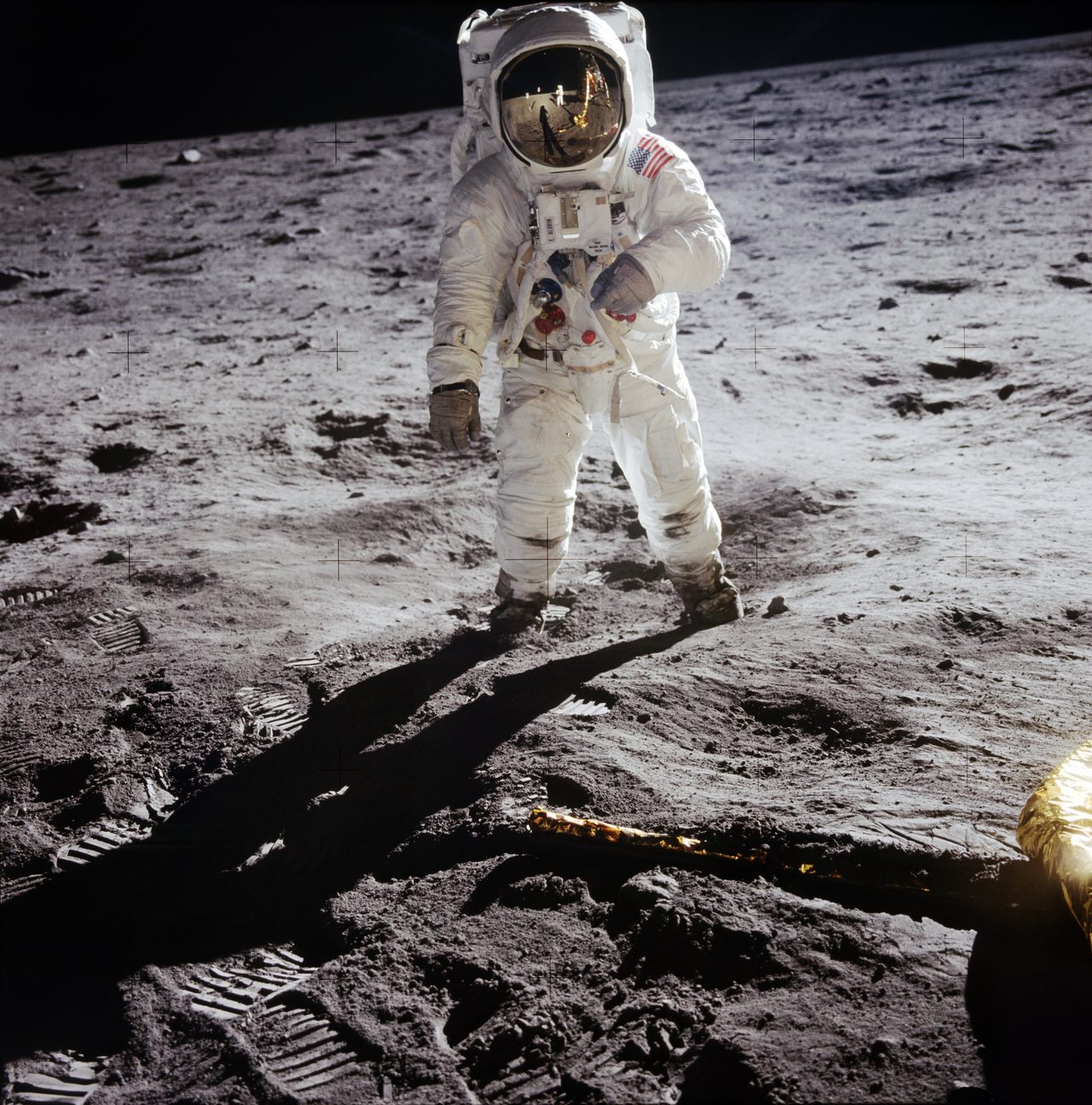
1969 is remembered above all for 20 July, when Apollo 11's Eagle landed in the Sea of Tranquility and Neil Armstrong and Buzz Aldrin became the first people to walk on the Moon. But the same year sent the first message on the network that became the Internet, saw the Stonewall uprising ignite the modern gay rights movement, and gathered hundreds of thousands at Woodstock.
At a Glance
- Defining event
- Apollo 11 Moon landing, 20 July 1969 — Armstrong and Aldrin walk on the Moon
- Crew
- Neil Armstrong, Buzz Aldrin, and Michael Collins in orbit
- The other network
- First ARPANET host-to-host message, 29 October — it crashed after two letters, 'lo'
- Movement begins
- Stonewall uprising in New York, 28 June, ignites the modern gay rights movement
- Opened the year
- Richard Nixon takes office on 20 January promising an 'era of negotiation'
- Closed the year
- Apollo 12 makes the second crewed Moon landing in November
The defining story: one small step
Apollo 11 was the answer to a deadline set eight years earlier, when President John F. Kennedy asked the United States to land a man on the Moon and return him safely before the decade ended. The rehearsals came in quick succession: Apollo 8 had circled the Moon at Christmas 1968, and on 18 May 1969 Apollo 10 launched on the full dress rehearsal, flying its lunar module to within reach of the surface without landing. Richard Nixon, inaugurated on 20 January promising an era of negotiation after a period of confrontation, inherited the programme at its climax, with the Vietnam War still raging and the memory of 1968's assassinations fresh.
On 16 July a Saturn V lifted off from Cape Kennedy carrying commander Neil Armstrong, lunar module pilot Buzz Aldrin and command module pilot Michael Collins. On 19 July Apollo 11 entered lunar orbit. The next day Armstrong and Aldrin descended in the lunar module Eagle and touched down in the Sea of Tranquility, and at 02:56 UTC on 21 July — still 20 July in the Americas — Armstrong stepped onto the surface, followed by Aldrin, while Collins kept station alone in orbit. For just over two hours the two men worked on the Moon, watched live by hundreds of millions of people on Earth.
On 24 July the crew splashed down safely in the Pacific, and on 13 August New York gave the astronauts a ticker-tape parade, the first celebration of the crew that had landed three weeks earlier. In November Apollo 12 lifted off for the second crewed landing, crewed by Conrad, Gordon and Bean, proving the first landing was a capability and not a fluke. Kennedy's deadline had been met with five months to spare, at the end of a decade that had begun with the first human spaceflight by a rival power.
The Moon landing shared its year with beginnings that proved just as durable, if quieter. On 7 April RFC 1, the first Request for Comments document of the ARPANET project, was published — a date sometimes kept as the symbolic birthday of the Internet — and on 29 October a UCLA student, Charley Kline, attempted the first host-to-host message, trying to type 'login' to a computer at Stanford Research Institute before the system crashed after two letters: 'lo'. Between those dates came Stonewall, Woodstock, the Beatles' last public performance on a London rooftop on 30 January, and their Abbey Road photograph on 8 August — a year in which the future arrived in several directions at once.
Timeline of 1969
- 20 January
Richard Nixon takes office, promising an 'era of negotiation' after a period of confrontation.
- 30 January
The Beatles perform in public together for the last time, on the roof of their Apple Corps headquarters in London.
- 17 March
Golda Meir becomes prime minister of Israel, the country's first woman to hold the office.
- 7 April
RFC 1, the first Request for Comments document of the ARPANET project, is published.
- 18 May
Apollo 10 launches on the dress rehearsal for the Moon landing.
- 22 June
The polluted Cuyahoga River in Cleveland catches fire, an image that helps drive the American environmental movement.
- 28 June
Patrons of the Stonewall Inn in New York fight back against a police raid, igniting the modern gay rights movement.
- 16 July
Apollo 11 launches from Cape Kennedy, carrying Armstrong, Aldrin and Collins toward the first Moon landing.
- 20 July
Apollo 11's Eagle lands on the Moon; Armstrong steps onto the surface at 02:56 UTC on 21 July, still 20 July in the Americas.
- 24 July
Apollo 11 splashes down in the Pacific, bringing the crew safely home from the first Moon landing.
- 15 August
The Woodstock music festival opens on a farm in Bethel, New York, drawing hundreds of thousands for three days of music.
- 2 September
America's first automatic teller machine opens to the public in Rockville Centre, New York.
- 29 October
The first host-to-host message is sent on ARPANET; the system crashes after two letters, 'lo'.
- 14 November
Apollo 12 lifts off for the second crewed landing on the Moon.
Why 1969 still matters
The Moon landing remains the benchmark of what organised effort can do: the first time human beings stood on another world, achieved not by a lone hero but by a vast workforce whose work converged on one July afternoon. It closed the Space Race's central contest and fixed the image of the century — a man in a white suit on grey dust, photographed by the only other person there, with his commander reflected in his gold visor. Twelve astronauts would walk on the Moon by 1972; none has returned since Apollo 17, which is why 1969 still stands alone.
The year's quieter firsts compounded more slowly but reached further. ARPANET's two-letter message began the network of networks that now carries daily life, and its open, request-for-comments method of building became a culture as much as a technology. Stonewall turned a police raid into a movement whose marches still fill the same streets each June. The Cuyahoga River fire helped drive the environmental movement that reshaped American law in the following decade, and the first cash machine in Rockville Centre began the automation of ordinary banking.
Even the year's culture marked endings as well as beginnings: the Beatles played together in public for the last time in January and were photographed crossing Abbey Road in August, while Woodstock gathered the counterculture at its peak and its limit. 1969 is therefore remembered in two registers at once — the species leaving its planet for the first time, and a generation at home discovering new ways to organise, protest, listen and connect. Sesame Street, first broadcast on 10 November, remade children's education as entertainment — a quieter 1969 first whose daily reach soon outlasted Apollo's.
1969 on The History Trail
Apollo dominates this year on The History Trail, but its network and protest stories are here too.
- July 20 in History — Apollo 11 lands on the Moon — the featured story of the century's defining voyage.
- July 16 in History — Apollo 11 launches from Cape Kennedy toward the first Moon landing.
- June 28 in History — The Stonewall uprising in New York ignites the modern gay rights movement.
- August 15 in History — The Woodstock festival opens on a farm in Bethel, New York.
- October 29 in History — The first ARPANET host-to-host message is attempted — and crashes after 'lo'.
- November 10 in History — Sesame Street is broadcast for the first time on American television.
- The Internet: A Network of Networks, Built in the Open — How the 1969 ARPANET experiment grew into the network of networks.
- NASA — The agency that flew Apollo 11 to the Moon.
Sources
- HISTORY — What Happened on January 20
- Encyclopaedia Britannica — On This Day: January 30
- Encyclopaedia Britannica — On This Day: April 7
- Encyclopaedia Britannica — On This Day: May 18
- Encyclopaedia Britannica — On This Day: June 22
- Encyclopaedia Britannica — On This Day: June 28
The facts on this page were checked against these sources on 19 November 2026. The History Trail's permanent pages are researched and written for this site; the live profiles elsewhere on The History Trail are assembled automatically from Wikipedia and Wikidata.
About the Author
Researched and written by the The History Trail Editorial Team — the accountable editorial function behind this site's permanent story pages. The team works from the published sources cited on each page; it does not invent historians, reviewers or credentials, and it corrects errors openly.
Fact Check
Every load-bearing fact on this page traces to one of the sources listed above, and significant claims link to their source in the text. Our checking method is described on the methodology page; errors can be reported via the corrections page.
Sources & Citations
Cite this page as: The History Trail Editorial Team, The History Trail — this article's title, publication and update dates are shown beneath its headline. The full source list appears under Sources above; the site's source standards are on the sources page.