
On This Day
August 15 in History
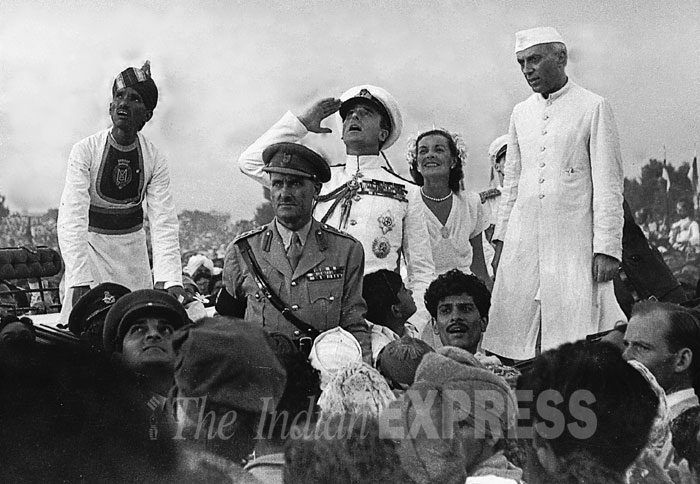
At midnight on 14–15 August 1947 India became an independent nation, as Jawaharlal Nehru told the Constituent Assembly of its 'tryst with destiny' — the end of British rule and the birth of two states, India and Pakistan, amid the largest migration in history. August 15 is also the day the Panama Canal opened, Woodstock began, and Japan heard its emperor announce the war's end.
Choose another date: open the On This Day calendar to browse events, births and deaths for any day of the year.
At a Glance
- The law
- The Indian Independence Act, given royal assent on 18 July 1947, created two dominions, India and Pakistan, effective 15 August 1947
- The moment
- Nehru's 'Tryst with Destiny' speech to the Constituent Assembly at midnight, 14–15 August
- The date
- Mountbatten chose 15 August because it was the second anniversary of Japan's surrender announcement in 1945
- The border
- The Radcliffe Line dividing India and Pakistan was not published until 17 August, two days after independence
- The cost
- Partition displaced millions of people; estimates of the dead vary widely, from several hundred thousand to a million or more
- The first leaders
- Nehru became India's first prime minister; Mountbatten stayed on as its first governor-general
Events on this day
- 1057Macbeth, king of Scotland, is killed by Malcolm Canmore at the Battle of Lumphanan — the real end of the reign Shakespeare later turned into tragedy.
- 1620The Mayflower and the Speedwell set sail from Southampton for America; the leaking Speedwell soon turns back, and the Mayflower sails on alone.
- 1914The Panama Canal opens to traffic with the passage of the SS Ancon, linking the Atlantic and Pacific oceans.
- 1945Emperor Hirohito's recorded surrender message is broadcast in Japan, the first time his subjects have heard his voice.
- 1947India becomes independent of British rule at midnight, with Jawaharlal Nehru as its first prime minister — the featured story above.
- 1948The Republic of Korea — South Korea — is proclaimed in Seoul, with Syngman Rhee as its first president.
- 1960The Republic of the Congo wins independence from France, with Brazzaville as its capital.
- 1969The Woodstock music festival opens on a farm in Bethel, New York, drawing hundreds of thousands of young people for three days of music.
- 1971Bahrain declares its independence from Britain.
- 1975The film Sholay opens in India; it becomes one of the most successful and best-loved films in Indian cinema history.
- 1979Francis Ford Coppola's Vietnam War epic Apocalypse Now is released in the United States.
- 1998A car bomb planted by the Real IRA explodes in Omagh, Northern Ireland, killing 29 people in the deadliest single attack of the Troubles.
- 2021Kabul falls to the Taliban as Afghanistan's government collapses, almost twenty years after the US-led invasion began.
Born on this day
- 1769Napoleon Bonaparte — French general who became emperor of France and redrew the map of Europe.
- 1912Julia Child — American chef and television presenter who taught America French cooking.
- 1912Wendy Hiller — English actress, an Academy Award winner for Separate Tables.
- 1924Phyllis Schlafly — American conservative activist who campaigned against the Equal Rights Amendment.
- 1972Ben Affleck — American actor and director, an Academy Award winner for Good Will Hunting and Argo.
Died on this day
- 1935Will Rogers — American humorist and actor, killed with pilot Wiley Post in a plane crash near Point Barrow, Alaska.
- 1967René Magritte — Belgian surrealist painter of The Son of Man and The Treachery of Images.
- 1975Sheikh Mujibur Rahman — founding leader of Bangladesh, assassinated with most of his family in a military coup.
- 2021Gerd Müller — German footballer 'Der Bomber', scorer of the winning goal in the 1974 World Cup final.
The featured story: India becomes independent, 15 August 1947
At the stroke of midnight on 14–15 August 1947, British rule in India ended. The legal instrument was the Indian Independence Act, which had received royal assent on 18 July 1947: it created two new dominions, India and Pakistan, and set them free of the British Parliament from 15 August. In the Constituent Assembly in New Delhi, Jawaharlal Nehru marked the hour with one of the century's famous speeches: 'Long years ago we made a tryst with destiny, and now the time comes when we shall redeem our pledge.' The last viceroy, Lord Mountbatten, stayed on briefly as independent India's first governor-general, and Nehru became its first prime minister.
The date itself was Mountbatten's choice, and a personal one: 15 August was the second anniversary of Japan's surrender in 1945, the day he had received as Allied supreme commander in South-East Asia. The timetable he set was breakneck. The frontier between the two new states — the Radcliffe Line, named for the British lawyer Cyril Radcliffe, who had never been to India before and was given a matter of weeks to draw it — was not even published until 17 August, two days after the countries it divided had come into existence. Millions of people woke up independent without knowing for certain which country they were in.
That uncertainty turned to catastrophe. Partition cut through the provinces of Punjab and Bengal, and set off one of the largest mass migrations in history: Muslims heading for Pakistan, Hindus and Sikhs heading for India, in columns that stretched for miles. The migration came with mass violence — massacres, abductions and trains arriving full of the dead. Estimates of how many died vary widely, from several hundred thousand to a million or more; millions more crossed the new borders and never went home. The joy of independence and the horror of Partition are inseparable in the memory of 15 August 1947, and the border drawn in those weeks still shapes the politics of South Asia.
The date's reach runs further still. The same 15 August had been, in 1945, the day Japan heard its emperor announce the war's end; in 1948 South Korea chose it for its own founding, exactly three years after liberation from Japanese rule. For India it remains the founding day — marked each year by the prime minister's address from the Red Fort in Delhi — the moment a civilisation-scale country of some 400 million people took its future into its own hands, in Nehru's words, as the world slept, waking 'to life and freedom' at midnight.
Why this date matters
August 15 is the great hinge of the mid-twentieth century. On it, in 1945, Asia's war ends in an emperor's recorded voice; in 1947 the British Empire's largest possession becomes free at midnight; in 1948 Korea founds its southern republic on the anniversary of its liberation. Again and again the date is chosen for beginnings that answer endings — independence days laid deliberately over surrender days. Add the Panama Canal opening a sea-road in 1914 and Woodstock opening a cultural era in 1969, and the pattern is plain: this is the day on which worlds are declared open.
Sources
- Encyclopaedia Britannica — On This Day: August 15
- HISTORY — This Day in History: August 15
- Encyclopaedia Britannica — Will Rogers
- Wikimedia — On This Day feed: August 15
The facts on this page were checked against these sources on 19 November 2026. The History Trail's permanent pages are researched and written for this site; the live profiles elsewhere on The History Trail are assembled automatically from Wikipedia and Wikidata.
About the Author
Researched and written by the The History Trail Editorial Team — the accountable editorial function behind this site's permanent story pages. The team works from the published sources cited on each page; it does not invent historians, reviewers or credentials, and it corrects errors openly.
Fact Check
Every load-bearing fact on this page traces to one of the sources listed above, and significant claims link to their source in the text. Our checking method is described on the methodology page; errors can be reported via the corrections page.
Sources & Citations
Cite this page as: The History Trail Editorial Team, The History Trail — this article's title, publication and update dates are shown beneath its headline. The full source list appears under Sources above; the site's source standards are on the sources page.