
On This Day
August 17 in History
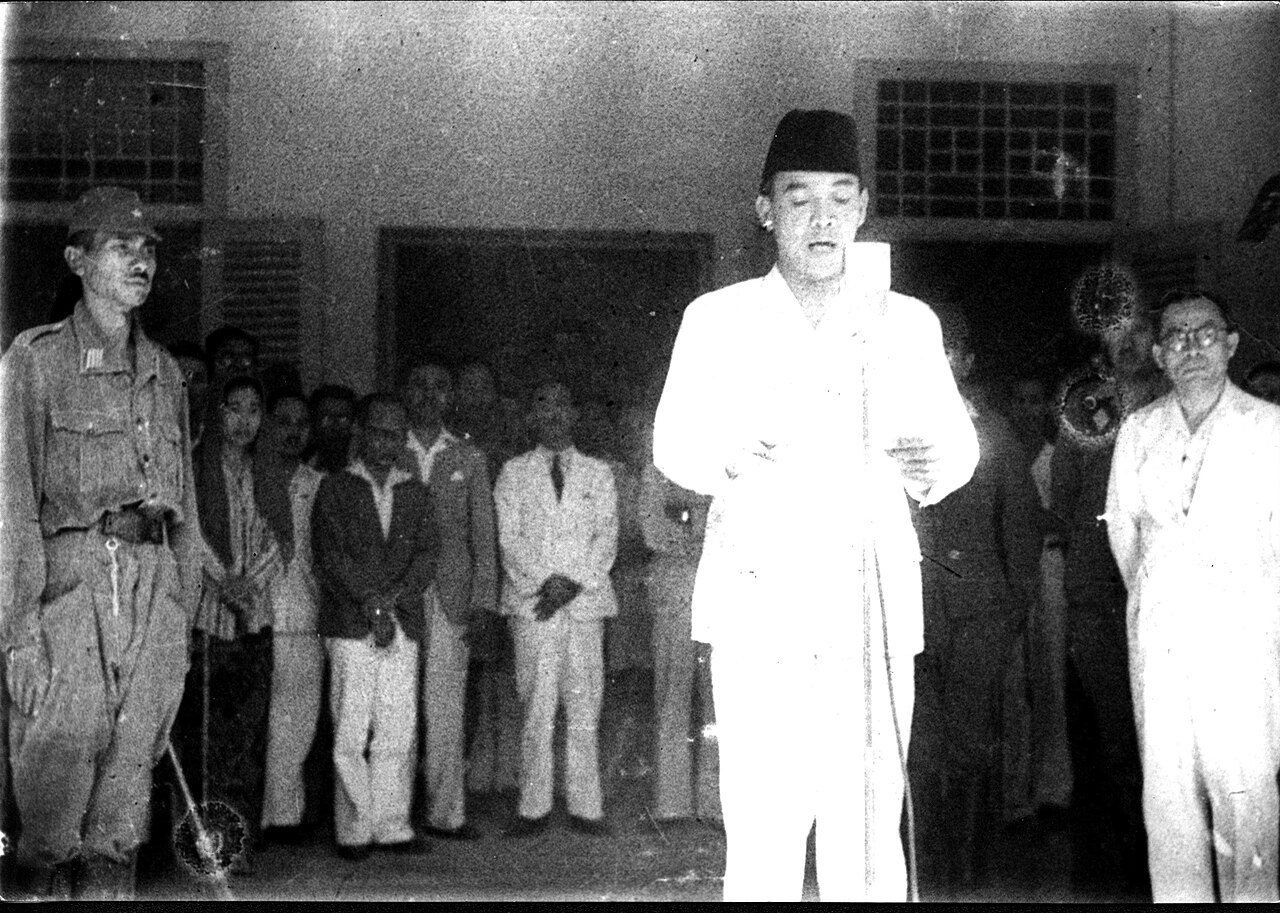
On 17 August 1945, two days after Japan's surrender announcement ended the Pacific war, Sukarno stood outside his Jakarta home and read a two-sentence proclamation: Indonesia was independent. August 17 is also the day Fulton's steamboat Clermont first steamed toward Albany, Orwell's Animal Farm was published, and Michael Phelps won his eighth gold medal of a single Olympics.
Choose another date: open the On This Day calendar to browse events, births and deaths for any day of the year.
At a Glance
- The moment
- 10 a.m., Friday 17 August 1945, at 56 Jalan Pegangsaan Timur, Jakarta
- The readers
- Sukarno read the proclamation with Mohammad Hatta beside him; the next day they became the republic's first president and vice-president
- The text
- Drafted the previous night at the home of Japanese Rear-Admiral Maeda, as Japanese rule collapsed
- The timing
- Two days after the announcement of Japan's surrender ended the Second World War in Asia
- The struggle
- The Netherlands fought to restore colonial rule; sovereignty was formally transferred only on 27 December 1949
- The recognition
- In 2023 the Netherlands recognised 17 August 1945 as Indonesia's independence day, while keeping 1949 as the date of the legal transfer
Events on this day
- 1807Robert Fulton's steamboat Clermont leaves New York for Albany, the first commercially successful steamboat voyage in America.
- 1862The US–Dakota War begins in Minnesota, a conflict sparked by broken treaties and starvation among the Dakota people.
- 1877Billy the Kid, then known as Henry Antrim, kills for the first time, shooting a blacksmith in Arizona who had bullied him.
- 1896George Carmack and Skookum Jim stake gold claims at Rabbit Creek — soon renamed Bonanza Creek — in the Yukon, setting off the Klondike Gold Rush.
- 1943General George Patton's forces reach Messina, completing the Allied conquest of Sicily ahead of the British.
- 1945Sukarno proclaims the independence of Indonesia outside his Jakarta home — the featured story above.
- 1945George Orwell's Animal Farm is published in London, his fable of a revolution betrayed.
- 1962Peter Fechter, an 18-year-old East German, is shot by border guards at the Berlin Wall and bleeds to death in full view of the West.
- 1978Three Americans complete the first crossing of the Atlantic by balloon, landing in France after setting out from Maine.
- 1998President Bill Clinton testifies before a grand jury about Monica Lewinsky, then addresses the nation on television the same evening.
- 2008Michael Phelps wins his eighth gold medal of the Beijing Olympics, the most ever won by one athlete at a single Games.
Born on this day
- 1786Davy Crockett — American frontiersman and congressman, the folk hero who died at the Alamo.
- 1887Marcus Garvey — Jamaican political leader, founder of the Universal Negro Improvement Association.
- 1911Mikhail Botvinnik — Soviet chess player, world champion and patriarch of the Soviet chess school.
- 1932V. S. Naipaul — Trinidad-born British novelist and Nobel laureate in Literature.
- 1943Robert De Niro — American actor, star of Taxi Driver and Raging Bull.
- 1960Sean Penn — American actor and director, a two-time Academy Award winner.
Died on this day
- 1786Frederick the Great — king of Prussia, dead at Sanssouci after a 46-year reign that made Prussia a great power.
- 1935Charlotte Perkins Gilman — American writer, author of 'The Yellow Wallpaper'.
- 1987Rudolf Hess — Hitler's former deputy and the last prisoner held in Spandau Prison, Berlin.
- 1988Muhammad Zia-ul-Haq — president of Pakistan, killed when his aircraft crashes near Bahawalpur in circumstances never explained.
The featured story: Indonesia proclaims independence, 17 August 1945
For more than three centuries the islands of the East Indies had been ruled from the Netherlands; since 1942 they had been occupied instead by Japan, whose empire collapsed in August 1945. When Japan's surrender was announced on 15 August, the Indonesian nationalist leaders Sukarno and Mohammad Hatta faced a moment that would not wait: the Japanese were defeated but still armed, the Dutch were certain to try to return, and no Allied forces had yet arrived to take control. Young activists, who had kidnapped the two leaders briefly to press them, demanded a proclamation at once — made by Indonesians themselves, not granted by anyone.
The text was drafted in a single night, on 16 August, in the house of a Japanese officer, Rear-Admiral Maeda, who quietly allowed the nationalists to use it and shielded the meeting. What they produced was one of the shortest founding documents in history: a declaration that the Indonesian people proclaimed their independence, and that the transfer of power would be carried out with care and in the shortest possible time. The next morning, Friday 17 August 1945, at ten o'clock, Sukarno read it aloud on the steps of his own house at 56 Jalan Pegangsaan Timur in Jakarta, with Hatta beside him and a small crowd in front of him. A photograph by Frans Mendur, one of the few taken that morning, shows the modest scene: no palace, no army, no foreign witness.
The day after, 18 August, a preparatory committee elected Sukarno president and Hatta vice-president of the Republic of Indonesia and adopted a constitution. But proclamation was not possession. The Netherlands refused to recognise the republic and fought for four years to restore its colony, in a struggle Indonesians call the National Revolution, while the republic's forces and diplomats fought back on the battlefield and at the United Nations. Only on 27 December 1949 did the Dutch formally transfer sovereignty.
Indonesia has always dated its nationhood from the morning at Pegangsaan Timur, not from the legal transfer four years later — and in 2023 the Netherlands itself recognised 17 August 1945 as Indonesia's independence day, while continuing to treat 1949 as the date sovereignty was formally handed over. The proclamation's brevity is part of its power: a whole nation's claim to exist, staked in two sentences, in a front garden, in the gap between one empire's surrender and another's return.
Why this date matters
August 17 is a date of first moves and declarations. A steamboat makes the first practical powered voyage in America; prospectors stake the claims that start a gold rush; a fable about power appears in London bookshops the same morning a nation declares itself in Jakarta. The Indonesian proclamation gives the day its centre of gravity: 17 August 1945 shows how much can be claimed in a single short statement when an empire's grip has momentarily loosened. Around it cluster the day's other themes — frontiers closing and opening, from the Dakota war to a young man dying at the Berlin Wall.
Sources
- Encyclopaedia Britannica — On This Day: August 17
- HISTORY — This Day in History: August 17
- Wikimedia — On This Day feed: August 17
- timeanddate — On This Day: August 17
The facts on this page were checked against these sources on 19 November 2026. The History Trail's permanent pages are researched and written for this site; the live profiles elsewhere on The History Trail are assembled automatically from Wikipedia and Wikidata.
About the Author
Researched and written by the The History Trail Editorial Team — the accountable editorial function behind this site's permanent story pages. The team works from the published sources cited on each page; it does not invent historians, reviewers or credentials, and it corrects errors openly.
Fact Check
Every load-bearing fact on this page traces to one of the sources listed above, and significant claims link to their source in the text. Our checking method is described on the methodology page; errors can be reported via the corrections page.
Sources & Citations
Cite this page as: The History Trail Editorial Team, The History Trail — this article's title, publication and update dates are shown beneath its headline. The full source list appears under Sources above; the site's source standards are on the sources page.