
On This Day
August 16 in History
On 16 August 1858 Queen Victoria sent the first official message down the new transatlantic telegraph cable to President James Buchanan — a telegram that crossed the ocean in hours instead of the ten days a ship needed, and announced that the Atlantic had shrunk. August 16 is also the day of the Peterloo Massacre, the deaths of Babe Ruth and Elvis Presley, and Usain Bolt's 9.58-second world record.
Choose another date: open the On This Day calendar to browse events, births and deaths for any day of the year.
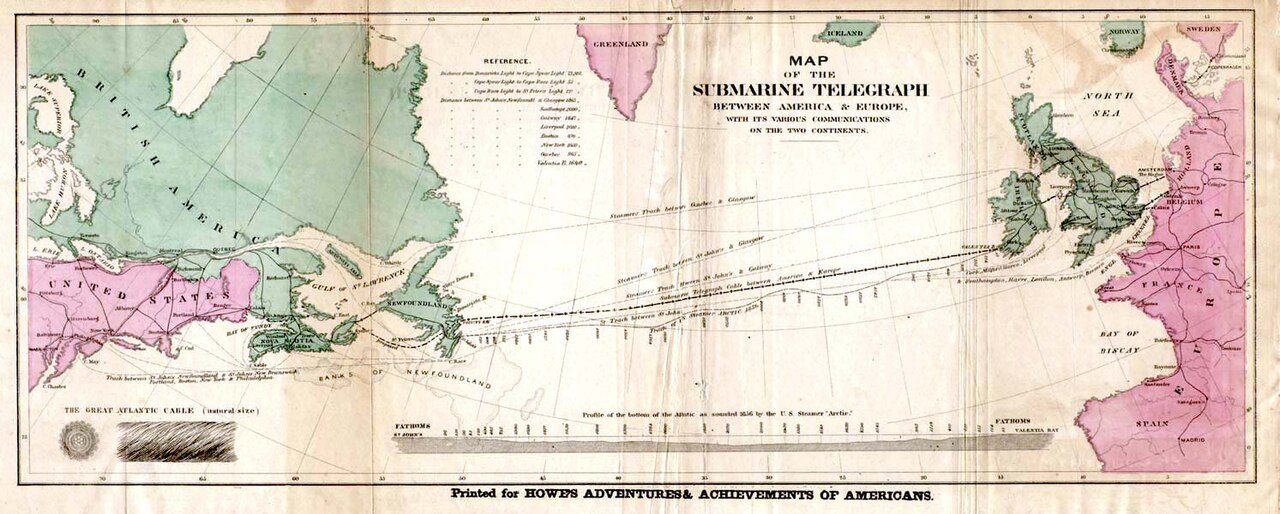
At a Glance
- The cable
- Completed on 5 August 1858 between Valentia Island, Ireland, and Trinity Bay, Newfoundland, after HMS Agamemnon and USS Niagara spliced their halves mid-ocean on 29 July
- The message
- Sent on 16 August 1858 from Queen Victoria to President James Buchanan, congratulating him 'upon the successful completion of this great international work'
- The distance
- Some 2,500 miles of cable lying on the floor of the Atlantic
- The speed
- News that had taken about ten days by ship now crossed the ocean the same day
- The failure
- The cable died within weeks — it had effectively failed by 1 September 1858 — after excessive voltage damaged its insulation
- The sequel
- A durable transatlantic telegraph cable was not laid until 1866
Events on this day
- 1812American forces under William Hull surrender Fort Detroit to the British without a serious fight, a humiliation for the young United States in the War of 1812.
- 1819At St Peter's Field, Manchester, cavalry charge a peaceful crowd demanding parliamentary reform; the Peterloo Massacre leaves more than a dozen dead and hundreds injured.
- 1858Queen Victoria sends the first official message through the new transatlantic telegraph cable to President Buchanan — the featured story above.
- 1920Cleveland Indians shortstop Ray Chapman is hit in the head by a pitch; he dies the next day, the only major league player killed by a pitch.
- 1954The first issue of Sports Illustrated magazine is published in the United States.
- 1960Cyprus becomes an independent republic, ending British colonial rule of the island.
- 1987Northwest Airlines Flight 255 crashes on takeoff from Detroit; 156 people are killed and the only survivor is a four-year-old girl.
- 1996Leonel Fernández is sworn in as president of the Dominican Republic.
- 2009Usain Bolt runs the 100 metres in 9.58 seconds at the World Championships in Berlin, a world record that still stands.
Born on this day
- 1888T. E. Lawrence — British officer and writer, 'Lawrence of Arabia', author of Seven Pillars of Wisdom.
- 1913Menachem Begin — Israeli prime minister who signed the Camp David peace agreement with Egypt.
- 1954James Cameron — Canadian film director of Titanic and Avatar.
- 1958Madonna — American singer, the best-selling female recording artist of all time.
Died on this day
- 1948Babe Ruth — American baseball legend, dead of cancer in New York at 53.
- 1949Margaret Mitchell — author of Gone with the Wind, dead in Atlanta days after being struck by a car.
- 1977Elvis Presley — the 'King of Rock and Roll', found dead at Graceland in Memphis, aged 42.
- 2003Idi Amin — former Ugandan dictator, dead in exile in Saudi Arabia.
- 2018Aretha Franklin — the 'Queen of Soul', dead in Detroit at 76.
The featured story: the first transatlantic telegraph message, 16 August 1858
Until 1858, a message could cross the Atlantic no faster than a ship — about ten days on a good passage. News of wars, markets and elections arrived in America stale, and replies took as long again. The telegraph had already bound together the towns of Britain and America by wire; the obvious, audacious next step was to lay a cable under the ocean itself, some 2,500 miles of it, between Ireland and Newfoundland. An American-backed project took up the challenge, and in the summer of 1858 two warships lent by the two governments — HMS Agamemnon and USS Niagara — each carrying half the cable, met in mid-Atlantic and spliced their halves together on 29 July.
The splice held. On 5 August 1858 the cable was complete, running from Valentia Island in Ireland to Trinity Bay in Newfoundland, and the two shores of the Atlantic were connected by wire for the first time in history. There were celebrations on both sides — fireworks, sermons, editorials about the annihilation of distance. The cable was fragile and its signals faint, but it worked, and the world waited for the formal first exchange between the two heads of state.
It came on 16 August 1858, when Queen Victoria sent a message to President James Buchanan down the line, congratulating him, in the surviving text, 'upon the successful completion of this great international work'. Buchanan replied in kind. The exchange was reported everywhere as a wonder: words had crossed the ocean not in days but within the day, travelling along a wire lying in darkness two miles beneath the waves. For a few weeks, the Atlantic had effectively ceased to exist as a barrier to news.
Then the miracle failed. The cable's signals weakened, garbled and finally died — by 1 September 1858, barely a month after completion, it had effectively ceased to work. The project's chief engineer had driven ever-higher voltages through the line to force the faint signals through, cooking the cable's insulation in the process. It took eight more years, a far larger ship and the hard lessons of 1858 — above all, gentler voltages and better insulation — before a durable transatlantic cable was laid in 1866, and that one stayed in service for years. But 16 August 1858 remains the birthday of instant intercontinental communication — the first day the ocean shrank.
Why this date matters
August 16 is a day of signals and sudden silences. Its proudest moment is a message crossing an ocean in 1858 — communication itself becoming instant — and its saddest are the abrupt endings of voices everyone knew: Babe Ruth in 1948, Elvis Presley in 1977, Aretha Franklin in 2018, three American icons gone on the same date. Between those poles sit a massacre of reformers at Peterloo in 1819, the launch of Sports Illustrated in 1954, and a Jamaican sprinter in 2009 running the 100 metres faster than anyone in recorded history. The date's character is compression: news, fame and life itself all moving faster than they did the day before.
Sources
- Encyclopaedia Britannica — On This Day: August 16
- HISTORY — This Day in History: August 16
- Science Museum — Sending messages across the Atlantic
- Wikimedia — On This Day feed: August 16
The facts on this page were checked against these sources on 19 November 2026. The History Trail's permanent pages are researched and written for this site; the live profiles elsewhere on The History Trail are assembled automatically from Wikipedia and Wikidata.
About the Author
Researched and written by the The History Trail Editorial Team — the accountable editorial function behind this site's permanent story pages. The team works from the published sources cited on each page; it does not invent historians, reviewers or credentials, and it corrects errors openly.
Fact Check
Every load-bearing fact on this page traces to one of the sources listed above, and significant claims link to their source in the text. Our checking method is described on the methodology page; errors can be reported via the corrections page.
Sources & Citations
Cite this page as: The History Trail Editorial Team, The History Trail — this article's title, publication and update dates are shown beneath its headline. The full source list appears under Sources above; the site's source standards are on the sources page.