
Years
1950 in History
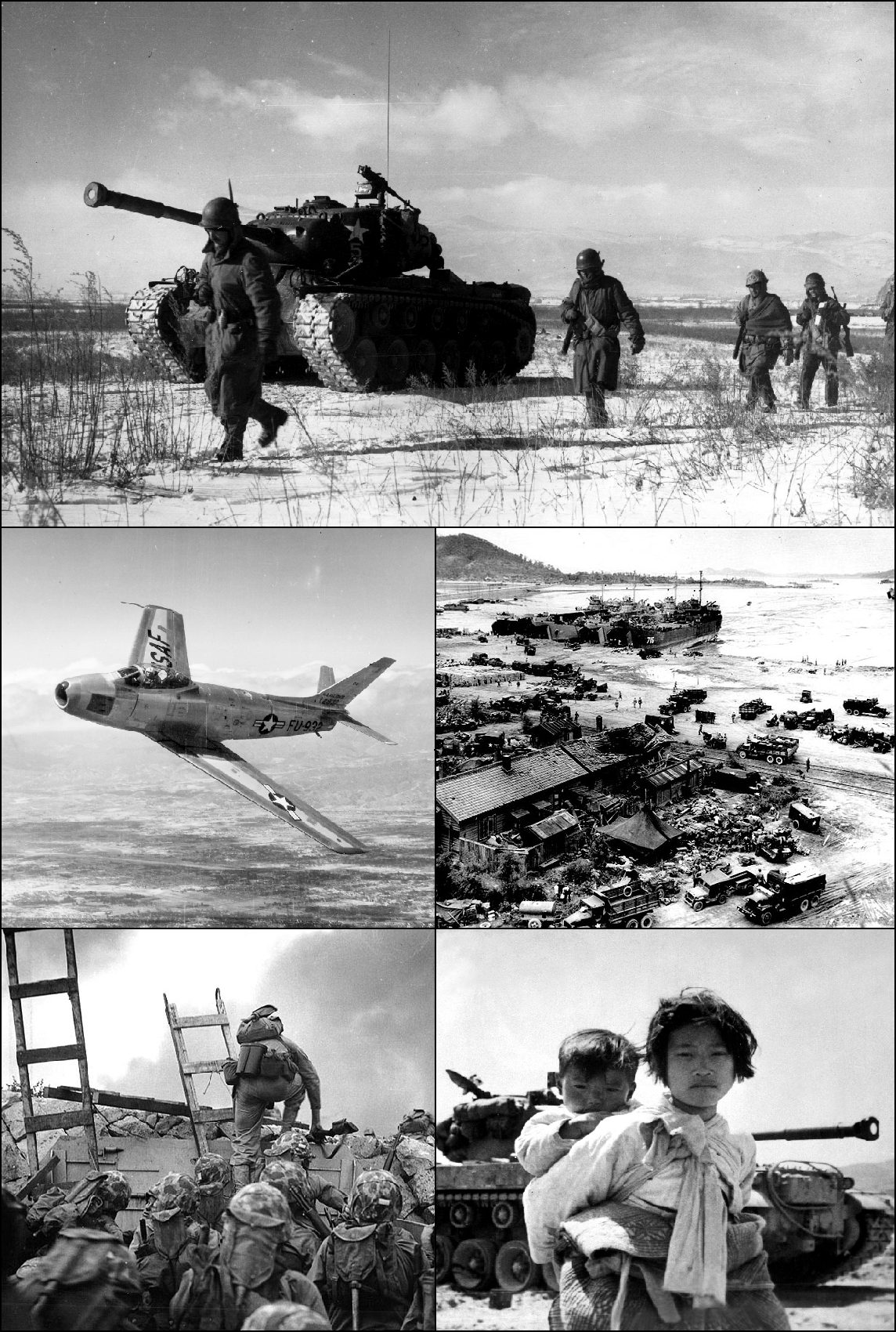
1950 is the year the Cold War turned hot. In June, North Korea invaded the South across the 38th parallel, and a United Nations coalition led by the United States fought back, beginning a war that ended in armistice rather than peace. The same year made India a republic, launched European integration with the Schuman Declaration, and saw President Truman order the development of the hydrogen bomb.
At a Glance
- Defining event
- The Korean War begins on 25 June, when North Korea invades South Korea across the 38th parallel
- Opened the year
- The Republic of India is born on 26 January, with Rajendra Prasad as its first president
- Europe's founding act
- The Schuman Declaration of 9 May proposes pooling French and West German coal and steel
- Arms race
- President Truman publicly orders development of the hydrogen bomb on 31 January
- The empty chair
- The Soviet Union boycotts the UN Security Council from 13 January, leaving the West a free hand over Korea
- Closed the year
- Truman declares a national emergency on 16 December as the war turns against UN forces after China's intervention
The defining story: the Korean War begins
The year opened with the Cold War's pieces being locked into place. On 13 January the Soviet Union began boycotting the UN Security Council over its refusal to seat Communist China — an absence that would matter enormously within six months. On 21 January Alger Hiss, the former US State Department official, was convicted of perjury in the era's defining espionage case; the same day, George Orwell died of tuberculosis at 46, leaving Animal Farm and Nineteen Eighty-Four as the age's warnings. On 26 January the Constitution of India took effect and the Republic of India was born, with Rajendra Prasad as its first president — the date chosen to honour the Purna Swaraj declaration of 26 January 1930. Four days later President Truman publicly ordered the development of the hydrogen bomb, escalating the arms race.
February tightened the screws on both sides. On 2 February Klaus Fuchs, a physicist who had worked on the atomic bomb, was arrested in Britain for passing secrets to the Soviet Union. On 8 February East Germany created the Stasi, the Ministry for State Security, which became one of history's most pervasive secret police forces. On 14 February the Soviet Union and the People's Republic of China signed a treaty of friendship, alliance and mutual assistance in Moscow, aligning the two great communist powers.
Against that hardening, one man proposed the opposite. On 9 May, French foreign minister Robert Schuman proposed that French and West German coal and steel be pooled under a common authority — the founding act of European integration, drafted behind the scenes by Jean Monnet. Its purpose, in the declaration's words, was to make war between France and Germany not merely unthinkable but materially impossible. Five days into a decade that would be defined by division, Europe had chosen to bind its old enemies' war industries together.
Asia chose the other path. On 25 June North Korean forces invaded South Korea across the 38th parallel. Because the Soviet Union was boycotting the Security Council, the United Nations could authorise a coalition to resist, and on 27 June Truman ordered United States air and naval forces to help the South. On 15 September US and South Korean forces landed at Inchon, a daring amphibious stroke that reversed the war's course within weeks. But China's intervention then drove UN forces back, and on 16 December Truman declared a national emergency. The war would run for three years, to an armistice that left Korea divided near the line where it started.
Timeline of 1950
- 13 January
The Soviet Union boycotts the UN Security Council over its refusal to seat Communist China.
- 21 January
George Orwell, author of Animal Farm and Nineteen Eighty-Four, dies of tuberculosis at 46.
- 26 January
The Constitution of India takes effect and the Republic of India is born.
- 31 January
President Truman publicly orders the development of the hydrogen bomb.
- 2 February
Klaus Fuchs, a physicist who worked on the atomic bomb, is arrested in Britain for spying for the Soviet Union.
- 8 February
East Germany creates the Stasi, the Ministry for State Security.
- 14 February
The Soviet Union and the People's Republic of China sign a treaty of friendship and alliance in Moscow.
- 9 May
Robert Schuman reads his declaration in Paris, proposing a common authority for French and West German coal and steel.
- 13 May
The first Formula One World Championship race is held at Silverstone, won by Giuseppe Farina for Alfa Romeo.
- 25 June
North Korea invades South Korea across the 38th parallel, beginning the Korean War.
- 27 June
President Truman orders United States air and naval forces to help South Korea.
- 15 September
US and South Korean forces land at Inchon, reversing the Korean War's course within weeks.
- 7 October
Mother Teresa founds the Missionaries of Charity in Kolkata to serve 'the poorest of the poor'.
- 16 December
President Truman declares a national emergency as the Korean War turns against UN forces after China's intervention.
Why 1950 still matters
Korea is 1950's unfinished business. The war that began on 25 June ran for three years and ended with an armistice on 27 July 1953 — never a peace treaty — near the line where it had started, and the peninsula's division, proclaimed in 1948 and fought over from 1950, remains in place. The on-site record puts the cost at millions of Korean civilians and an estimated 1.5 million or more soldiers of all armies. The war also proved the United Nations could authorise collective defence — though only, as the record notes, because the Soviet Union's boycott left its chair empty when the votes were taken.
The year's other founding has had the happier sequel. The Schuman Declaration led within a year to the Treaty of Paris and the European Coal and Steel Community of six nations, the ancestor of the European Union, and 9 May is still kept as Europe Day. India's republic, meanwhile, began with what the record calls the world's longest constitution, at 395 articles, and the republic proclaimed that January still stands on that foundation.
The darker threads also ran forward. Truman's hydrogen bomb order pushed the arms race toward weapons of an entirely new scale, and the espionage cases of Hiss and Fuchs fed the suspicion that defined the decade's politics in the West. Nineteen-fifty was the year the postwar settlement stopped being a negotiation and became a confrontation — in Korea with armies, in Europe, mercifully, with coal and steel.
1950 on The History Trail
The year's defining stories have full pages of their own on The History Trail.
- January 26 in History — the Republic of India is born as its constitution takes effect.
- May 9 in History — the Schuman Declaration proposes pooling French and West German coal and steel.
- June 25 in History — North Korea invades the South and the Korean War begins.
- Korean War — the three-year war that left Korea divided at an armistice, not a peace.
- Formula One — the championship whose first race was run at Silverstone on 13 May 1950.
Sources
- HISTORY — What Happened on January 13
- Encyclopaedia Britannica — On This Day: January 26
- Encyclopaedia Britannica — On This Day: January 31
- European Union — Schuman Declaration
- Encyclopaedia Britannica — On This Day: May 9
- HISTORY — What Happened on June 25
- Encyclopaedia Britannica — On This Day: June 25
The facts on this page were checked against these sources on 19 November 2026. The History Trail's permanent pages are researched and written for this site; the live profiles elsewhere on The History Trail are assembled automatically from Wikipedia and Wikidata.
About the Author
Researched and written by the The History Trail Editorial Team — the accountable editorial function behind this site's permanent story pages. The team works from the published sources cited on each page; it does not invent historians, reviewers or credentials, and it corrects errors openly.
Fact Check
Every load-bearing fact on this page traces to one of the sources listed above, and significant claims link to their source in the text. Our checking method is described on the methodology page; errors can be reported via the corrections page.
Sources & Citations
Cite this page as: The History Trail Editorial Team, The History Trail — this article's title, publication and update dates are shown beneath its headline. The full source list appears under Sources above; the site's source standards are on the sources page.