
On This Day
June 25 in History
Before dawn on 25 June 1950 North Korean forces crossed the 38th parallel and invaded the South, beginning the Korean War — three years of fighting that left Korea divided where it started. June 25 is also the day of Custer's defeat at the Little Bighorn, the publication of Anne Frank's diary, and the first flying of the rainbow flag.
Choose another date: open the On This Day calendar to browse events, births and deaths for any day of the year.
At a Glance
- The invasion
- North Korean forces crossed the 38th parallel into South Korea on 25 June 1950
- The division
- Korea had been split at the parallel in 1945 between Soviet and American occupation zones
- The response
- The UN Security Council, boycotted by the USSR, authorised a coalition to repel the attack
- The swings
- Seoul changed hands four times; China's intervention in November 1950 drove UN forces back south
- The end of fighting
- An armistice on 27 July 1953 — never a peace treaty — near the line where the war began
- The cost
- Millions of Korean civilians and an estimated 1.5 million or more soldiers of all armies died
Events on this day
- 1876At the Little Bighorn in Montana, Lakota, Cheyenne and Arapaho warriors destroy George Armstrong Custer's immediate command of the 7th Cavalry.
- 1910Stravinsky's ballet The Firebird is premiered in Paris by Diaghilev's Ballets Russes, making the young composer's name.
- 1941President Franklin D. Roosevelt signs Executive Order 8802, banning racial discrimination in America's defence industries.
- 1942Dwight D. Eisenhower takes command of United States forces in Europe, arriving in London to build the army that will invade Normandy.
- 1947The Diary of Anne Frank is published in Amsterdam under the title Het Achterhuis, 'The House Behind'.
- 1950North Korea invades South Korea across the 38th parallel, beginning the Korean War — the featured story above.
- 1956The last Packard rolls off the line in Detroit, ending one of America's classic luxury car marques.
- 1978The rainbow flag flies for the first time at San Francisco's Gay Freedom Day parade, in Gilbert Baker's original eight-stripe design.
- 1993Kim Campbell is sworn in as Canada's first female prime minister.
- 1996A truck bomb at the Khobar Towers housing complex in Saudi Arabia kills 19 American airmen.
- 2009Michael Jackson, the 'King of Pop', dies in Los Angeles at the age of 50.
Born on this day
- 1852Antoni Gaudi — Catalan architect of the Sagrada Familia and the defining figure of Catalan Modernism.
- 1900Louis Mountbatten, 1st Earl Mountbatten of Burma — British admiral and the last viceroy of India.
- 1903George Orwell — English novelist and essayist, author of Animal Farm and Nineteen Eighty-Four, born Eric Blair in India.
- 1961Ricky Gervais — English comedian and co-creator of The Office.
Died on this day
- 1876George Armstrong Custer — United States cavalry commander, killed with his immediate command at the Little Bighorn at 36.
- 1997Jacques Cousteau — French ocean explorer, inventor of the Aqua-Lung and maker of The Silent World, dead at 87.
- 2009Farrah Fawcett — American actress, star of Charlie's Angels, dead of cancer at 62.
- 2009Michael Jackson — American singer, the best-selling solo artist of his era, dead in Los Angeles at 50.
The featured story: the Korean War begins, 25 June 1950
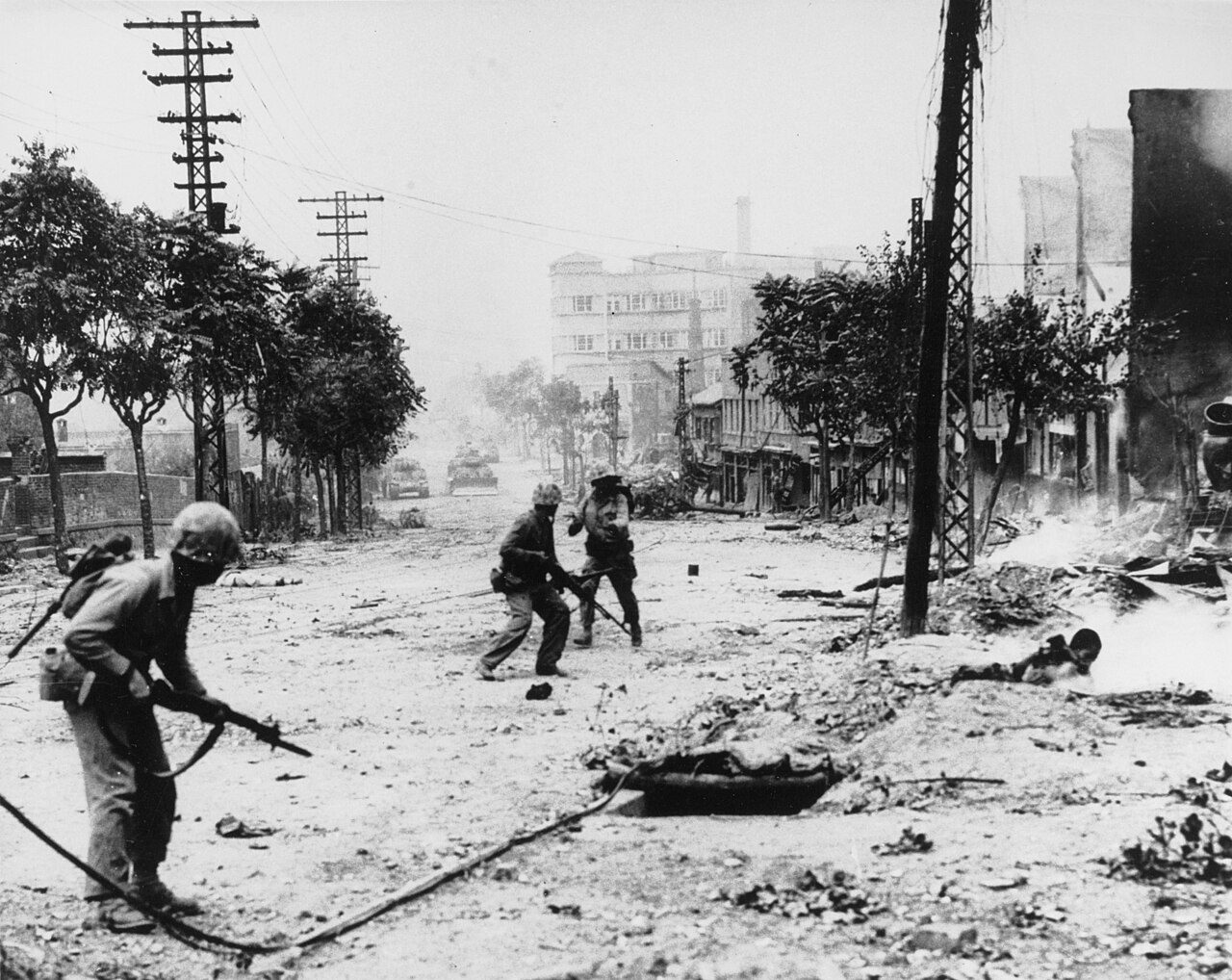
In the early hours of 25 June 1950, North Korean forces crossed the 38th parallel and invaded South Korea, opening the Korean War. As HISTORY records it, armed forces from Communist North Korea smashed into South Korea that day, and the United States, acting under the auspices of the United Nations, quickly sprang to the defence of the South. Korea had been divided at the parallel in 1945, when Soviet and American forces accepted the Japanese surrender in the north and south respectively; by 1948 two hostile states stood there, each claiming the whole peninsula — the Republic of Korea under Syngman Rhee in Seoul and the Democratic People's Republic under Kim Il Sung in Pyongyang, the latter armed by Moscow and, with Stalin's approval, resolved to unify the country by force.
The invasion achieved near-total surprise. North Korea's Soviet-equipped army, built around T-34 tanks for which the South had no answer, drove down the peninsula's road corridors; Seoul fell within three days. In Washington, President Truman, who saw the attack as a test of whether aggression would be resisted as it had not been in the 1930s, committed American air and sea power on 27 June and ground troops days later. The United Nations Security Council, which the Soviet Union was then boycotting over the seating of Communist China, demanded North Korea's withdrawal and then authorised member states to repel the attack — creating, by an accident of the boycott, the UN's first great military coalition, ultimately sixteen nations under an American-led command.
The war that followed swung violently across the peninsula. UN forces were compressed into the Pusan Perimeter in the south-east before General MacArthur's amphibious landing at Inchon in September cut the North Korean army in two and carried the war to the Yalu river — whereupon China intervened massively in November, driving the UN back south in the depths of winter. Seoul changed hands four times. By the summer of 1951 the front had stabilised near the parallel where the war began, and the remaining two years were a grinding war of hills and trenches conducted alongside armistice talks at Panmunjom. The fighting stopped on 27 July 1953 with an armistice, not a peace treaty: Korea remains divided, and technically at war, along a line close to the one crossed on 25 June 1950.
The human cost was enormous, and its figures are still estimates: millions of Korean civilians died, alongside an estimated 1.5 million or more soldiers of all armies, including more than 36,000 Americans. The war fixed the Cold War's Asian geography — an American alliance system around the Pacific, a garrisoned South Korea, a sealed North — and set the template of the limited war, fought for contained aims under the shadow of nuclear weapons. It is sometimes called the Forgotten War, overshadowed by the world war before it and Vietnam after. For the two Koreas, whose division it made permanent, nothing about it is forgotten.
Why this date matters
June 25 is a date of lines crossed and lines drawn. An army crossed the 38th parallel in 1950 and a peninsula has lived divided by the scar ever since; Custer crossed into the Little Bighorn valley in 1876 and did not come out. Against those military lines the day sets lines of another kind: an executive order in 1941 drawing a line against discrimination in war industry, a murdered girl's diary published in 1947 drawing the line of witness, and in 1978 a flag of eight coloured stripes raised in San Francisco, a line redrawn as a spectrum. It is a day that keeps asking where boundaries fall, and who pays for them.
Sources
- Encyclopaedia Britannica — On This Day: June 25
- HISTORY — What Happened on June 25
- Encyclopaedia Britannica — Korean War
- HISTORY — Korean War begins
The facts on this page were checked against these sources on 19 November 2026. The History Trail's permanent pages are researched and written for this site; the live profiles elsewhere on The History Trail are assembled automatically from Wikipedia and Wikidata.
About the Author
Researched and written by the The History Trail Editorial Team — the accountable editorial function behind this site's permanent story pages. The team works from the published sources cited on each page; it does not invent historians, reviewers or credentials, and it corrects errors openly.
Fact Check
Every load-bearing fact on this page traces to one of the sources listed above, and significant claims link to their source in the text. Our checking method is described on the methodology page; errors can be reported via the corrections page.
Sources & Citations
Cite this page as: The History Trail Editorial Team, The History Trail — this article's title, publication and update dates are shown beneath its headline. The full source list appears under Sources above; the site's source standards are on the sources page.