
Years
1937 in History
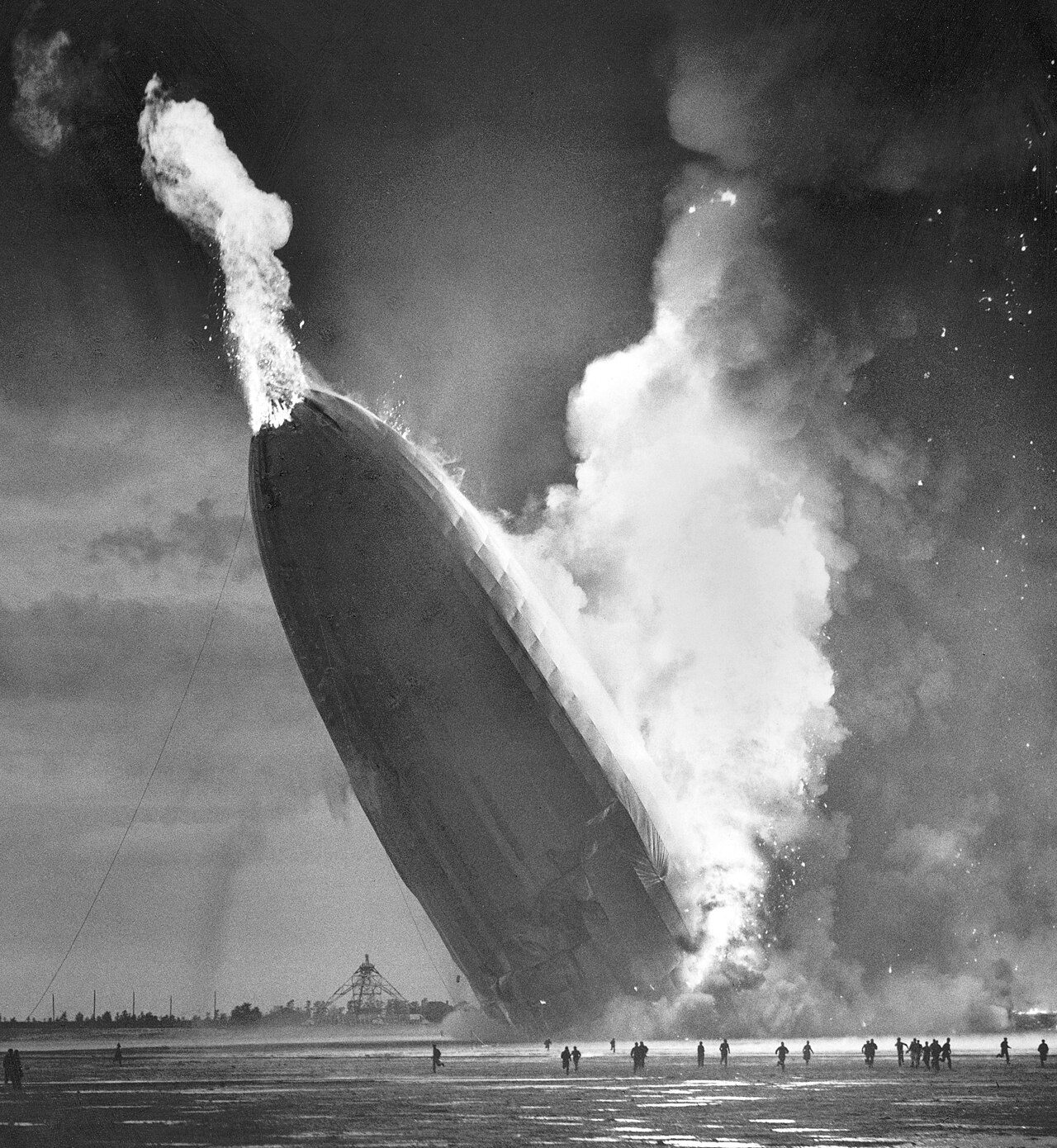
1937 is remembered for two May images a continent apart: on 6 May the German airship Hindenburg burst into flames at Lakehurst, New Jersey, killing 36 people and ending the passenger airship age, and on 27 May some 200,000 people walked across the newly opened Golden Gate Bridge. Around them came Guernica, the disappearance of Amelia Earhart, and in December the fall of Nanjing.
At a Glance
- Defining event
- Hindenburg disaster, 6 May 1937 — 36 people die and the passenger airship age ends
- Engineering landmark
- Golden Gate Bridge opens to pedestrians on 27 May; then the longest suspension bridge in the world
- War foretold
- Guernica is bombed on 26 April during the Spanish Civil War
- Vanished
- Amelia Earhart and Fred Noonan are last heard from over the Pacific on 2 July
- In Asia
- Japanese troops seize Nanjing on 13 December and begin the Nanjing Massacre
- Closed the year
- Snow White and the Seven Dwarfs, the first full-length animated feature, premieres on 21 December
The defining story: fire at Lakehurst
The Hindenburg was the pride of a revived Germany and the queen of a brief, luxurious age of travel. At 245 metres she was as long as an ocean liner, with a dining room, a lounge and cabins for fifty passengers. In her first season, 1936, she made ten round trips across the North Atlantic between Frankfurt and Lakehurst, carrying a thousand passengers in a style no aeroplane of the day could match. She was filled with hydrogen, because the United States, the only source of safe helium, would not sell it to Nazi Germany, and her operators had handled hydrogen safely for decades of zeppelin flight.
Her first North American crossing of 1937 was troubled by weather. Delayed by headwinds, she arrived over New Jersey hours late on 6 May, then waited out thunderstorms before making her approach to Lakehurst in the early evening, with Captain Max Pruss in command. At 7:21 p.m. the landing lines dropped from her nose. Four minutes later a small flame was seen at the stern, near the upper fin. Within seconds the tail was ablaze; the stern sank, the nose rose, and fire ran forward through the hydrogen cells. In about 34 seconds the whole structure had fallen to the ground, still burning.
Of the 97 people aboard, 62 survived, many by jumping as the ship neared the ground, since the fire burned upward. Thirty-five aboard died, along with one member of the ground crew — 36 people in all. The disaster was captured whole by the new media: newsreel cameras filmed it, photographs circled the world within hours, and radio reporter Herbert Morrison broke down on air in the broadcast that made the words Oh, the humanity immortal. The official inquiry blamed a discharge of atmospheric electricity igniting leaking hydrogen; sabotage was suspected at the time and has been argued ever since, without proof.
Public confidence in the airship collapsed overnight, and the age of the passenger zeppelin ended on a New Jersey field in half a minute of fire. Three weeks later the year's other emblem opened in triumph: on 27 May the Golden Gate Bridge opened to pedestrians, some 200,000 of whom crossed on foot a day before vehicles, on what was then the longest suspension bridge in the world. Between fire and span, 1937 also saw German and Italian aircraft bomb Guernica on market day on 26 April, during the Spanish Civil War — an atrocity Picasso's outraged canvas made immortal.
Timeline of 1937
- 20 January
Franklin D. Roosevelt is inaugurated for a second term, the first inauguration held on 20 January under the 20th Amendment.
- 5 February
Roosevelt announces his court-packing plan to expand the Supreme Court, provoking a constitutional storm.
- 16 February
DuPont chemist Wallace Carothers patents nylon, the first fully synthetic fibre.
- 18 March
A gas explosion destroys the school at New London, Texas, killing nearly 300 children and teachers.
- 26 April
German and Italian aircraft bomb Guernica on market day during the Spanish Civil War.
- 6 May
The Hindenburg burns at Lakehurst, New Jersey; 36 people die.
- 12 May
King George VI and Queen Elizabeth are crowned at Westminster Abbey.
- 27 May
The Golden Gate Bridge opens to pedestrians, who cross a day before the first cars.
- 4 June
The first shopping carts are introduced at a supermarket in Oklahoma City.
- 2 July
Amelia Earhart and Fred Noonan are last heard from over the Pacific; they are never found.
- 12 December
Japanese aircraft sink the U.S. gunboat Panay on China's Yangtze River, killing three Americans.
- 13 December
Japanese troops seize Nanjing and begin the Nanjing Massacre, in which, by Britannica's account, as many as 300,000 Chinese citizens and soldiers were killed.
- 21 December
Snow White and the Seven Dwarfs, the first full-length animated feature film, premieres in Los Angeles.
- 29 December
Ireland's constitution takes effect, replacing the Irish Free State with a sovereign state called Ireland.
Why 1937 still matters
The Hindenburg endures because it was witnessed so completely: no disaster had ever been seen so fully by so many who were not there. Its lesson was not that hydrogen flight was impossible — zeppelins had flown safely for decades — but that public confidence, once burned away on camera, does not return. Aeroplanes, slower and less graceful, inherited the Atlantic crossing by default. The Golden Gate Bridge made the opposite argument in the same month: that public works built in the Depression's hardest decade could be both useful and beautiful, and it remains the image by which much of the world recognises California.
The year's violence pointed directly at the war to come. Guernica showed what aircraft could do to an undefended town, and Picasso fixed that warning in paint. In Asia, the sinking of the Panay and the seizure of Nanjing, where, by Britannica's account, as many as 300,000 Chinese citizens and soldiers were killed, strained relations four years before Pearl Harbor. At home, Roosevelt's court-packing plan tested the Constitution's limits, while nylon, the shopping cart and Snow White quietly reshaped everyday life.
Even the year's smaller dates carried weight: J.R.R. Tolkien's The Hobbit was published in London on 21 September, introducing Bilbo Baggins and Middle-earth, and the former Edward VIII married Wallis Simpson in France on 3 June, six months after abdicating to be free to wed her. George Gershwin died at 38 on 11 July, and Ernest Rutherford, the father of nuclear physics, died on 19 October.
1937 on The History Trail
Fire, span and foreboding fill 1937 on The History Trail.
- May 6 in History — The Hindenburg burns at Lakehurst, told in full.
- May 27 in History — The Golden Gate Bridge opens to pedestrians.
- April 26 in History — Guernica is bombed during the Spanish Civil War.
- July 2 in History — Amelia Earhart is last heard from over the Pacific.
- December 13 in History — Japanese troops seize Nanjing.
- December 21 in History — Snow White and the Seven Dwarfs premieres in Los Angeles.
- World War II — The war that Guernica and Nanjing foretold.
Sources
- Encyclopaedia Britannica — Hindenburg
- HISTORY — Hindenburg
- Encyclopaedia Britannica — On This Day: May 27
- Encyclopaedia Britannica — On This Day: April 26
- Encyclopaedia Britannica — On This Day: July 2
- Encyclopaedia Britannica — On This Day: December 13
- Encyclopaedia Britannica — On This Day: December 21
The facts on this page were checked against these sources on 19 November 2026. The History Trail's permanent pages are researched and written for this site; the live profiles elsewhere on The History Trail are assembled automatically from Wikipedia and Wikidata.
About the Author
Researched and written by the The History Trail Editorial Team — the accountable editorial function behind this site's permanent story pages. The team works from the published sources cited on each page; it does not invent historians, reviewers or credentials, and it corrects errors openly.
Fact Check
Every load-bearing fact on this page traces to one of the sources listed above, and significant claims link to their source in the text. Our checking method is described on the methodology page; errors can be reported via the corrections page.
Sources & Citations
Cite this page as: The History Trail Editorial Team, The History Trail — this article's title, publication and update dates are shown beneath its headline. The full source list appears under Sources above; the site's source standards are on the sources page.