
Years
1939 in History
1939 is the year the Second World War began in Europe. Germany and the Soviet Union stunned the world with their non-aggression pact in August, Germany invaded Poland on 1 September, and Britain and France declared war two days later. Spain's civil war ended the same year, and Albert Einstein signed the letter that warned America about the atomic bomb.
At a Glance
- Defining event
- Germany invades Poland, 1 September 1939, beginning the Second World War in Europe
- The pact
- Molotov-Ribbentrop non-aggression pact signed in Moscow, 23 August, with a secret protocol dividing Eastern Europe
- War declared
- Britain and France declare war on Germany, 3 September
- Spain's war ends
- Nationalist forces enter Madrid, 28 March; Franco's dictatorship begins
- Atomic warning
- Einstein signs his letter to President Roosevelt warning Germany might build an atomic bomb, 2 August
- Closed the year
- The Soviet Union invades Finland, 30 November, opening the Winter War
The defining story: the invasion of Poland
The year was a countdown conducted in public. In January Barcelona fell to General Franco's Nationalist forces, and on 28 March Nationalists entered Madrid, ending the Spanish Civil War after nearly three years and beginning Franco's dictatorship. Two days later Britain and France announced their guarantee of Poland's independence, the pledge that would turn Hitler's next aggression into a European war. Italy invaded Albania in April, Germany and Italy formalised their alliance in the Pact of Steel in May, and on 2 August Albert Einstein signed his letter to President Roosevelt warning that Germany might build an atomic bomb. Then, on 23 August, the countdown's decisive turn: Nazi Germany and the Soviet Union signed a non-aggression pact in Moscow, stunning the world, and in a secret protocol divided Eastern Europe between them.
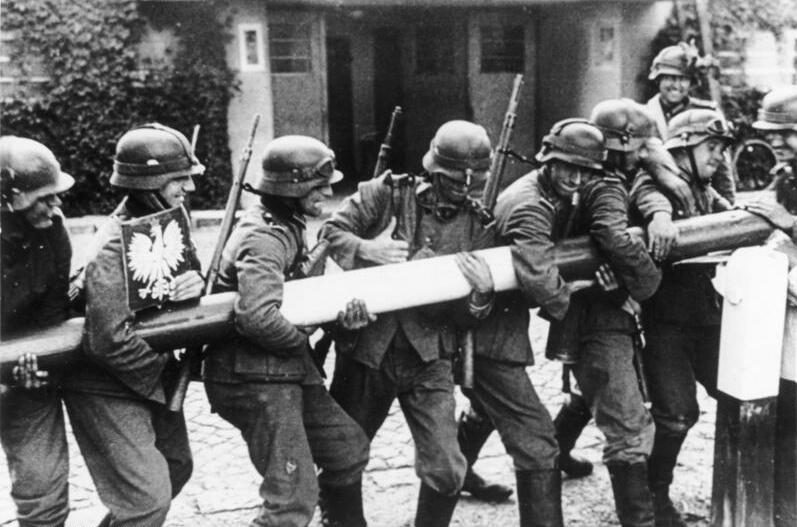
In the grey light of 1 September the German pre-dreadnought Schleswig-Holstein, which had sailed into Danzig harbour a week earlier on an ostensibly friendly visit, opened fire on the small Polish military depot at Westerplatte: the first shot of a general European war. Along a frontier more than a thousand miles long, German armies were already crossing into Poland from East Prussia in the north, from Germany in the west and from Slovakia in the south, while the Luftwaffe bombed Polish airfields, railways and towns, and the little town of Wielun, with no military target of consequence, was flattened that first morning. The attack had been dressed up as self-defence: the night before, SS men had staged fake Polish provocations along the border, most notoriously at the Gleiwitz radio station, and Hitler told the Reichstag that Germany was merely returning fire. In reality the invasion, codenamed Case White, had been planned for months, and its way had been cleared by the August pact.
On paper the contest was hopelessly uneven: Germany fielded some 1.5 million men, about 2,750 tanks and more than 2,300 aircraft, against a Polish mobilisation of about a million men with only a few hundred modern tanks and aircraft. The German method of fast armoured thrusts supported from the air tore through defences designed for a slower war, yet the Poles fought hard, Warsaw held out until 27 September, and the last Polish field army did not surrender until the Battle of Kock ended on 6 October. Poland's allies could not save it: Britain and France declared war on 3 September, as their guarantee required, but no western offensive came, and on 17 September the Soviet Union invaded from the east, completing the partition the pact had promised.
The war then widened by instalments. On 14 October the U-boat U-47 penetrated the anchorage at Scapa Flow and sank the battleship HMS Royal Oak with heavy loss of life. In November a bomb planted by Georg Elser exploded in a Munich beer hall minutes after Hitler had left, killing eight people. And on 30 November the Soviet Union invaded Finland, opening the Winter War, in which Finnish resistance held the Red Army for 105 days before a peace that cost territory but preserved independence. The League of Nations expelled the Soviet Union for the invasion, the only expulsion in its history.
Timeline of 1939
- 26 January
Barcelona falls to Franco's Nationalist forces in the Spanish Civil War; the Republic's collapse follows within weeks.
- 28 March
Nationalist forces enter Madrid and the Spanish Civil War effectively ends; Franco's dictatorship begins.
- 31 March
Britain and France announce their guarantee of Poland's independence.
- 7 April
Italy invades Albania, annexing the kingdom across the Adriatic in a five-day campaign.
- 22 May
Germany and Italy sign the Pact of Steel, formally allying the two Axis powers.
- 2 August
Albert Einstein signs his letter to President Roosevelt warning that Germany might build an atomic bomb.
- 23 August
Germany and the Soviet Union sign the non-aggression pact in Moscow, with a secret protocol dividing Eastern Europe.
- 1 September
Germany invades Poland, beginning the Second World War in Europe.
- 3 September
Britain and France declare war on Germany after it refuses to withdraw from Poland.
- 10 September
Canada declares war on Germany, a week after Britain, its first independent declaration of war.
- 6 October
The Battle of Kock ends the Polish September Campaign, as the last Polish field army surrenders.
- 14 October
U-47 penetrates Scapa Flow and sinks the battleship HMS Royal Oak with heavy loss of life.
- 8 November
Georg Elser's bomb explodes in a Munich beer hall minutes after Hitler has left, killing eight people.
- 30 November
The Soviet Union invades Finland, opening the Winter War.
Why 1939 still matters
Everything in the modern world that runs through the Second World War runs through 1939. The invasion of Poland began the conflict that would redraw every border in Europe, destroy the old empires, produce the Holocaust and the atomic age, and end with the continent divided between the two powers that had partitioned Poland between them in the August pact. The guarantee to Poland, honoured in form on 3 September but not in substance on the ground, remains the classic case study in deterrence promised and deterrence failed.
The year's side doors opened onto the future as well. Einstein's August letter set in motion the research that became the Manhattan Project. Days before the invasion, on 27 August, the Heinkel He 178 made the first flight of a jet aircraft, previewing the technology that would dominate the war's later years and all aviation after it. And amid the countdown, culture went on setting records that still stand: The Wizard of Oz opened in August, Steinbeck's The Grapes of Wrath had been published in April, and Gone with the Wind premiered in Atlanta in December, becoming the highest-grossing film of its era. The world that went to war in 1939 is recognisably the parent of our own, in its weapons, its alliances and its warnings ignored.
1939 on The History Trail
Four of 1939's days carry featured stories on The History Trail, from the Moscow pact to the invasion of Finland.
- August 23 in History — Germany and the Soviet Union sign the non-aggression pact in Moscow.
- September 1 in History — Germany invades Poland and the Second World War begins in Europe.
- September 3 in History — Britain and France declare war on Germany; the liner Athenia is sunk that evening.
- November 30 in History — The Soviet Union invades Finland and the Winter War begins.
- World War II — The war that began in 1939, told as a permanent story on The History Trail.
- The Lord of the Rings — A permanent page from the site's collection, among the stories this year touches.
Sources
- Encyclopaedia Britannica — On This Day: March 28
- Encyclopaedia Britannica — On This Day: March 31
- Encyclopaedia Britannica — On This Day: April 7
- HISTORY — This Day in History: May 22
- HISTORY — What Happened on August 2
- Encyclopaedia Britannica — On This Day: August 23
The facts on this page were checked against these sources on 19 November 2026. The History Trail's permanent pages are researched and written for this site; the live profiles elsewhere on The History Trail are assembled automatically from Wikipedia and Wikidata.
About the Author
Researched and written by the The History Trail Editorial Team — the accountable editorial function behind this site's permanent story pages. The team works from the published sources cited on each page; it does not invent historians, reviewers or credentials, and it corrects errors openly.
Fact Check
Every load-bearing fact on this page traces to one of the sources listed above, and significant claims link to their source in the text. Our checking method is described on the methodology page; errors can be reported via the corrections page.
Sources & Citations
Cite this page as: The History Trail Editorial Team, The History Trail — this article's title, publication and update dates are shown beneath its headline. The full source list appears under Sources above; the site's source standards are on the sources page.