
On This Day
September 1 in History
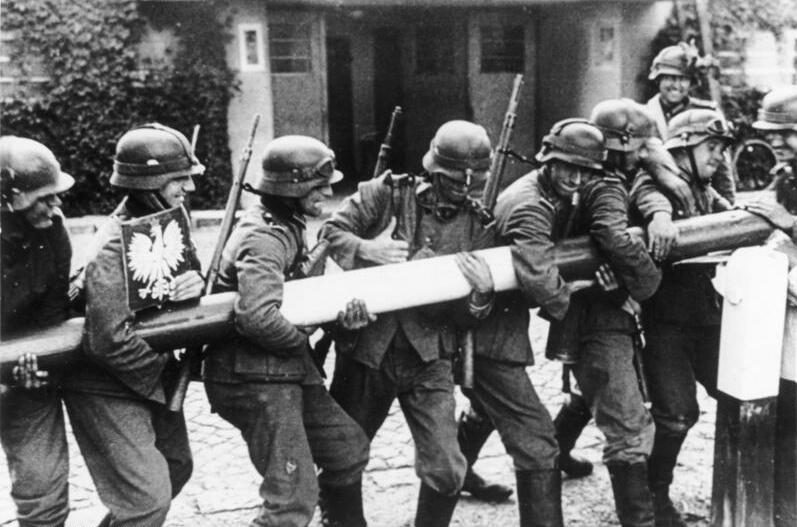
On 1 September 1939 Nazi Germany invaded Poland, and the Second World War began in Europe. German forces struck from the north, west and south while the battleship Schleswig-Holstein shelled the Polish depot at Westerplatte; Britain and France, bound to Poland, declared war two days later. September 1 is also the day Atlanta fell in 1864, the Great Kanto earthquake struck Japan in 1923, and the wreck of the Titanic was found in 1985.
Choose another date: open the On This Day calendar to browse events, births and deaths for any day of the year.
At a Glance
- The first shots
- The German battleship Schleswig-Holstein opened fire on the Polish transit depot at Westerplatte at about 4:43 a.m. on 1 September 1939
- The pretext
- On the night of 31 August the SS staged a fake Polish attack on the German radio station at Gleiwitz, which Hitler used to justify the invasion
- The forces
- Germany attacked with about 1.5 million men, some 2,750 tanks and more than 2,300 aircraft, against a Polish army of about one million with far older equipment
- The secret deal
- The Molotov-Ribbentrop Pact of 23 August 1939 secretly divided eastern Europe between Germany and the Soviet Union, which invaded Poland from the east on 17 September
- The response
- Britain and France declared war on Germany on 3 September 1939, honouring their guarantee to Poland
- The outcome
- Warsaw surrendered on 27 September; organised Polish resistance ended in early October, but Poland never formally surrendered
Events on this day
- 1775Richard Penn and Arthur Lee present the Olive Branch Petition to the Earl of Dartmouth in London; King George III refuses to receive the colonies' last appeal for reconciliation.
- 1807Former U.S. vice president Aaron Burr is acquitted of treason over his alleged plot to carve an independent republic out of Louisiana and Spanish Mexico.
- 1864Confederate general John Bell Hood evacuates Atlanta, Georgia, as Union forces under William T. Sherman close in; the city surrenders the next day.
- 1870At the Battle of Sedan in the Franco-Prussian War, the French army is encircled and Napoleon III is taken prisoner, sealing France's defeat.
- 1894The Great Hinckley Fire sweeps through pine country in Minnesota, killing more than 400 people.
- 1923The Great Kanto earthquake, magnitude 7.9, devastates Tokyo and Yokohama at lunchtime; Britannica and other sources put the dead at more than 100,000.
- 1939Germany invades Poland, beginning the Second World War in Europe — the featured story above.
- 1969A military coup led by the 27-year-old Captain Muammar Gaddafi deposes King Idris I of Libya.
- 1972Bobby Fischer wins the World Chess Championship in Reykjavik, becoming the first American world champion, after Boris Spassky resigns the final game.
- 1983A Soviet fighter shoots down Korean Air Lines Flight 007 after it strays into Soviet airspace, killing all 269 people on board.
- 1985A joint American-French expedition led by Robert Ballard and Jean-Louis Michel locates the wreck of the Titanic, some 73 years after it sank.
- 2004Armed militants seize School Number One in Beslan, Russia, taking more than 1,000 hostages on the first day of term; the siege ends in bloodshed three days later.
Born on this day
- 1875Edgar Rice Burroughs — American novelist who created Tarzan and John Carter of Mars.
- 1877Francis William Aston — English chemist and Nobel laureate who built the mass spectrograph and identified isotopes.
- 1902Carlo Gambino — Italian-born American crime boss who came to head one of New York's Five Families.
- 1923Rocky Marciano — American heavyweight boxing champion who retired undefeated.
- 1939Lily Tomlin — American comedian and actress of Rowan & Martin's Laugh-In and Grace and Frankie.
- 1946Barry Gibb — singer and songwriter, the last surviving member of the Bee Gees.
- 1957Gloria Estefan — Cuban-American singer who fronted the Miami Sound Machine.
Died on this day
- 1715Louis XIV — king of France, dead after a reign of 72 years, the longest of any major European monarch.
- 1970Francois Mauriac — French novelist and Nobel laureate in literature.
- 1977Ethel Waters — American singer and actress, a star of jazz, Broadway and film.
- 1981Albert Speer — Nazi armaments minister who served 20 years in Spandau prison after Nuremberg.
- 1988Luis Alvarez — American physicist and Nobel laureate who helped develop radar and later championed the asteroid theory of dinosaur extinction.
The featured story: Germany invades Poland, 1 September 1939
In the grey light of 1 September 1939 the German pre-dreadnought Schleswig-Holstein, which had sailed into Danzig harbour a week earlier on an ostensibly friendly visit, opened fire on the small Polish military transit depot at Westerplatte. It was the first shot of a general European war. Along a frontier more than a thousand miles long, German armies were already crossing into Poland from East Prussia in the north, from Germany in the west and from Slovakia in the south, while the Luftwaffe bombed Polish airfields, railways and towns. The little town of Wielun, with no military target of consequence, was flattened that first morning.
The attack had been dressed up as self-defence. The night before, SS men had staged a series of fake Polish provocations along the border, most notoriously at the radio station at Gleiwitz, where a Silesian farmer sympathetic to Poland, Franciszek Honiok, was murdered and left as evidence. Hitler told the Reichstag that Germany was merely returning fire. In reality the invasion, codenamed Case White, had been planned for months, and its way had been cleared on 23 August by the Molotov-Ribbentrop Pact, whose secret protocol divided Poland between Germany and the Soviet Union.
On paper the contest was hopelessly uneven. As the National WWII Museum sets out, Germany fielded some 1.5 million men, about 2,750 tanks and more than 2,300 aircraft; Poland could mobilise about a million men but with only a few hundred modern tanks and aircraft and equipment a generation old. The German method — fast armoured thrusts supported from the air, later famous as Blitzkrieg — tore through Polish defences designed for a slower war. Yet the Poles fought hard: at Mokra a cavalry brigade destroyed dozens of German tanks, and at the Bzura in mid-September the largest battle of the campaign briefly threw the Germans back twenty kilometres. Warsaw, bombed systematically and defended by soldiers and civilians together, held out until 27 September.
Poland's allies could not save it. Britain and France declared war on 3 September, as their guarantee required, but no western offensive came. On 17 September the Soviet Union invaded from the east, completing the partition the August pact had promised, and by 6 October organised resistance was over. What followed was occupation by two of the century's most murderous regimes: executions of Poland's elite, deportations to Siberia, the Katyn massacre of Polish officers, and the destruction of Polish Jewry. Poland never formally surrendered, its government went into exile, and its soldiers fought on every Allied front — but the war that began on 1 September 1939 had six years to run, and Poland's own freedom was not restored until 1989.
Why this date matters
September 1 is the day Europe's twentieth century turned. Its hinge is 1939, when the invasion of Poland made a local war a world war in waiting, but the date keeps the same double character elsewhere: Atlanta's fall in 1864 decided the American Civil War's direction, the Kanto earthquake of 1923 showed nature outdoing armies, and in 1985 the day gave something back, returning the Titanic from legend to a located, photographed wreck on the ocean floor. Openings and endings crowd this date — a war begun, a chess crown won, a school year begun in horror at Beslan — and few dates carry so much weight at the hinge of summer and autumn.
Sources
- Encyclopaedia Britannica — On This Day: September 1
- HISTORY — This Day in History: September 1
- National WWII Museum — The Invasion of Poland
- Wikipedia — September 1
The facts on this page were checked against these sources on 19 November 2026. The History Trail's permanent pages are researched and written for this site; the live profiles elsewhere on The History Trail are assembled automatically from Wikipedia and Wikidata.
About the Author
Researched and written by the The History Trail Editorial Team — the accountable editorial function behind this site's permanent story pages. The team works from the published sources cited on each page; it does not invent historians, reviewers or credentials, and it corrects errors openly.
Fact Check
Every load-bearing fact on this page traces to one of the sources listed above, and significant claims link to their source in the text. Our checking method is described on the methodology page; errors can be reported via the corrections page.
Sources & Citations
Cite this page as: The History Trail Editorial Team, The History Trail — this article's title, publication and update dates are shown beneath its headline. The full source list appears under Sources above; the site's source standards are on the sources page.