
On This Day
July 2 in History
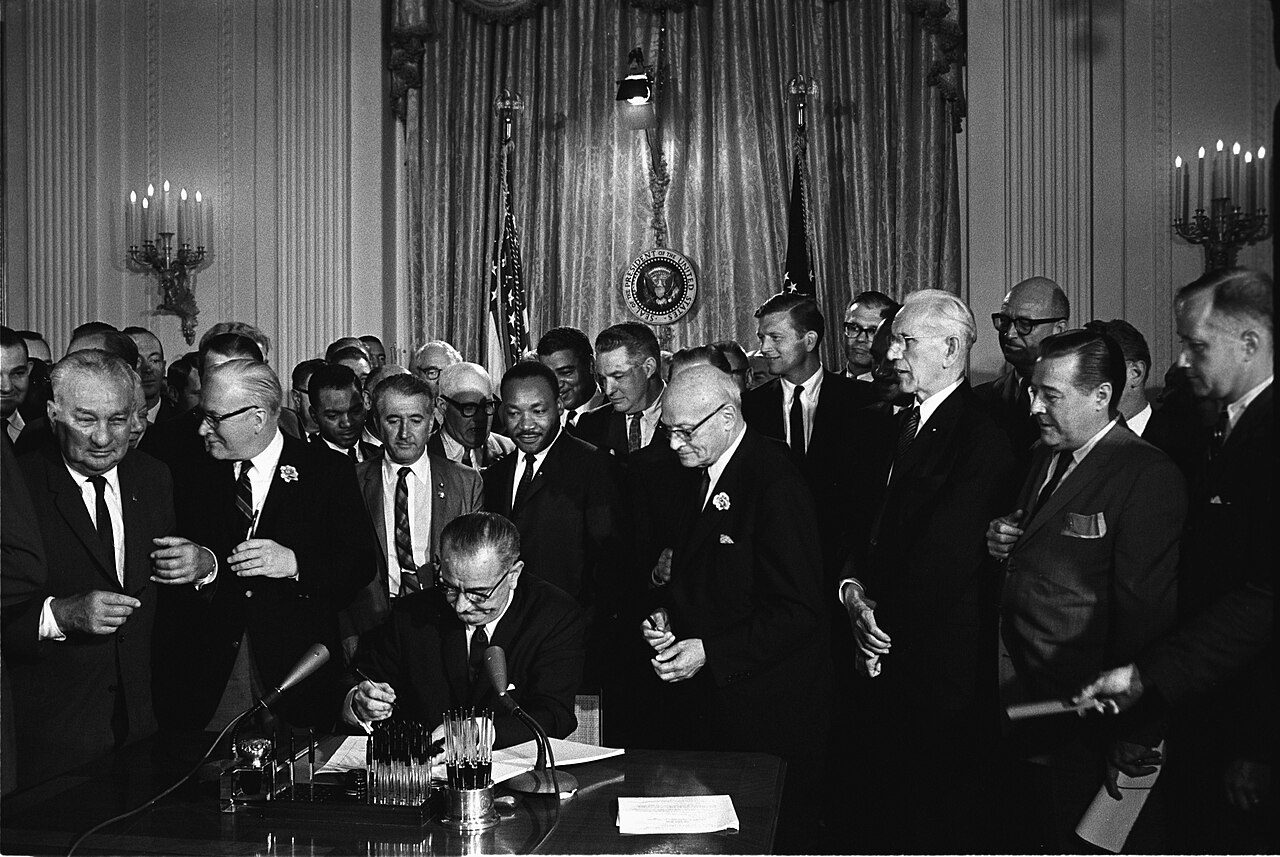
On 2 July 1964 President Lyndon B. Johnson signed the Civil Rights Act, the landmark law that outlawed segregation in public places and banned discrimination in employment across the United States. July 2 is also the day Congress actually voted for American independence in 1776, the Amistad mutiny began in 1839, and President Garfield was shot in 1881.
Choose another date: open the On This Day calendar to browse events, births and deaths for any day of the year.
At a Glance
- Signed
- 2 July 1964, by President Lyndon B. Johnson in the East Room of the White House, hours after Congress passed the bill
- What it banned
- Discrimination based on race, colour, religion, sex or national origin
- Public places
- Segregation outlawed in businesses such as theatres, restaurants and hotels
- Jobs
- Title VII banned employment discrimination and created the Equal Employment Opportunity Commission
- The obstacle
- Supporters had to break the longest filibuster in Senate history to bring the bill to a vote
- Proposed by
- President John F. Kennedy in June 1963; Johnson drove it through after Kennedy's assassination
Events on this day
- 1644Parliament's army destroys a Royalist force at Marston Moor, the largest battle of the English Civil War, giving Parliament control of the north.
- 1776The Continental Congress adopts the Lee Resolution, declaring the American colonies free and independent states — the vote for independence itself.
- 1839Enslaved Africans aboard the Spanish ship Amistad rise up and seize the vessel, beginning a case that ends with their freedom before the U.S. Supreme Court.
- 1865William and Catherine Booth found the Christian Mission in London's East End, the movement that becomes the Salvation Army.
- 1881President James A. Garfield is shot by Charles Guiteau at a Washington railway station; he dies of his wounds eleven weeks later.
- 1890The Sherman Antitrust Act becomes law, the first federal statute against monopolies and restraint of trade in the United States.
- 1937Amelia Earhart and her navigator Fred Noonan are last heard from over the Pacific during her attempt to fly around the world; they are never found.
- 1962Sam Walton opens the first Walmart store, in Rogers, Arkansas — the seed of the world's largest retailer.
- 1964President Lyndon B. Johnson signs the Civil Rights Act, outlawing segregation and employment discrimination — the featured story above.
- 1976North and South Vietnam are formally reunified as the Socialist Republic of Vietnam, a year after the fall of Saigon.
- 1992Canada announces a moratorium on cod fishing off Newfoundland after the collapse of the northern cod stock, ending a five-century fishery.
- 1994Colombian footballer Andrés Escobar is shot dead in Medellín, days after scoring an own goal at the World Cup.
- 2002Steve Fossett lands in Australia to complete the first solo nonstop balloon flight around the world.
Born on this day
- 1489Thomas Cranmer — first Protestant Archbishop of Canterbury, architect of the English Reformation under Henry VIII.
- 1724Friedrich Gottlieb Klopstock — German poet whose epic The Messiah made him a founder of modern German literature.
- 1877Hermann Hesse — German-Swiss novelist of Steppenwolf and Siddhartha, winner of the Nobel Prize in Literature.
- 1900Tyrone Guthrie — British theatre director who founded the Shakespeare Festival at Stratford, Ontario.
- 1908Thurgood Marshall — NAACP lawyer who argued Brown v. Board of Education and became the first African American justice of the U.S. Supreme Court.
- 1923Wisława Szymborska — Polish poet, winner of the Nobel Prize in Literature, famed for her precise and ironic verse.
Died on this day
- 936Henry the Fowler — Duke of Saxony and king of East Francia, founder of the Ottonian dynasty.
- 1961Ernest Hemingway — American novelist of The Old Man and the Sea and A Farewell to Arms, dead by his own hand in Idaho at 61.
- 1966Jan Brzechwa — Polish poet and author beloved for his children's verse.
- 1978Aris Alexandrou — Greek novelist and poet, author of The Box, who had been imprisoned for his politics.
The featured story: the Civil Rights Act is signed, 2 July 1964
On the evening of 2 July 1964, a few hours after the House of Representatives completed congressional passage of the bill, President Lyndon B. Johnson signed the Civil Rights Act into law in the East Room of the White House, using dozens of pens that were handed out as souvenirs. As the National Archives puts it, the act was a landmark law that outlawed segregation in businesses such as theatres, restaurants and hotels, and banned discrimination in employment.
The act had been proposed by President John F. Kennedy in June 1963, as televised images of police violence against peaceful demonstrators in Birmingham, Alabama, shocked the country. After Kennedy's assassination that November, Johnson made the bill the test of his presidency, telling Congress that no memorial could honour Kennedy better than passing it. In the Senate, supporters had to break the longest filibuster in that chamber's history, as southern senators talked against the bill for weeks before a bipartisan coalition imposed cloture and forced a vote.
The law's reach was broad. It prohibited discrimination on the basis of race, colour, religion, sex or national origin. It barred segregation in public accommodations, strengthened the enforcement of school desegregation and voting rights, and, in its Title VII, made employment discrimination unlawful and created the Equal Employment Opportunity Commission to investigate complaints. Businesses that had operated under Jim Crow for generations now faced federal law, and most complied with striking speed.
The Civil Rights Act did not end the struggle — voting rights required a further act in 1965, and fair housing another in 1968 — but it changed the legal ground of American life in a single signature. It remains the foundation on which later anti-discrimination law was built, and its passage is remembered as the moment the federal government finally used its full power against the segregation system that had stood since the end of Reconstruction.
Why this date matters
July 2 is a day of signatures that changed who counts as a citizen. In 1776 Congress voted the colonies independent — the act of independence itself, a day earlier than the famous one. In 1964 a president's signature dismantled legal segregation in American public life. Between those poles the day holds a mutiny for freedom aboard the Amistad, a new kind of army for the poor in the Salvation Army, and an assassination that cut short a presidency. Twice over, this date marks the moment an old order was formally told it was finished.
Sources
- Encyclopaedia Britannica — On This Day: July 2
- HISTORY — This Day in History: July 2
- National Archives — Civil Rights Act (1964)
- The Writer's Almanac — July 2, 2010
- Prairie Schooner — Specimen Days: July 2
The facts on this page were checked against these sources on 19 November 2026. The History Trail's permanent pages are researched and written for this site; the live profiles elsewhere on The History Trail are assembled automatically from Wikipedia and Wikidata.
About the Author
Researched and written by the The History Trail Editorial Team — the accountable editorial function behind this site's permanent story pages. The team works from the published sources cited on each page; it does not invent historians, reviewers or credentials, and it corrects errors openly.
Fact Check
Every load-bearing fact on this page traces to one of the sources listed above, and significant claims link to their source in the text. Our checking method is described on the methodology page; errors can be reported via the corrections page.
Sources & Citations
Cite this page as: The History Trail Editorial Team, The History Trail — this article's title, publication and update dates are shown beneath its headline. The full source list appears under Sources above; the site's source standards are on the sources page.