
On This Day
July 3 in History
On 3 July 1863 the Battle of Gettysburg ended in Pennsylvania with the repulse of Pickett's Charge, the crushing Southern defeat remembered as the turning point of the American Civil War. July 3 is also the day Quebec City was founded in 1608, Washington took command of the Continental Army in 1775, and the first automobile drove on a public road in 1886.
Choose another date: open the On This Day calendar to browse events, births and deaths for any day of the year.
At a Glance
- The battle
- 1–3 July 1863, near Gettysburg, Pennsylvania, 35 miles southwest of Harrisburg
- The armies
- About 94,000 Union troops under George Meade against more than 71,000 Confederates under Robert E. Lee
- The climax
- Pickett's Charge, 3 July: some 12,500 Confederates advance across open fields; nearly half become casualties
- The cost
- About 23,000 Union and 28,000 Confederate casualties in three days, including more than 3,100 and some 3,900 killed respectively
- The consequence
- Lee retreats to Virginia on 4 July and never again mounts a major invasion of the North
- Remembered by
- Lincoln's Gettysburg Address, delivered at the cemetery dedication on 19 November 1863
Events on this day
- 1608Samuel de Champlain founds Quebec City, the first permanent European settlement in Canada.
- 1775George Washington takes command of the Continental Army at Cambridge, Massachusetts, two months after the first shots of the Revolutionary War.
- 1863The Battle of Gettysburg ends with the failure of Pickett's Charge, the turning point of the American Civil War — the featured story above.
- 1886Karl Benz gives the first public demonstration of his Patent-Motorwagen in Mannheim, Germany — the first automobile takes to a public road.
- 1938The steam locomotive Mallard reaches 126 mph on a run south of Grantham, England, setting a world speed record for steam that still stands.
- 1976Israeli commandos storm a hijacked airliner at Entebbe airport in Uganda in a night raid spanning 3–4 July, rescuing more than a hundred hostages.
- 1988The U.S. warship Vincennes shoots down Iran Air Flight 655 over the Persian Gulf, killing all 290 people aboard, in a case of mistaken identity.
- 2013Egypt's military removes President Mohamed Morsi from power a year after his election, following mass protests against his rule.
Born on this day
- 1854Leoš Janáček — Czech composer of Jenůfa and the Sinfonietta, who built a music from the rhythms of speech.
- 1878George M. Cohan — American songwriter and showman, born in Providence on 3 July by his baptismal record, though his family long claimed the Fourth.
- 1883Franz Kafka — Prague novelist and story writer whose The Trial and The Metamorphosis defined a literature of anxiety.
- 1927Ken Russell — British film director of Women in Love and The Devils, flamboyant pioneer of the artist biopic.
- 1962Tom Cruise — American actor, star of Top Gun and the Mission: Impossible films, among the biggest box-office draws of his era.
Died on this day
- 1958Charles Bathurst, 1st Viscount Bledisloe — English politician who served as Governor-General of New Zealand.
- 1969Brian Jones — founding guitarist of the Rolling Stones, found dead in his swimming pool at 27, weeks after leaving the band.
- 1971Jim Morrison — American singer and poet of the Doors, dead in Paris at 27, two years to the day after Brian Jones.
The featured story: the Battle of Gettysburg ends, 3 July 1863
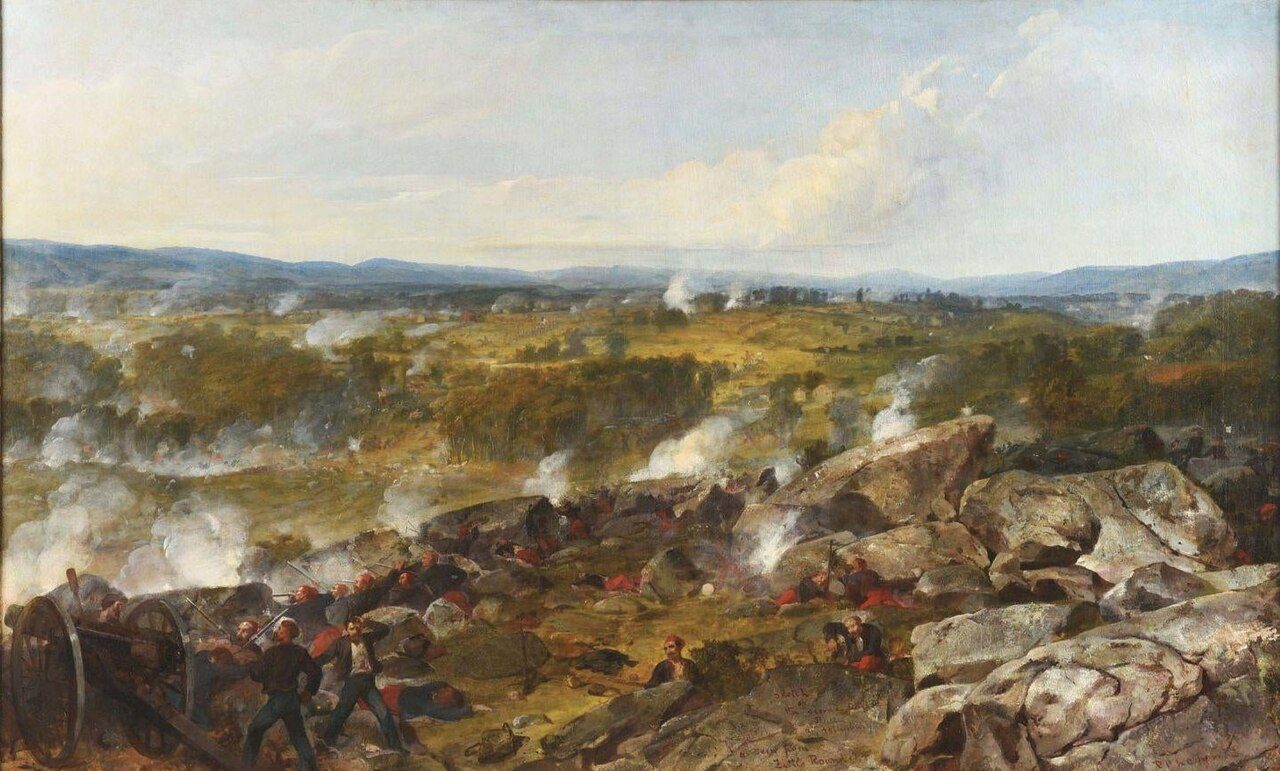
On the afternoon of 3 July 1863, after a cannonade of some two hours, about 12,500 Confederate soldiers stepped out of the woods on Seminary Ridge in Pennsylvania and advanced across open fields towards the Union line on Cemetery Ridge. The attack, remembered as Pickett's Charge after one of its divisional commanders, was the climax of the three-day Battle of Gettysburg. Union artillery and rifle fire tore into the advancing lines; a small part of the Confederate force briefly reached the Union position at a bend in a stone wall before being killed, captured or driven back. Nearly half the attacking force became casualties.
The battle had begun on 1 July, when Confederate forces under Robert E. Lee, invading the North for the second time, collided with George Meade's Army of the Potomac near the market town of Gettysburg, some 35 miles southwest of Harrisburg. Fighting on 2 July raged at places whose names became permanent in American memory: Little Round Top, the Wheatfield, Devil's Den and the Peach Orchard. Lee's army of more than 71,000 men faced a Union force of about 94,000.
The cost was the heaviest of the American Civil War. Britannica puts Union casualties at about 23,000, including more than 3,100 killed, and Confederate casualties at about 28,000, including some 3,900 killed — more than 50,000 men in three days, by some counts. On the night of 4 July, in heavy rain, Lee began the retreat to Virginia. He would never again mount a major invasion of the North, and the battle, fought in the same week that Vicksburg surrendered in the west, is remembered as the turning point of the war.
Four and a half months later, Abraham Lincoln returned to Gettysburg for the dedication of the soldiers' cemetery and delivered the Gettysburg Address, two minutes of prose that redefined the war as a test of whether a nation conceived in liberty could endure. The battlefield became a national park in 1895 and passed to the National Park Service in 1933; its fields and ridges remain the most visited of all Civil War battlefields. Veterans returned to the field for fifty years of reunions, and at the fiftieth anniversary in 1913 more than 50,000 old soldiers camped on the ground where they had fought, re-enacting the charge in a spirit of reconciliation.
Why this date matters
July 3 is a hinge day. Gettysburg ended on it, and with the ending went the Confederacy's best hope of winning its war on northern soil; the same date saw Washington take command of the army that made the United States, and Champlain plant the settlement that became Canada. Later centuries added firsts and records — the first automobile on a public road, the fastest steam run ever made — and two darker entries, a hijack rescue and an airliner shot down. The day specialises in moments after which a story could not go back to what it was. It is also, twice over, a musicians' graveyard: Brian Jones and Jim Morrison, both 27, died on it two years apart.
Sources
- Encyclopaedia Britannica — On This Day: July 3
- HISTORY — This Day in History: July 3
- Encyclopaedia Britannica — Battle of Gettysburg
- Mercedes-Benz — The Benz Patent Motor Car (first public drive, 3 July 1886)
- Audlem Online — On This Day, July 3: Mallard breaks the record
The facts on this page were checked against these sources on 19 November 2026. The History Trail's permanent pages are researched and written for this site; the live profiles elsewhere on The History Trail are assembled automatically from Wikipedia and Wikidata.
About the Author
Researched and written by the The History Trail Editorial Team — the accountable editorial function behind this site's permanent story pages. The team works from the published sources cited on each page; it does not invent historians, reviewers or credentials, and it corrects errors openly.
Fact Check
Every load-bearing fact on this page traces to one of the sources listed above, and significant claims link to their source in the text. Our checking method is described on the methodology page; errors can be reported via the corrections page.
Sources & Citations
Cite this page as: The History Trail Editorial Team, The History Trail — this article's title, publication and update dates are shown beneath its headline. The full source list appears under Sources above; the site's source standards are on the sources page.