
On This Day
July 4 in History
On 4 July 1776 the Continental Congress adopted the Declaration of Independence, announcing that the thirteen American colonies were free and independent states. July 4 is also the day Vicksburg surrendered in 1863, the Philippines won independence in 1946, and — in one of history's coincidences — the day John Adams and Thomas Jefferson both died in 1826.
Choose another date: open the On This Day calendar to browse events, births and deaths for any day of the year.
At a Glance
- Adopted
- 4 July 1776, by the Continental Congress in Philadelphia
- Drafted by
- A committee of five — Jefferson, Adams, Franklin, Sherman and Livingston — with the writing delegated to Jefferson, 11–28 June 1776
- The actual independence vote
- 2 July 1776, when Congress adopted the independence section of the Lee Resolution
- The signing
- The engrossed parchment was signed by most delegates beginning 2 August 1776, not on 4 July
- First printed
- As the Dunlap broadside, printed in Philadelphia on the night of 4–5 July 1776
- The anniversary deaths
- Adams and Jefferson both died on 4 July 1826, the fiftieth anniversary; Monroe followed on 4 July 1831
Events on this day
- 1776The Continental Congress adopts the Declaration of Independence in Philadelphia — the featured story above.
- 1827Slavery is abolished in New York state, the culmination of a gradual emancipation begun in 1799.
- 1863Vicksburg, Mississippi, surrenders to Ulysses S. Grant after a 47-day siege, giving the Union control of the Mississippi River — one day after Gettysburg ended.
- 1910Jack Johnson defeats Jim Jeffries in Reno in the 'Fight of the Century', becoming the first Black heavyweight champion to defend the title against a former champion.
- 1884The completed Statue of Liberty, France's gift to the United States, is formally presented to the American minister Levi P. Morton at a ceremony in Paris, on Independence Day itself.
- 1946The Philippines becomes fully independent of the United States, as the Republic of the Philippines is proclaimed in Manila.
- 1976Israeli commandos free the hostages of a hijacked airliner at Entebbe, Uganda, in the climax of a rescue begun the previous night.
- 2012Scientists at CERN announce the discovery of a particle consistent with the Higgs boson, the long-sought keystone of the Standard Model of physics.
Born on this day
- 1804Nathaniel Hawthorne — American novelist of The Scarlet Letter and The House of the Seven Gables.
- 1807Giuseppe Garibaldi — Italian soldier and patriot whose campaigns unified Italy.
- 1826Stephen Foster — American songwriter of 'Oh! Susanna' and 'My Old Kentucky Home'.
- 1872Calvin Coolidge — thirtieth president of the United States, the only president born on the Fourth of July.
Died on this day
- 1826John Adams — second president of the United States and a drafter of the Declaration, dead on its fiftieth anniversary.
- 1826Thomas Jefferson — third president and the Declaration's principal author, dead hours before Adams on the same anniversary.
- 1831James Monroe — fifth president of the United States, the third president to die on the Fourth of July.
- 1902Vivekananda — Hindu monk who introduced Indian philosophy to the West at the Chicago Parliament of Religions in 1893.
- 1934Marie Curie — Polish-French physicist and chemist, winner of two Nobel Prizes, dead of aplastic anaemia after years of radiation exposure.
The featured story: the Declaration of Independence is adopted, 4 July 1776
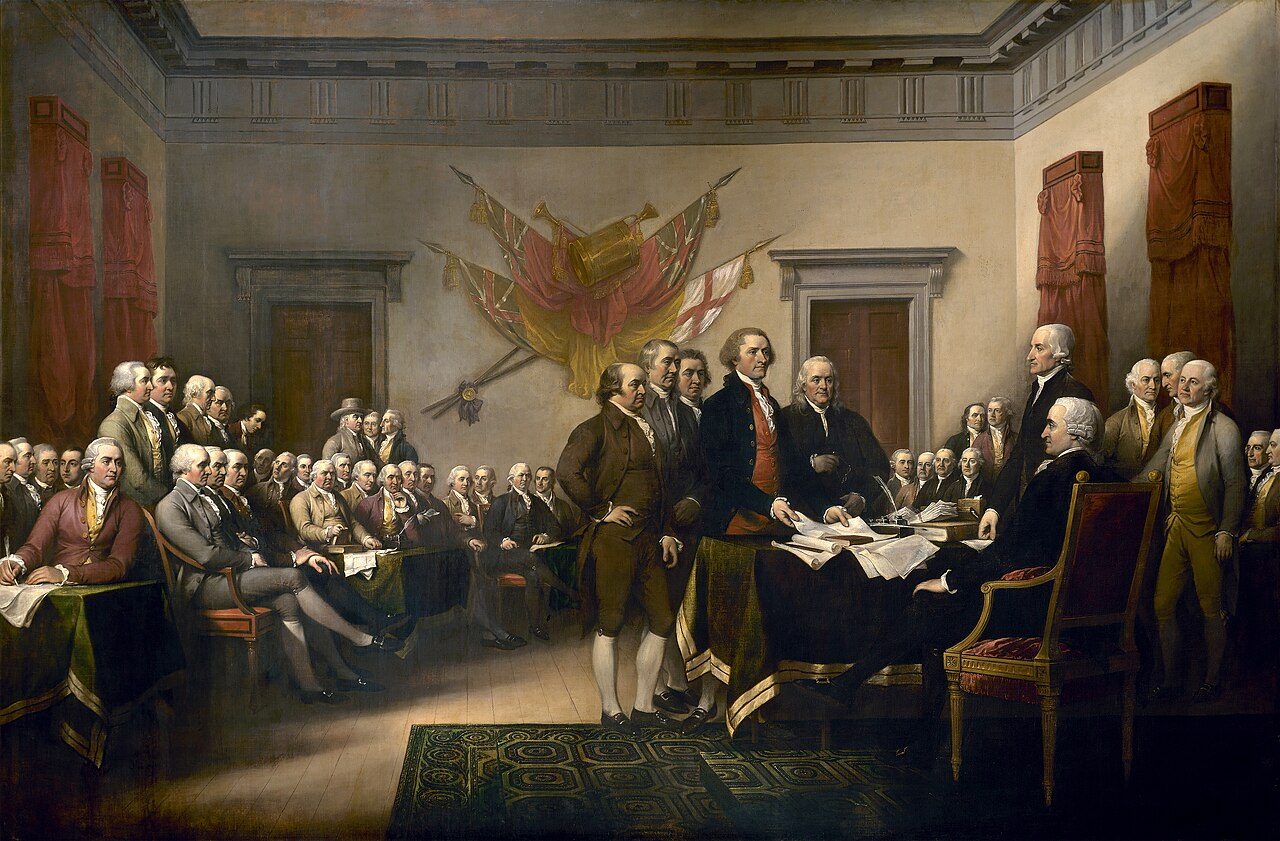
On 4 July 1776 the Continental Congress, meeting in Philadelphia, adopted the Declaration of Independence, the document that announced to the world that thirteen British colonies in North America now considered themselves independent states. As the National Archives records, Congress had appointed a committee of five — Thomas Jefferson, John Adams, Benjamin Franklin, Roger Sherman and Robert Livingston — on 11 June, and the committee had delegated the drafting to Jefferson, who wrote the text between 11 and 28 June. Congress debated and revised it for two days before adopting it on the fourth.
The Declaration did two things at once. Its opening argued a philosophy: that all men are created equal, that governments derive their just powers from the consent of the governed, and that a people may alter or abolish a government that destroys those ends. Its long middle section listed the colonists' grievances against George III, and its conclusion dissolved the political bands with Britain. The vote for independence itself had actually come two days earlier, on 2 July, when Congress adopted the independence section of the Lee Resolution; the fourth was the day the explanation was agreed and issued.
The famous parchment copy, engrossed after adoption, was not signed by most delegates until 2 August 1776, and some signed later still — a useful reminder that the fourth of July marks the adoption of the text, not the signing ceremony of popular imagination. John Hancock's outsized signature belongs to that later process. The document was printed first as a broadside by John Dunlap on the night of 4–5 July and carried to the states, where it was read aloud to crowds and to Washington's army in New York on 9 July.
The date acquired a strange symmetry in American memory. John Adams and Thomas Jefferson, the two men most responsible for the Declaration after Jefferson himself, both died on 4 July 1826, the fiftieth anniversary of its adoption — Jefferson a few hours before Adams, whose last words are traditionally reported as 'Thomas Jefferson still lives.' James Monroe, the fifth president, also died on 4 July, in 1831. The fourth became the national birthday, marked with fireworks, and the parchment itself now rests in the National Archives in Washington.
Why this date matters
No date in the American calendar carries more of its own story than this one. The Declaration was adopted on it; two of its makers died on its fiftieth anniversary and a third president on the same date five years later; the only president born on it, Coolidge, arrived in 1872. Around that core the day gathers the fall of Vicksburg, Philippine independence and the Higgs boson — but the pattern is really about beginnings formally declared: a nation announcing itself, a state ending slavery, a republic proclaimed. July 4 is the calendar's great day of public announcements. France understood the date's power well enough to present the Statue of Liberty in Paris on 4 July 1884, choosing the anniversary deliberately.
Sources
- Encyclopaedia Britannica — On This Day: July 4
- HISTORY — This Day in History: July 4
- National Archives — Declaration of Independence (1776)
- Encyclopaedia Britannica — Independence Day
- U.S. Department of State, Office of the Historian — Presentation of the Statue of Liberty, Paris, 4 July 1884
The facts on this page were checked against these sources on 19 November 2026. The History Trail's permanent pages are researched and written for this site; the live profiles elsewhere on The History Trail are assembled automatically from Wikipedia and Wikidata.
About the Author
Researched and written by the The History Trail Editorial Team — the accountable editorial function behind this site's permanent story pages. The team works from the published sources cited on each page; it does not invent historians, reviewers or credentials, and it corrects errors openly.
Fact Check
Every load-bearing fact on this page traces to one of the sources listed above, and significant claims link to their source in the text. Our checking method is described on the methodology page; errors can be reported via the corrections page.
Sources & Citations
Cite this page as: The History Trail Editorial Team, The History Trail — this article's title, publication and update dates are shown beneath its headline. The full source list appears under Sources above; the site's source standards are on the sources page.