
On This Day
July 5 in History
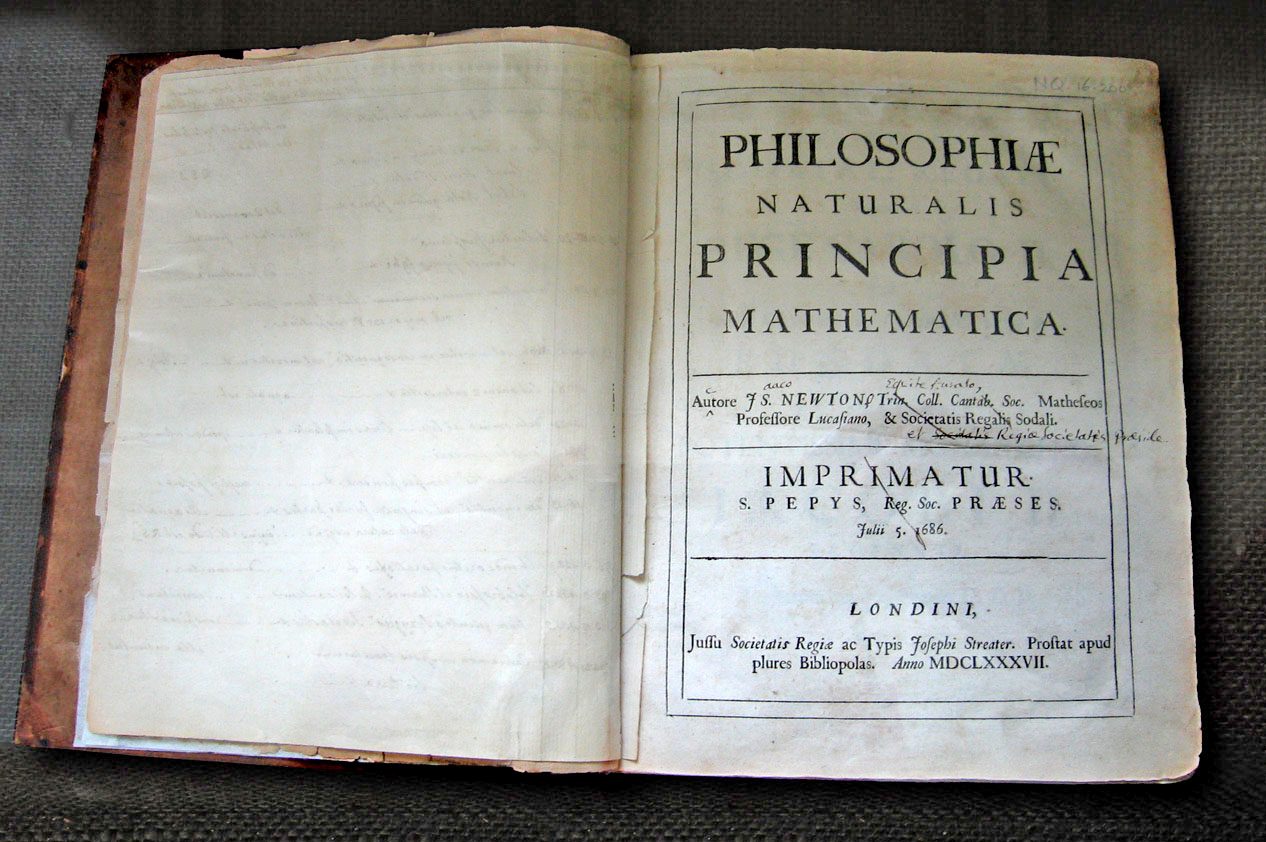
On 5 July 1687 the Royal Society published Isaac Newton's Principia, the work that set out the laws of motion and universal gravitation and founded modern physics. July 5 is also the day the NHS was launched in 1948, Venezuela declared independence in 1811, and Dolly the sheep, the first mammal cloned from an adult cell, was born in 1996.
Choose another date: open the On This Day calendar to browse events, births and deaths for any day of the year.
At a Glance
- Published
- 5 July 1687, by the Royal Society in London
- Full title
- Philosophiae Naturalis Principia Mathematica — Mathematical Principles of Natural Philosophy
- Contents
- The three laws of motion and the law of universal gravitation, applied to planets, moons, comets and tides
- The midwife
- Edmond Halley prompted the work, edited it and paid for its printing; his letter to Newton of 5 July 1687 announced the book finished
- First presented
- The text of Book I was received by the Royal Society on 28 April 1686
- Later editions
- Revised editions followed in 1713 and 1726; Newton's own annotated first-edition copy is in the Wren Library, Cambridge
Events on this day
- 1687Isaac Newton's Principia is published by the Royal Society in London, setting out the laws of motion and universal gravitation — the featured story above.
- 1811Venezuela declares independence from Spain, the first South American colony to do so.
- 1865The United States Secret Service begins operations, founded to combat the counterfeiting that plagued Civil War-era currency.
- 1946The modern bikini, designed by Louis Réard, is unveiled at a Paris swimming pool, four days after the atomic test at Bikini Atoll gave it its name.
- 1948Britain's National Health Service is launched, providing healthcare free at the point of use to the whole population.
- 1954Elvis Presley records 'That's All Right' at Sun Studio in Memphis, the session widely treated as the birth of his career and of rock and roll's breakthrough.
- 1962Algeria's independence from France is proclaimed, ending a war of eight years and 132 years of French rule.
- 1971The Twenty-sixth Amendment to the U.S. Constitution is certified, lowering the voting age from 21 to 18.
- 1975Arthur Ashe defeats Jimmy Connors to win Wimbledon, becoming the first Black man to win the men's singles title.
- 1994Jeff Bezos incorporates the company that becomes Amazon, founded as an online bookshop in Seattle.
- 1996Dolly the sheep is born near Edinburgh, the first mammal cloned from an adult cell — though her birth is not announced until the following year.
Born on this day
- 1810P. T. Barnum — American showman and founder of the Barnum & Bailey circus, master of the art of publicity.
- 1853Cecil Rhodes — British imperialist and mining magnate in southern Africa, founder of Rhodesia and of the Rhodes scholarships.
- 1889Jean Cocteau — French poet, playwright and filmmaker, a central figure of the Parisian avant-garde.
- 1963Edie Falco — American actress, Emmy winner for The Sopranos and Nurse Jackie.
Died on this day
- 1826Stamford Raffles — British colonial official who founded Singapore in 1819, dead in London a day short of his forty-fifth birthday.
- 1945John Curtin — wartime prime minister of Australia, dead in office weeks before the end of the Second World War.
- 1969Walter Gropius — German architect, founder of the Bauhaus, dead in Boston at 86.
- 2002Ted Williams — American baseball player, the last man to hit .400 in a major-league season, dead at 83.
The featured story: Newton's Principia is published, 5 July 1687
On 5 July 1687 the Royal Society in London published Philosophiae Naturalis Principia Mathematica — the Principia — Isaac Newton's mathematical account of the laws of motion and universal gravitation. In a letter to Newton dated that very day, Edmond Halley, who had coaxed the book out of its author, edited it and paid for its printing himself, wrote that he had 'at length brought your Book to an end'. The work Halley delivered would remake science: one law of attraction, falling off with the square of distance, shown to govern both a falling apple and the Moon.
The book had nearly not existed. Newton had worked out much of its content years earlier and shown it to almost no one. In August 1684 Halley visited Cambridge and asked what curve a planet would follow under an inverse-square attraction; Newton answered at once — an ellipse — and admitted he had calculated it but mislaid the proof. The promised re-derivation grew, through Halley's encouragement, into three books: the laws of motion, the motion of bodies in resisting media, and the system of the world, applying the mathematics to the planets, the Moon, comets and the tides. The Royal Society received the text of Book I on 28 April 1686.
The Principia was written in Latin and in a deliberately forbidding geometrical style, and its first edition was small. Even so, its effect was immediate among those who could follow it: here, for the first time, was a single mathematical framework that predicted the motions of the heavens and explained phenomena from the precession of the equinoxes to the shape of the Earth. Newton revised it through two further editions, in 1713 and 1726, annotating his own copy of the first edition — the copy now held by the Wren Library at Trinity College, Cambridge — with handwritten corrections.
What was published on 5 July 1687 became the foundation of classical mechanics and the model of what a scientific theory could be. For more than two centuries its laws were simply physics, until Einstein's relativity redrew their boundaries in the twentieth century — and even then, spacecraft are still flown, and bridges still built, on Newton's equations. Few books can be assigned a birthday; this one can, and the date is a fair candidate for the day the modern scientific world began.
Why this date matters
July 5 is a day for launches that outgrow their launchers. The Principia began as one man's private mathematics and became the operating system of the physical world; the NHS began as a post-war British reform and became a model argued over everywhere; a Seattle bookshop incorporated in 1994 became Amazon. The day also holds a cloned sheep, a two-piece swimsuit and an eighteen-year-old's vote. Its pattern is the unveiling: ideas and institutions stepped out on this date and then refused to stay the size they started.
Sources
- Encyclopaedia Britannica — On This Day: July 5
- Encyclopaedia Britannica — On This Day podcast: July 5
- HISTORY — This Day in History: July 5
- Cambridge University Library — The Newton Papers: Principia manuscript
- Lai Times — July 5 in history
The facts on this page were checked against these sources on 19 November 2026. The History Trail's permanent pages are researched and written for this site; the live profiles elsewhere on The History Trail are assembled automatically from Wikipedia and Wikidata.
About the Author
Researched and written by the The History Trail Editorial Team — the accountable editorial function behind this site's permanent story pages. The team works from the published sources cited on each page; it does not invent historians, reviewers or credentials, and it corrects errors openly.
Fact Check
Every load-bearing fact on this page traces to one of the sources listed above, and significant claims link to their source in the text. Our checking method is described on the methodology page; errors can be reported via the corrections page.
Sources & Citations
Cite this page as: The History Trail Editorial Team, The History Trail — this article's title, publication and update dates are shown beneath its headline. The full source list appears under Sources above; the site's source standards are on the sources page.