
On This Day
December 13 in History
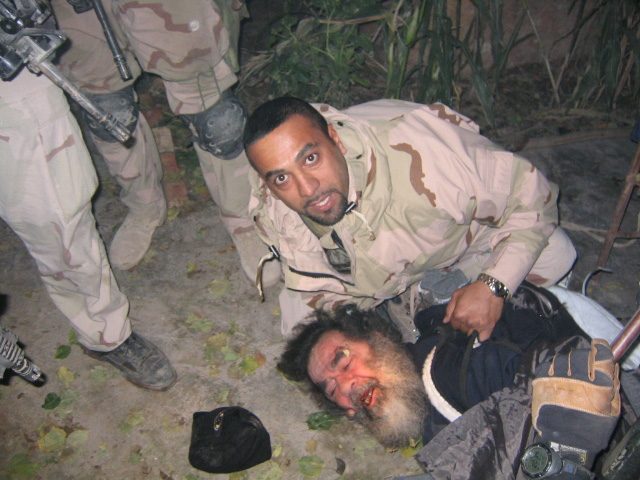
On 13 December 2003, American soldiers found Saddam Hussein hiding in a cramped underground hole near the Iraqi town of Ad-Dawr, outside Tikrit, and the fallen dictator surrendered without a shot. December 13 is also the day of the Battle of Fredericksburg, the fall of Nanjing, and the opening of the Council of Trent.
Choose another date: open the On This Day calendar to browse events, births and deaths for any day of the year.
At a Glance
- Found
- 13 December 2003, in a hole six to eight feet deep near Ad-Dawr, about nine miles outside Tikrit, Iraq
- Resistance
- None — the former dictator was taken alive without a fight
- Condition
- Bearded and dishevelled after eight months in hiding, barely recognisable beside his official portraits
- Background
- Iraq had been invaded on 20 March 2003; Saddam's sons Uday and Qusay were killed in Mosul on 22 July 2003
- Aftermath
- Tried by an Iraqi court for crimes against humanity, Saddam was executed on 30 December 2006
- The wider search
- No weapons of mass destruction — the invasion's stated rationale — were ever found in Iraq
Events on this day
- 1545The Council of Trent opens in northern Italy, launching the Catholic Church's Counter-Reformation; it will meet, on and off, for 18 years.
- 1577Francis Drake sets sail from Plymouth with five ships on the voyage that will become the second circumnavigation of the globe.
- 1642Dutch navigator Abel Tasman sights New Zealand, the first European known to reach it, though he never lands.
- 1776American general Charles Lee is captured by the British at a New Jersey tavern, depriving Washington of his second-in-command.
- 1862At the Battle of Fredericksburg, Robert E. Lee's Confederates repel repeated Union assaults on Marye's Heights in one of the most one-sided battles of the Civil War.
- 1916An avalanche strikes Austro-Hungarian barracks below Mount Marmolada in the Italian Alps, one of a series of mid-December avalanches that killed an estimated 10,000 soldiers in days.
- 1918Woodrow Wilson arrives in France, the first serving U.S. president to visit Europe, to negotiate the peace after the First World War.
- 1937Japanese troops seize Nanjing, China's capital, and begin the Nanjing Massacre, in which, by Britannica's account, as many as 300,000 Chinese citizens and soldiers were killed.
- 2000Al Gore concedes the 2000 U.S. presidential election to George W. Bush, a day after the Supreme Court halted the Florida recount.
- 2003Saddam Hussein is captured by U.S. soldiers near Tikrit, Iraq — the featured story above.
- 2013Beyoncé shocks the music industry by releasing her self-titled fifth album with no advance announcement or publicity.
Born on this day
- 1797Heinrich Heine — German poet and essayist whose lyrics were set to music by Schubert, Schumann and Brahms.
- 1925Dick Van Dyke — American actor and comedian, star of Mary Poppins and The Dick Van Dyke Show.
- 1929Christopher Plummer — Canadian actor whose career ran from The Sound of Music to an Oscar at 82, then the oldest acting winner.
- 1957Steve Buscemi — American actor known for Reservoir Dogs, Fargo and Boardwalk Empire; a former New York firefighter.
- 1967Jamie Foxx — American actor and singer who won an Oscar playing Ray Charles in Ray.
- 1989Taylor Swift — American singer-songwriter whose re-recorded albums reshaped the music industry's argument over artists' rights.
Died on this day
- 1204Moses Maimonides — Jewish philosopher, jurist and physician, the foremost intellectual figure of medieval Judaism, dead in Egypt at 69.
- 1784Samuel Johnson — English writer and lexicographer whose Dictionary of the English Language defined the language for a century.
- 1944Wassily Kandinsky — Russian painter and theorist, a pioneer of abstract art, dead in France at 77.
The featured story: Saddam Hussein is captured, 13 December 2003
When the United States and its allies invaded Iraq on 20 March 2003, Saddam Hussein's regime collapsed within weeks — but the dictator himself vanished. For eight months American forces hunted the man who had ruled Iraq for nearly a quarter of a century — the most wanted figure of the fallen regime. His sons Uday and Qusay were killed in a gun battle in Mosul on 22 July 2003, but their father stayed ahead of the search, moving between hiding places around his home region of Tikrit while defiant recorded messages surfaced periodically to prove he was alive.
The trail ended in the dark on 13 December 2003. Acting on intelligence, American soldiers searched the area around the farming town of Ad-Dawr, about nine miles south of Tikrit, and found what they were looking for: a concealed 'spider hole', a shaft some six to eight feet deep, camouflaged so the man inside could breathe and stay hidden. Inside it was Saddam Hussein — bearded, his hair long and matted, dishevelled almost beyond recognition beside the carefully staged portraits of his years in power. He did not resist. The most powerful man in Iraq was pulled out of the ground and taken prisoner without a shot being fired.
The capture closed the manhunt but not the argument about the war. Saddam was held, interrogated and eventually handed over to the new Iraqi authorities, who tried him for crimes against humanity; he was executed by hanging on 30 December 2006. The weapons of mass destruction whose alleged existence had been the invasion's central justification were never found — a fact that shadowed the triumph of the capture almost immediately. The insurgency that was already growing in Iraq did not end with its former ruler in a cell; in the years after his fall, the country descended into sectarian violence far beyond anything the invasion's planners had predicted.
Yet the image of 13 December 2003 endures as one of the defining pictures of the Iraq War: the dictator in the hole, blinking in the torchlight, while a soldier holds him down for the camera. It was the complete inversion of Saddam's own mythology of omnipotence — the president-for-life discovered hiding in a hole in the ground a few miles from the city where he was born. Whatever else the war became, that night near Ad-Dawr was the moment the old Iraq, the one built entirely around one man, was finally and visibly over.
Why this date matters
December 13 is a day of journeys ending in hard places. Drake sails out of Plymouth towards an ocean no Englishman had crossed; Tasman sights a land he cannot land on; Washington's deputy is dragged from a tavern into captivity; Wilson crosses an ocean to make a peace that will not hold. Nanjing falls, Fredericksburg's slopes fill with dead, and in 2003 the most hunted man on Earth is found not in a palace or a bunker complex but in a hole in a farmyard, a few miles from home. The date keeps teaching the same lesson: power and ambition travel far, and then they stop, abruptly, somewhere small.
Sources
- Encyclopaedia Britannica — On This Day: December 13
- HISTORY — This Day in History: December 13
- HISTORY — Saddam Hussein captured
- Encyclopaedia Britannica — Moses Maimonides
- Wikipedia — Vasily Kandinsky
The facts on this page were checked against these sources on 19 November 2026. The History Trail's permanent pages are researched and written for this site; the live profiles elsewhere on The History Trail are assembled automatically from Wikipedia and Wikidata.
About the Author
Researched and written by the The History Trail Editorial Team — the accountable editorial function behind this site's permanent story pages. The team works from the published sources cited on each page; it does not invent historians, reviewers or credentials, and it corrects errors openly.
Fact Check
Every load-bearing fact on this page traces to one of the sources listed above, and significant claims link to their source in the text. Our checking method is described on the methodology page; errors can be reported via the corrections page.
Sources & Citations
Cite this page as: The History Trail Editorial Team, The History Trail — this article's title, publication and update dates are shown beneath its headline. The full source list appears under Sources above; the site's source standards are on the sources page.