
On This Day
December 12 in History
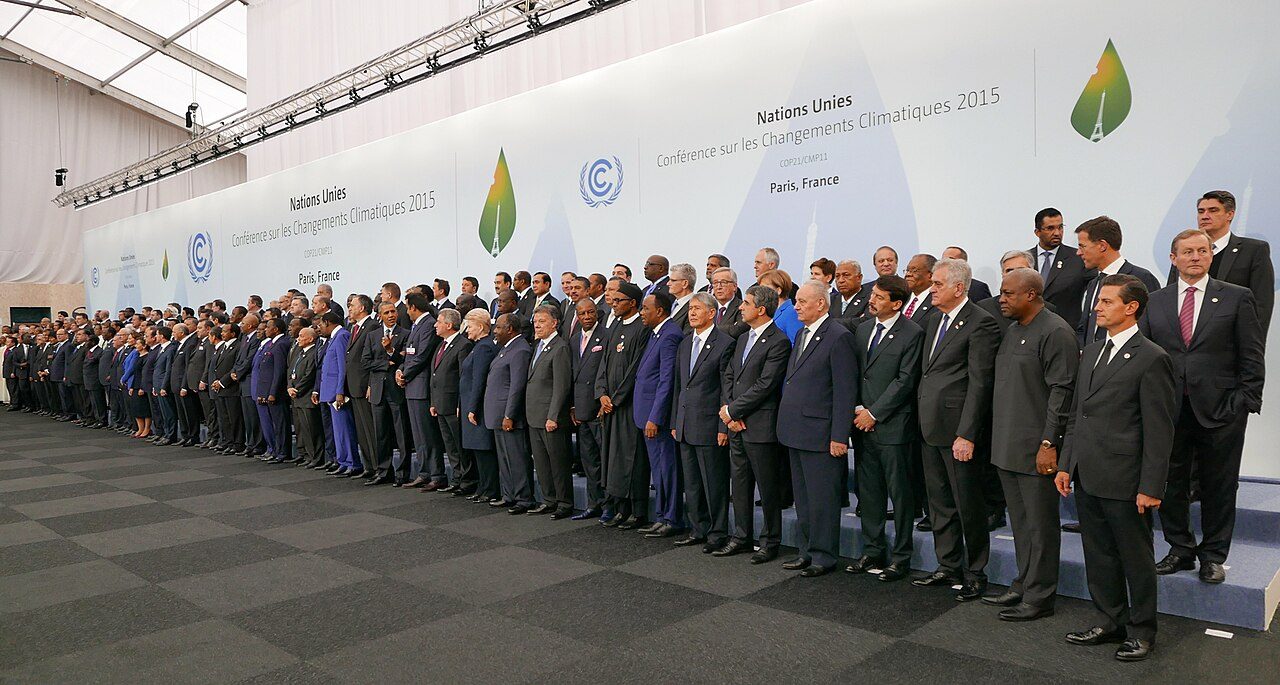
On 12 December 2015, after two weeks of negotiation at Le Bourget outside Paris, the Paris Agreement was adopted by consensus — the first climate treaty in which nearly every country on Earth pledged to cut the emissions warming the planet. December 12 is also the day Marconi received the first transatlantic radio signal, the Mona Lisa was recovered in Florence, and Pennsylvania ratified the U.S. Constitution.
Choose another date: open the On This Day calendar to browse events, births and deaths for any day of the year.
At a Glance
- Adopted
- 12 December 2015, by consensus at the COP21 conference at Le Bourget, Paris, by the parties to the UN Framework Convention on Climate Change
- The goal
- Hold warming well below 2°C above pre-industrial levels and pursue efforts to limit the rise to 1.5°C
- The mechanism
- Nationally determined contributions from every country, updated every five years — replacing the Kyoto Protocol's top-down targets
- Opened for signature
- 22 April 2016 (Earth Day) at the United Nations in New York
- Entered into force
- 4 November 2016, after at least 55 parties accounting for at least 55 percent of global emissions had ratified
- The near-miss
- A last-day crisis over the word 'shall' versus 'should' in the final text was resolved by treating it as a typographical error
Events on this day
- 1787Pennsylvania ratifies the U.S. Constitution by 46 votes to 23, becoming the second state to join the Union.
- 1846The Bidlack Treaty is signed, by which New Granada (Colombia) grants the United States transit rights across Panama, a foothold that eventually leads to the Panama Canal.
- 1901Guglielmo Marconi receives the first transatlantic radio signal — the letter 'S' in Morse code — sent from Poldhu, Cornwall, to St. John's, Newfoundland.
- 1913Leonardo da Vinci's Mona Lisa, stolen from the Louvre two years earlier, is recovered in Florence, where the thief Vincenzo Peruggia had tried to sell it.
- 1925The world's first motel, the Milestone Mo-Tel, opens in San Luis Obispo, California, midway between Los Angeles and San Francisco.
- 1936In the Xi'an Incident, Nationalist leader Chiang Kai-shek is seized by his own generals, who force him to ally with the Communists against Japan.
- 1937Japanese aircraft sink the U.S. gunboat Panay on China's Yangtze River, killing three Americans and straining relations four years before Pearl Harbor.
- 1963Kenya becomes independent from Britain, with Jomo Kenyatta as its first prime minister; exactly a year later it becomes a republic.
- 1977Saturday Night Fever premieres in New York, launching the disco era and making John Travolta a star.
- 2000The U.S. Supreme Court decides Bush v. Gore, halting the Florida recount and effectively awarding the 2000 presidential election to George W. Bush.
- 2009Houston elects Annise Parker, making it the largest U.S. city to choose an openly gay mayor.
- 2015The Paris Agreement on climate change is adopted by consensus at the COP21 conference — the featured story above.
Born on this day
- 1731Erasmus Darwin — English physician and naturalist, grandfather of Charles Darwin and an early thinker on evolution.
- 1805Henry Wells — American businessman who co-founded Wells Fargo and American Express.
- 1821Gustave Flaubert — French novelist, the perfectionist author of Madame Bovary.
- 1863Edvard Munch — Norwegian painter of The Scream, a defining image of modern anxiety.
- 1866Alfred Werner — Swiss chemist whose work on molecular structure won the Nobel Prize in Chemistry.
- 1915Frank Sinatra — American singer and actor, 'Ol' Blue Eyes', one of the best-selling recording artists of all time.
- 1923Bob Barker — American television host who fronted The Price Is Right for 35 years.
Died on this day
- 1889Robert Browning — English poet, master of the dramatic monologue, dead in Venice at 77.
- 1939Douglas Fairbanks — American actor, the swashbuckling star of silent films such as The Mark of Zorro.
- 1999Joseph Heller — American novelist whose Catch-22 gave the language a word for an absurd no-win dilemma.
- 2020John le Carré — British novelist who reinvented the spy story with Tinker Tailor Soldier Spy.
- 2020Charley Pride — American country singer, the first Black superstar of country music, dead of COVID-19 complications at 86.
The featured story: the Paris Agreement is adopted, 12 December 2015
For more than twenty years, the world's climate negotiations had produced frameworks, targets and disappointments: the Kyoto Protocol of 1997 bound only developed countries, and the Copenhagen summit of 2009 collapsed without a universal deal. The conference that opened at Le Bourget, a former airfield outside Paris, on 30 November 2015 was meant to succeed where Copenhagen had failed. Nearly 200 parties to the UN Framework Convention on Climate Change — 195 states and the European Union — had come with national pledges in hand, and the French hosts, presided over by foreign minister Laurent Fabius, were determined that no delegation would leave able to say it had not been heard.
The final day nearly broke the agreement over a single word. In the draft text, one clause said developed countries 'shall' undertake economy-wide emission targets; the United States objected that 'shall' would make the targets legally binding in a way its Senate would never accept, where 'should' would not. After hours of delay, the change was accepted as the correction of a typographical error, and on the evening of 12 December Fabius brought the conference back into session. Looking round the hall, he declared that he saw no objections — and brought down a small green gavel shaped like a leaf. 'It is a small gavel,' he said, 'but I think it can do a great job.' Delegates rose, cheered, wept and embraced: the Paris Agreement was adopted by consensus.
What they had agreed was a new kind of treaty. Every country, rich and poor, would set its own nationally determined contribution to cutting emissions and update it every five years, each update meant to be stronger than the last. Together the parties committed to hold global warming 'well below' 2 degrees Celsius above pre-industrial levels and to pursue efforts to limit it to 1.5 degrees — the threshold the most vulnerable island states had fought for. Developed countries pledged continued financial support to help poorer nations adapt and switch to clean energy. Unlike Kyoto, the agreement imposed no top-down targets and no penalties; its force was to come from transparency, repetition and peer pressure.
The agreement opened for signature at the United Nations in New York on Earth Day, 22 April 2016, and entered into force with remarkable speed on 4 November 2016, once at least 55 parties accounting for at least 55 percent of global emissions had ratified it. Whether it succeeds will be judged not in Paris but in the decades of rising or falling emissions that follow. But 12 December 2015 remains the day climate policy changed shape: the first time virtually every nation on Earth signed up, in a single legal instrument, to the same destination — and accepted that the world would be watching, every five years, to see if they were walking towards it.
Why this date matters
December 12 keeps staging encounters between the old world and the new. Pennsylvania's ratification in 1787 helped turn thirteen colonies into a union; Marconi's three faint dots in 1901 shrank the Atlantic to the width of a radio wave; a stolen Renaissance masterpiece came home to Florence in 1913 while, a world away, Kenya began its march out of empire. The date's modern signature, though, is negotiation against the clock: generals bargaining in Xi'an, judges deciding an election in Washington, and, above all, nearly two hundred nations in a Paris exhibition hall discovering that the hardest word in diplomacy can be the difference between 'shall' and 'should'.
Sources
- Encyclopaedia Britannica — On This Day: December 12
- HISTORY — This Day in History: December 12
- Encyclopaedia Britannica — Paris Agreement
- Wikipedia — Paris Agreement
- IISD Reporting Services — UNFCCC COP 21 Adopts Paris Agreement
The facts on this page were checked against these sources on 19 November 2026. The History Trail's permanent pages are researched and written for this site; the live profiles elsewhere on The History Trail are assembled automatically from Wikipedia and Wikidata.
About the Author
Researched and written by the The History Trail Editorial Team — the accountable editorial function behind this site's permanent story pages. The team works from the published sources cited on each page; it does not invent historians, reviewers or credentials, and it corrects errors openly.
Fact Check
Every load-bearing fact on this page traces to one of the sources listed above, and significant claims link to their source in the text. Our checking method is described on the methodology page; errors can be reported via the corrections page.
Sources & Citations
Cite this page as: The History Trail Editorial Team, The History Trail — this article's title, publication and update dates are shown beneath its headline. The full source list appears under Sources above; the site's source standards are on the sources page.