
On This Day
December 14 in History
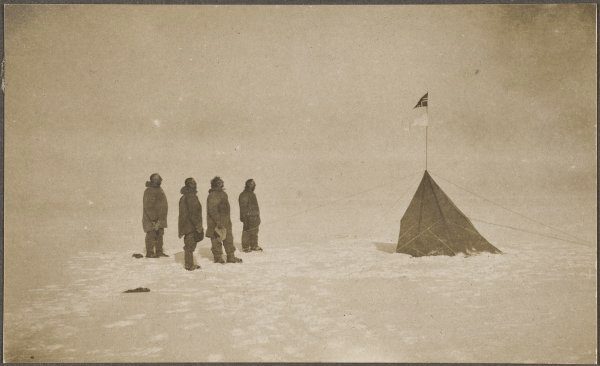
On 14 December 1911 the Norwegian explorer Roald Amundsen and four companions reached the geographic South Pole — the first people ever to stand there — about five weeks ahead of Robert Falcon Scott's British party. December 14 is also the day George Washington died, Max Planck unveiled quantum theory in Berlin, and the Sandy Hook shooting shocked the United States.
Choose another date: open the On This Day calendar to browse events, births and deaths for any day of the year.
At a Glance
- The party
- Five men — Roald Amundsen, Olav Bjaaland, Helmer Hanssen, Sverre Hassel and Oscar Wisting — with four sledges and 52 dogs
- Departure
- 19 October 1911, from Framheim, the expedition's base at the Bay of Whales on the Ross Ice Shelf
- Arrival
- About 3 p.m. on 14 December 1911; the party pitched a tent they called Polheim and planted the Norwegian flag
- The margin
- About five weeks before Robert Falcon Scott's party reached the Pole on 17 January 1912
- The return
- Back at Framheim on 25 January 1912, after 99 days on the journey, with 11 dogs surviving
- The secret
- Amundsen had publicly prepared for the North Pole and revealed the southern goal only after sailing, cabling Scott from Madeira
Events on this day
- 867Adrian II is elected pope in Rome, a pontificate that opens amid the growing schism between the Latin and Greek churches.
- 1799George Washington, first president of the United States, dies at Mount Vernon at 67, less than three years after leaving office.
- 1863President Abraham Lincoln pardons his sister-in-law Emilie Todd Helm, a Confederate general's widow, after she takes an oath of loyalty.
- 1900Max Planck presents his quantum theory to the German Physical Society in Berlin, proposing that energy is emitted in discrete packets — the birth of quantum physics.
- 1911Roald Amundsen and four companions reach the South Pole, the first people to stand there — the featured story above.
- 1939The League of Nations expels the Soviet Union for its invasion of Finland, the only expulsion in the League's history.
- 1960The convention establishing the Organisation for Economic Co-operation and Development (OECD) is signed in Paris.
- 2012A gunman kills 26 people, including 20 children, at Sandy Hook Elementary School in Newtown, Connecticut, one of the deadliest school shootings in U.S. history.
Born on this day
- 1503Nostradamus — French astrologer and physician whose cryptic Prophecies have been read as predictions for nearly five centuries.
- 1546Tycho Brahe — Danish astronomer whose precise observations of the planets made Kepler's laws of motion possible.
- 1895George VI — king of the United Kingdom who led Britain through the Second World War after his brother's abdication.
- 1896Jimmy Doolittle — American aviator who led the first U.S. bombing raid on Tokyo in 1942.
- 1922Nikolay Basov — Soviet physicist who shared the Nobel Prize for work leading to the laser and maser.
Died on this day
- 1799George Washington — first U.S. president, dead at Mount Vernon at 67, of a throat infection, two days after riding round his estate in bad weather.
- 1943John Harvey Kellogg — American physician and health reformer who, with his brother, created corn flakes and the breakfast-cereal industry.
- 1980Richard G. Drew — American inventor at 3M who created masking tape and Scotch tape.
- 2013Peter O'Toole — Irish actor, star of Lawrence of Arabia, who received eight Oscar nominations without a win.
The featured story: Amundsen reaches the South Pole, 14 December 1911
The race for the South Pole was not supposed to involve Roald Amundsen at all. The Norwegian explorer had borrowed the ship Fram and raised money for an expedition to the North Pole — and then, when rival claims to the northern prize made it worthless, he changed his mind in secret. Only his brother and a handful of others knew. Amundsen sailed south in 1910 still publicly bound for the Arctic, and revealed the true destination only when the ship reached Madeira, from where he sent a famously blunt telegram to his rival: Robert Falcon Scott, camped in Antarctica preparing his own attempt, learned that the race was on.
Amundsen built his base, Framheim, at the Bay of Whales on the Ross Ice Shelf, and spent the Antarctic winter preparing with the discipline of a man who had learned polar travel from the Inuit and from his own crossing of the Northwest Passage. Where Scott relied on ponies and motor sledges as well as men and dogs, Amundsen staked everything on skis and Greenland dogs — 52 of them for the polar journey. After one false start in the spring cold, the real attempt began on 19 October 1911: five men — Amundsen, Olav Bjaaland, Helmer Hanssen, Sverre Hassel and Oscar Wisting — four sledges, and a route up the previously unknown Axel Heiberg Glacier onto the polar plateau.
On 8 December they passed the farthest point south reached by Ernest Shackleton three years earlier, a moment that moved Amundsen to tears. Six days later, in the early afternoon of 14 December 1911, the dog drivers called a halt at the same instant: their sledge-meters showed the full distance. 'The goal was reached, the journey ended,' Amundsen wrote. The five men planted the Norwegian flag, named the plateau for King Haakon VII, and spent three days taking observations and skiing out in every direction to make certain of their position, before leaving a tent — Polheim — containing a letter for their king, in case they did not return.
They did return, reaching Framheim on 25 January 1912 after 99 days, with 11 dogs surviving. Scott's party of five reached the Pole on 17 January 1912, found the Norwegian tent and letter, and perished on the journey back — a tragedy that for decades overshadowed the Norwegian achievement in the English-speaking world. But the verdict of 14 December stands: the last great geographical prize on Earth was won not by dash but by preparation — by the team that treated the Pole as a logistics problem, solved it, and came home without losing a man.
Why this date matters
December 14 is a date of extremes arriving quietly. A pope takes office in the ninth century; the father of the United States dies in his bed while, a century later, a German professor in Berlin announces the idea that will dissolve classical physics. Above all it is the date of the Pole: five Norwegians on skis, in the middle of the emptiest place on Earth, calling 'Halt' at three in the afternoon and finding nothing there but the end of the world they had travelled so far to reach. The date's pattern is understatement — Washington's death, Planck's lecture and Amundsen's arrival were all, on the day, smaller than what they turned out to mean.
Sources
- Encyclopaedia Britannica — On This Day: December 14
- HISTORY — This Day in History: December 14
- Wikipedia — Amundsen's South Pole expedition
- Norwegian Polar Institute — The 1911 expedition to the South Pole
The facts on this page were checked against these sources on 19 November 2026. The History Trail's permanent pages are researched and written for this site; the live profiles elsewhere on The History Trail are assembled automatically from Wikipedia and Wikidata.
About the Author
Researched and written by the The History Trail Editorial Team — the accountable editorial function behind this site's permanent story pages. The team works from the published sources cited on each page; it does not invent historians, reviewers or credentials, and it corrects errors openly.
Fact Check
Every load-bearing fact on this page traces to one of the sources listed above, and significant claims link to their source in the text. Our checking method is described on the methodology page; errors can be reported via the corrections page.
Sources & Citations
Cite this page as: The History Trail Editorial Team, The History Trail — this article's title, publication and update dates are shown beneath its headline. The full source list appears under Sources above; the site's source standards are on the sources page.