
On This Day
December 15 in History
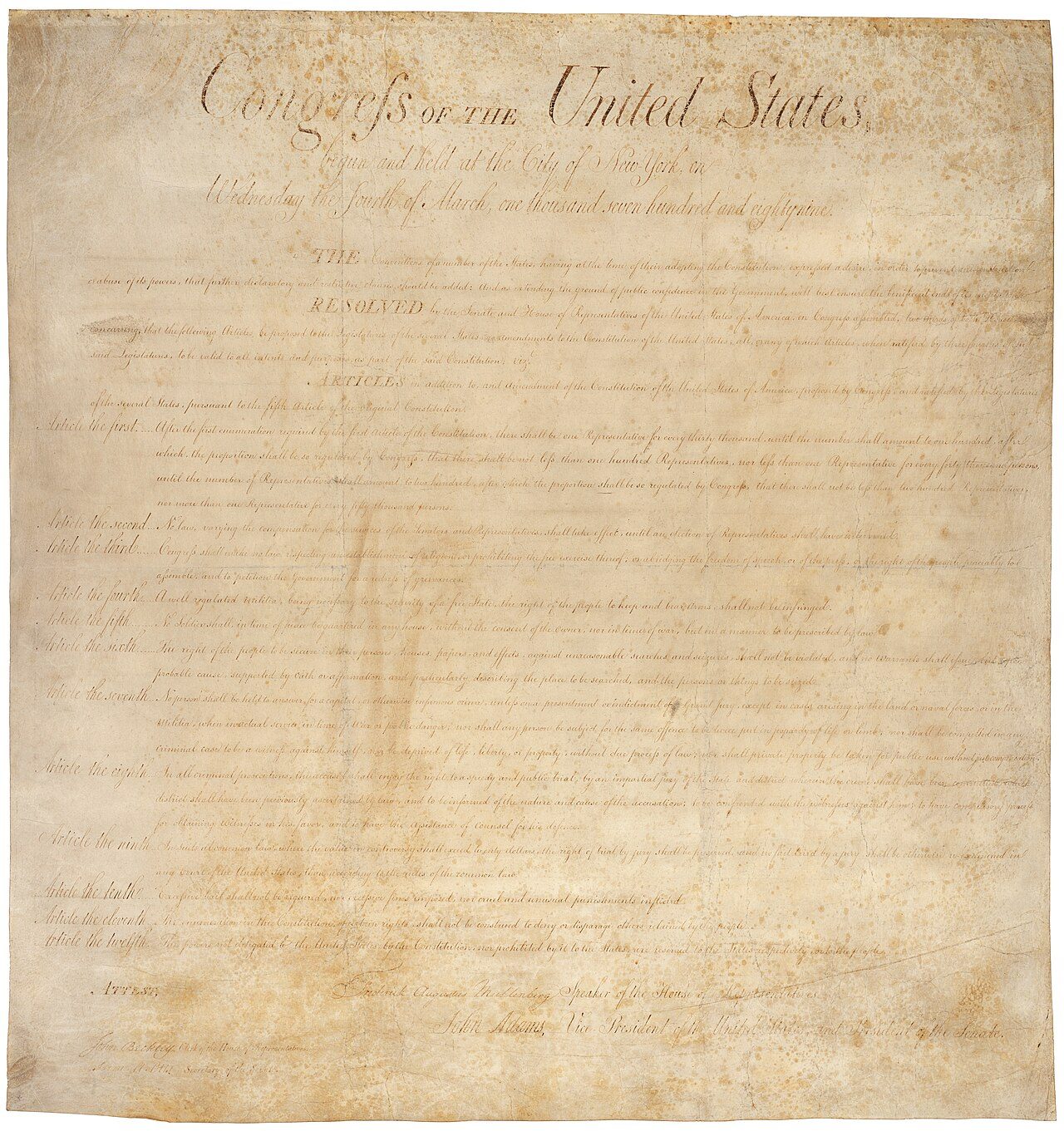
On 15 December 1791 Virginia became the eleventh state to ratify the first ten amendments to the United States Constitution, completing the Bill of Rights — the charter of freedoms of speech, religion, press and fair trial that still anchors American law. December 15 is also the day Sitting Bull was killed, Gone with the Wind premiered in Atlanta, and Walt Disney died.
Choose another date: open the On This Day calendar to browse events, births and deaths for any day of the year.
At a Glance
- Proposed
- Congress proposed twelve amendments to the states on 25 September 1789
- Ratified
- 15 December 1791, when Virginia became the eleventh state to approve — three-fourths of the fourteen states then in the Union
- What became law
- Proposed Articles Three to Twelve, renumbered as the First to Tenth Amendments
- The guarantees
- Religion, speech, press, assembly, arms, security against unreasonable searches, due process, fair trials and protection from cruel and unusual punishment
- The driver
- James Madison, who steered the amendments through the First Congress to answer demands for explicit limits on federal power
- The leftover
- The proposed article on congressional pay was ratified 203 years later, in 1992, as the Twenty-Seventh Amendment
Events on this day
- 1791The first ten amendments to the U.S. Constitution — the Bill of Rights — are ratified when Virginia becomes the eleventh state to approve them — the featured story above.
- 1890Sitting Bull, the Lakota leader who had helped defeat Custer at the Little Bighorn, is killed by Indian agency police during an attempt to arrest him at Standing Rock.
- 1917Revolutionary Russia signs an armistice with the Central Powers, taking itself out of the First World War ahead of the Treaty of Brest-Litovsk.
- 1939Gone with the Wind, the film of Margaret Mitchell's novel, premieres in Atlanta, Georgia; it will become the highest-grossing film of its era.
- 1944American bandleader Glenn Miller's plane disappears over the English Channel on a flight to Paris, where his orchestra was to entertain U.S. troops.
- 1961Adolf Eichmann, the Nazi official who organised the logistics of the Holocaust, is sentenced to death by an Israeli court in Jerusalem.
- 1973The American Psychiatric Association votes to remove homosexuality from its official list of mental disorders.
- 1978The United States announces it will establish full diplomatic relations with the People's Republic of China from 1 January 1979, ending formal ties with Taiwan's government.
- 1993Schindler's List, Steven Spielberg's film of the Holocaust, opens in the United States.
- 2001The Leaning Tower of Pisa reopens to the public after eleven years of stabilisation work to stop it toppling.
Born on this day
- 37Nero — last emperor of Rome's Julio-Claudian dynasty, whose reign ended in revolt and his own forced suicide.
- 1832Gustave Eiffel — French engineer whose Paris tower, finished for the 1889 world's fair, became France's emblem.
- 1892J. Paul Getty — American oil magnate, once the world's richest private citizen and founder of the Getty Museum.
- 1899Harold Abrahams — British sprinter whose 100 metres gold at the 1924 Olympics was dramatised in Chariots of Fire.
- 1907Oscar Niemeyer — Brazilian architect who designed the modernist capital Brasília and lived to 104.
Died on this day
- 1890Sitting Bull — Lakota holy man and leader, killed at Standing Rock at about 59, two weeks before the massacre at Wounded Knee.
- 1944Glenn Miller — American big-band leader, missing over the English Channel at 40 while flying to entertain troops in liberated Paris.
- 1966Walt Disney — American animator and studio founder, dead of lung cancer in Burbank at 65.
The featured story: the Bill of Rights is ratified, 15 December 1791
The United States Constitution, as drafted in 1787, contained no bill of rights — and that omission nearly killed it. State after state ratified only on the understanding that amendments protecting individual liberty would follow, and Anti-Federalist critics warned that a federal government without explicit limits could tax, search, censor and imprison as it pleased. James Madison, who had helped write the original document, took the task on himself in the First Congress, sifting the amendments the states had proposed into a list that could pass. Congress approved twelve amendments and sent them to the states on 25 September 1789.
The states then took more than two years over them. New Jersey led in November 1789; others followed through 1790. The arithmetic kept shifting under the process: when Vermont joined the Union in 1791 and ratified that November, it became the tenth state to approve — but its admission had raised the total number of states to fourteen, so eleven approvals were now needed, not ten. The last of them came from Virginia, Madison's own state, whose General Assembly ratified the amendments on 15 December 1791. With that vote, ten of the twelve proposed articles — the third through the twelfth — became part of the Constitution: the Bill of Rights.
Their contents are now the most quoted sentences in American law. The first ten amendments guarantee freedom of religion, speech, the press and assembly; protect the right to bear arms and the security of homes against unreasonable searches and soldiers quartered in them; promise due process, speedy public trials and juries; and forbid excessive bail and cruel and unusual punishments. The last two reserve unlisted rights to the people and unlisted powers to the states. At first they bound only the federal government, not the states — a limitation that later centuries, through the Fourteenth Amendment and the courts, would steadily undo.
The two articles that failed in 1791 have their own afterlives. The first, regulating the size of congressional districts, was never ratified and remains, technically, pending before the states. The second, barring Congress from raising its own pay before an election intervenes, slept for two centuries before a ratification campaign revived it — and on 7 May 1992 it was proclaimed the Twenty-Seventh Amendment, completing a 203-year journey begun the day the Bill of Rights was proposed. It is fitting that the story ends in delay: the Bill of Rights itself was a promise made in 1788, kept on 15 December 1791 — the date now marked each year in the United States as Bill of Rights Day.
Why this date matters
December 15 is a day about the terms on which power may be used. Its centre is a list of things a government may not do, ratified in 1791 — and around it the date arranges its counterpoints: a Lakota leader killed by the police of the government his people never consented to join, a Nazi bureaucrat sentenced by a court determined to do justice by law rather than vengeance, psychiatrists voting to stop calling a class of citizens ill, and two superpowers formally recognising each other after thirty years. Again and again on this date, authority is not seized or celebrated but limited, judged or brought to account.
Sources
- Encyclopaedia Britannica — On This Day: December 15
- HISTORY — This Day in History: December 15
- National Archives — The Bill of Rights: A Transcription
- Library of Congress — Constitution Annotated: Bill of Rights
- Library of Virginia — The Bill of Rights to the U.S. Constitution, December 15, 1791
The facts on this page were checked against these sources on 19 November 2026. The History Trail's permanent pages are researched and written for this site; the live profiles elsewhere on The History Trail are assembled automatically from Wikipedia and Wikidata.
About the Author
Researched and written by the The History Trail Editorial Team — the accountable editorial function behind this site's permanent story pages. The team works from the published sources cited on each page; it does not invent historians, reviewers or credentials, and it corrects errors openly.
Fact Check
Every load-bearing fact on this page traces to one of the sources listed above, and significant claims link to their source in the text. Our checking method is described on the methodology page; errors can be reported via the corrections page.
Sources & Citations
Cite this page as: The History Trail Editorial Team, The History Trail — this article's title, publication and update dates are shown beneath its headline. The full source list appears under Sources above; the site's source standards are on the sources page.