
Years
1895 in History
1895 is remembered for a closing season of wonders: in November Wilhelm Röntgen discovered X-rays in Würzburg and Alfred Nobel signed the will that created the Nobel Prizes, and on 28 December the Lumière brothers gave the first paid public film screening in Paris — the same day Röntgen announced his rays to the world. It was the year modern seeing, modern honour and modern entertainment all began at once.
At a Glance
- Defining event
- Wilhelm Röntgen discovers X-rays at Würzburg, 8 November 1895
- The announcement
- Röntgen submits 'On a New Kind of Rays' on 28 December 1895; hospitals are using X-rays within a year
- The will
- Alfred Nobel signs his final will in Paris, 27 November, leaving some 31 million kronor to endow five prizes
- Cinema begins
- The Lumière brothers' first commercial public screening, Salon Indien, Paris, 28 December — ten short films for a paying audience
- The year's injustice
- Alfred Dreyfus is degraded in Paris and imprisoned on Devil's Island; Oscar Wilde is convicted and jailed in London
- Born this year
- Babe Ruth (6 February), Buster Keaton (4 October) and George VI (14 December)
The defining story: the invisible made visible
On the evening of Friday 8 November 1895, Wilhelm Conrad Röntgen, professor of physics at the University of Würzburg, was working alone in his darkened laboratory with a discharge tube sealed in black cardboard — when, across the room, a screen coated with barium platinocyanide began to glow. No known ray should have done that: cathode rays travel only a few centimetres in air, and the cardboard blocked all light. Something entirely new was passing through the room, through wood and books and flesh, and stopping at bone and lead.
Röntgen spent the next seven weeks in his laboratory, eating and sleeping there, testing the unknown radiation and telling almost no one. Because he did not know what the rays were, he named them with the mathematician's symbol for the unknown: X. On 22 December he made the image that carried the discovery around the world — an X-ray photograph of his wife Anna Bertha's hand, her finger bones dark inside the faint outline of flesh, her wedding ring solid black. A week later, on 28 December, he submitted his paper 'On a New Kind of Rays' to the Würzburg Physical-Medical Society. Within weeks laboratories everywhere were repeating the experiment; within a year, hospitals were using X-rays to find bullets and set bones, and in 1901 Röntgen received the first Nobel Prize in Physics.
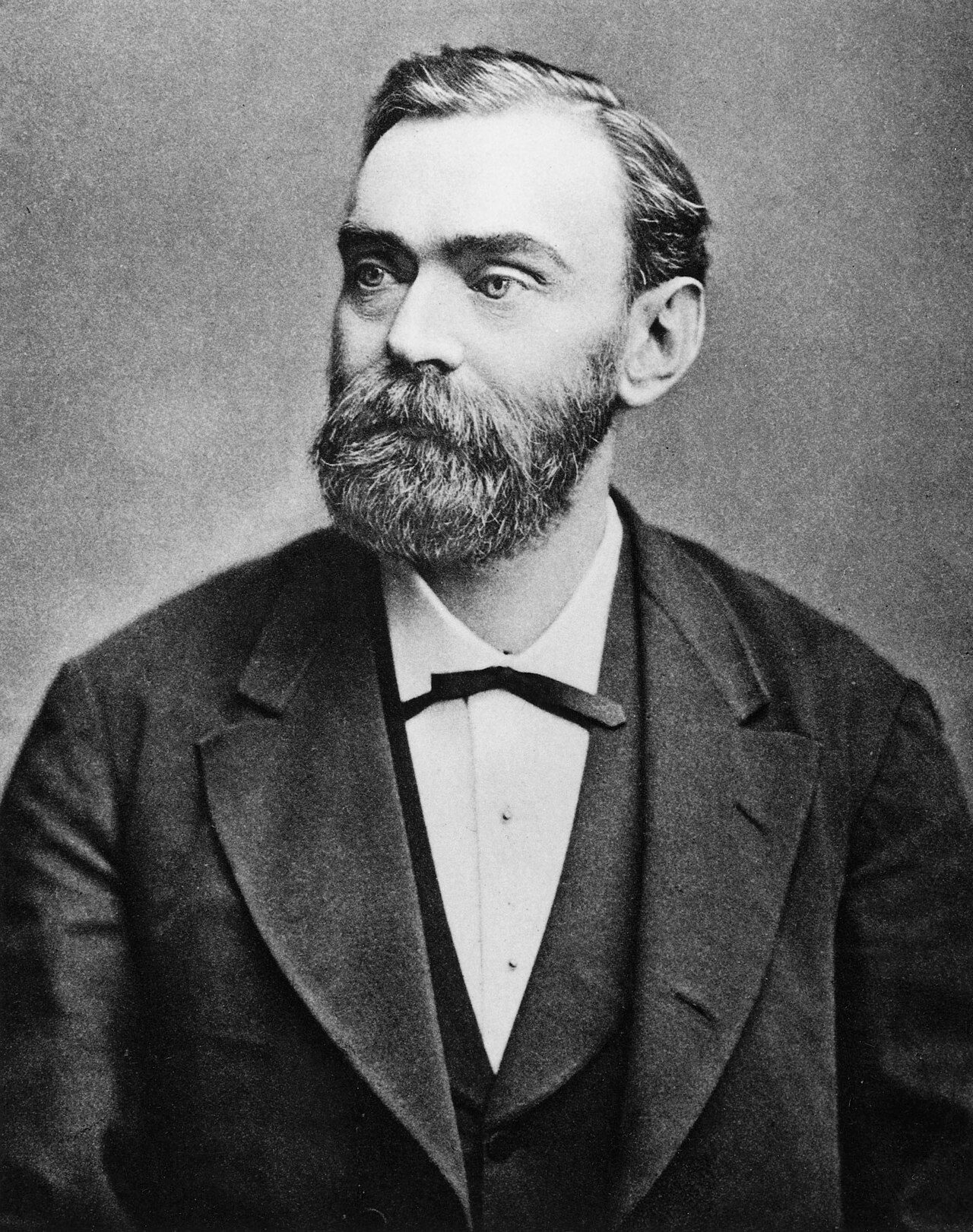
That prize existed because of the year's other November signature. On 27 November, at the Swedish-Norwegian Club in Paris, Alfred Nobel — the inventor of dynamite, holder of more than 350 patents — signed his third and final will. After specific legacies, the whole of his remaining fortune, some 31 million Swedish kronor, was to form a fund whose annual interest would be divided into five prizes, for physics, chemistry, physiology or medicine, literature and peace, awarded to those who had conferred the greatest benefit to humankind — with nationality expressly irrelevant. A French newspaper had once published his obituary by mistake under the headline 'The merchant of death is dead'; the will was his answer.
And on the very day Röntgen's paper was submitted, 28 December, Paris gave the year its third beginning. In the Salon Indien, the basement of the Grand Café, Auguste and Louis Lumière projected ten short films with their Cinématographe to a small paying audience — fewer than forty people, at one franc each — opening with workers leaving their father's factory. Within days, queues stretched down the boulevard, with more than 2,000 spectators a day reported in the first days of January 1896. In a single evening, the movies became a business.
Timeline of 1895
- 5 January
Alfred Dreyfus is publicly degraded in Paris, stripped of his rank and insignia before his exile to Devil's Island.
- 6 February
Babe Ruth, the American baseball legend whose 714 home runs defined the sport's heroic age, is born.
- 20 February
Frederick Douglass, who escaped slavery to become the leading abolitionist voice of his century, dies.
- 5 April
Playwright Oscar Wilde is arrested in London on charges of gross indecency, the beginning of his fall and imprisonment.
- 13 April
Alfred Dreyfus is imprisoned on Devil's Island off French Guiana, after a treason conviction driven by antisemitism; he is eventually cleared.
- 17 April
The Treaty of Shimonoseki ends the First Sino-Japanese War, with China ceding Taiwan and recognising Korean independence.
- 25 May
Oscar Wilde is convicted of gross indecency in London and sentenced to two years' hard labour.
- 28 September
Louis Pasteur, who proved the germ theory of disease and invented pasteurisation, dies.
- 8 November
Wilhelm Röntgen discovers X-rays in his Würzburg laboratory.
- 27 November
Alfred Nobel signs his last will in Paris, leaving his fortune to found the Nobel Prizes.
- 14 December
George VI, who will lead Britain through the Second World War as king, is born.
- 28 December
The Lumière brothers give the first paid public screening of projected films at the Grand Café in Paris, and Röntgen submits his report announcing X-rays.
Why 1895 still matters
Few years have started so many permanent institutions of modern life in so few weeks. X-rays gave medicine sight inside the living body — a capability so immediately useful that hospitals adopted it within a year, before anyone understood its dangers. The Nobel will converted an explosives fortune into the world's standing definition of achievement in science, literature and peace; its first prizes were presented on 10 December 1901, the fifth anniversary of Nobel's death, and Röntgen himself was the first physics laureate — the year's two November stories literally meeting on the same podium.
The Lumière screening founded the century's dominant art form as a commercial proposition: a machine that could record, print and project, an audience that paid, and a programme of ten films each under a minute. Everything in cinema since — the feature film, the newsreel, the documentary, the global star — descends from that basement room and its one-franc admissions.
Against those beginnings the year also displayed the era's injustices at full strength. Dreyfus, an innocent officer, was degraded and shipped to Devil's Island because he was Jewish; Wilde, at the height of his fame, was destroyed by prosecution for his private life. Both cases became defining scandals of the age — reminders that the same civilisation learning to see through flesh and project moving light could not yet see two of its own citizens clearly.
1895 on The History Trail
Three featured stories anchor this year on The History Trail: X-rays, the Nobel will and the first night of the movies.
- November 8 in History — Wilhelm Röntgen discovers X-rays in Würzburg, the featured story of the discovery.
- November 27 in History — Alfred Nobel signs the will establishing the Nobel Prizes.
- December 28 in History — The Lumière brothers' first public cinema screening, and Röntgen's X-ray paper, on the same day.
- January 5 in History — Alfred Dreyfus is publicly degraded in Paris.
- May 25 in History — Oscar Wilde is convicted in London and sentenced to hard labour.
- February 6 in History — Babe Ruth, baseball's Sultan of Swat, is born.
- Rugby union — The game whose great split into union and league belongs to this era.
Sources
- Encyclopaedia Britannica — On This Day: November 8
- Nobel Prize — Wilhelm Conrad Röntgen: Biographical
- Encyclopaedia Britannica — On This Day: November 27
- Nobel Prize — Alfred Nobel's will
- Encyclopaedia Britannica — On This Day: December 28
- Smithsonian Magazine — Poster From One of the Earliest Public Movie Screenings Is Heading to Auction
- Encyclopaedia Britannica — On This Day: January 5
- Encyclopaedia Britannica — On This Day: April 17
The facts on this page were checked against these sources on 19 November 2026. The History Trail's permanent pages are researched and written for this site; the live profiles elsewhere on The History Trail are assembled automatically from Wikipedia and Wikidata.
About the Author
Researched and written by the The History Trail Editorial Team — the accountable editorial function behind this site's permanent story pages. The team works from the published sources cited on each page; it does not invent historians, reviewers or credentials, and it corrects errors openly.
Fact Check
Every load-bearing fact on this page traces to one of the sources listed above, and significant claims link to their source in the text. Our checking method is described on the methodology page; errors can be reported via the corrections page.
Sources & Citations
Cite this page as: The History Trail Editorial Team, The History Trail — this article's title, publication and update dates are shown beneath its headline. The full source list appears under Sources above; the site's source standards are on the sources page.