
On This Day
February 6 in History
On 6 February 1952 King George VI died in his sleep at Sandringham, and his twenty-five-year-old daughter, in Kenya on a Commonwealth tour, became Queen Elizabeth II — beginning what would be the longest reign in British history. February 6 is also the day of the Treaty of Waitangi, the Munich air disaster, and the births of Babe Ruth, Ronald Reagan and Bob Marley.
Choose another date: open the On This Day calendar to browse events, births and deaths for any day of the year.
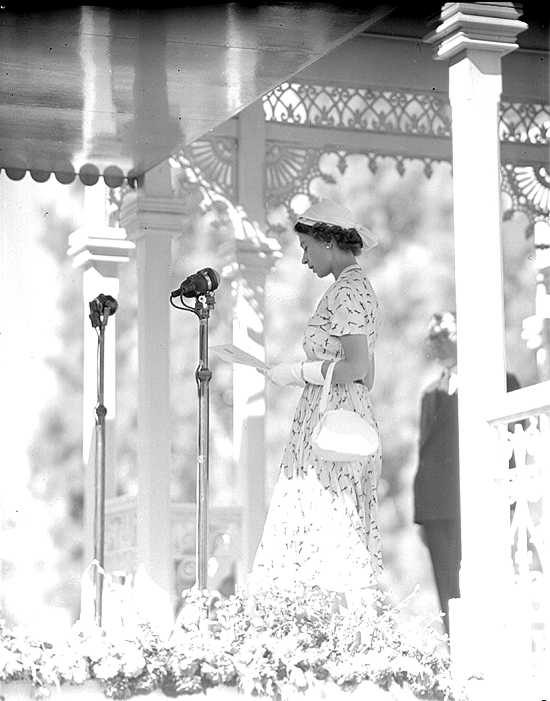
At a Glance
- The king
- George VI, 56, died in his sleep at Sandringham House, Norfolk, in the early hours of 6 February 1952
- The new queen
- Princess Elizabeth, 25, was in Kenya with Prince Philip, standing in for her ailing father on a Commonwealth tour
- The night before
- She had spent the night of 5–6 February at Treetops Hotel, watching game from a platform in the trees
- The accession
- She became queen the instant her father died; the Accession Council proclaimed her in London the same day
- The coronation
- She was crowned at Westminster Abbey on 2 June 1953
- The reign
- Seventy years and 214 days — the longest of any British monarch — ending with her death on 8 September 2022
Events on this day
- 1778France signs treaties of alliance and commerce with the United States, recognising American independence and transforming the Revolutionary War.
- 1820The first organised party of formerly enslaved people sails from New York for Sierra Leone under the American Colonization Society.
- 1840British representatives and Maori chiefs sign the Treaty of Waitangi, New Zealand's founding document — whose English and Maori texts say different things about sovereignty.
- 1862Union forces under Ulysses S. Grant and Andrew Foote capture Fort Henry in Tennessee, opening the Tennessee River to Union gunboats.
- 1891The Dalton Gang attempts its first train robbery, near Alila, California, beginning a short career as the West's most wanted outlaws.
- 1937John Steinbeck's novella Of Mice and Men is published, becoming an enduring classic of American literature.
- 1952George VI dies and his daughter becomes Queen Elizabeth II — the featured story above.
- 1958A plane carrying the Manchester United team crashes on takeoff at Munich; twenty-three people die, including eight of the 'Busby Babes'.
- 1985President Ronald Reagan sets out the 'Reagan Doctrine' of support for anti-communist fighters in his State of the Union address.
- 2018SpaceX launches its Falcon Heavy rocket for the first time, sending a Tesla Roadster toward solar orbit.
- 2023A devastating earthquake strikes southern Turkey and northern Syria, killing tens of thousands of people.
Born on this day
- 1895Babe Ruth — American baseball legend, the 'Sultan of Swat', whose 714 home runs defined the sport's heroic age.
- 1911Ronald Reagan — fortieth president of the United States, former film actor and governor of California.
- 1917Zsa Zsa Gabor — Hungarian-American actress and socialite, a byword for Hollywood glamour.
- 1932Francois Truffaut — French director, a founder of the New Wave with The 400 Blows.
- 1945Bob Marley — Jamaican singer-songwriter who carried reggae and the Rastafari message to the world.
- 1966Rick Astley — English singer whose 'Never Gonna Give You Up' became both a hit and an internet phenomenon.
Died on this day
- 1952George VI — king of the United Kingdom through the Second World War, dead at Sandringham at 56; his death brings Elizabeth II to the throne.
- 1993Arthur Ashe — American tennis champion, the first Black man to win Wimbledon, dead of AIDS-related illness at 49.
- 1998Falco — Austrian pop star of 'Rock Me Amadeus', killed in a car accident in the Dominican Republic at 40.
- 2012Antoni Tapies — Catalan painter and sculptor, one of Spain's greatest postwar artists, dead at 88.
The featured story: Elizabeth II becomes queen, 6 February 1952
George VI had never expected to be king, and the burden — a shy man with a stammer, thrust onto the throne by his brother's abdication in 1936, then through six years of total war — had consumed his health. By 1951 he had lung cancer, though he was not told its name. A planned Commonwealth tour was more than he could manage, so in January 1952 Princess Elizabeth and Prince Philip set out in his place. The king waved them off at London Airport on 31 January, standing bareheaded in the cold. It was the last time father and daughter saw each other.
In Kenya the royal couple spent the night of 5 February at Treetops, a small hotel built into the branches of a giant fig tree overlooking a waterhole, watching elephants and rhino by floodlight. In the early hours of 6 February, at Sandringham, George VI died in his sleep of a coronary thrombosis. By the law of succession his daughter became queen at that instant, asleep on another continent. The news reached Kenya slowly — broken first by a wire-service report, confirmed by official telegram — and it was Philip who told his wife, walking her in the garden of Sagana Lodge. As the hunter Jim Corbett, who was at Treetops, wrote in the visitors' book, for the first time in history a young girl had climbed into a tree one day a princess and climbed down the next a queen.
The machinery of monarchy moved at once. In London the Accession Council met at St James's Palace on 6 February and proclaimed Elizabeth II queen of the United Kingdom and of her other realms — she was also queen of Canada, Australia, New Zealand, South Africa, Pakistan and Ceylon, and Head of the Commonwealth. The new queen flew home through gathering mourning, landing in London on 7 February in black, to be greeted by her prime minister, the seventy-seven-year-old Winston Churchill — the first of fifteen British prime ministers who would serve under her. Her coronation followed on 2 June 1953, the first to be televised.
No one at Treetops could have imagined the scale of what had begun. Elizabeth II reigned for seventy years and 214 days — longer than any other British monarch — through the end of empire, the Cold War, the digital revolution and a pandemic, becoming in her lifetime the most widely travelled and widely recognised head of state in the world. When she died on 8 September 2022, the accession that began in a Kenyan treehouse closed as the defining constant of several generations' public life. The instant, unceremonious way she became queen — a daughter learning of her father's death six thousand miles from home — set the pattern of a reign in which duty always arrived before feeling.
Why this date matters
February 6 is a day of inheritance. A queen inherits a throne in Kenya in 1952; Maori chiefs and the British Crown sign a treaty in 1840 whose contested inheritance New Zealand still negotiates; France's alliance of 1778 hands the American revolution its lifeline. The day's births are heirs of a different kind — Ruth, Reagan and Marley, each inheriting an art form and remaking it. And its shadows are inheritances too: the Munich crash that widowed a football team, and the earthquake of 2023. What passes from one generation to the next is this date's whole subject.
Sources
- Encyclopaedia Britannica — On This Day: February 6
- HISTORY — What Happened on February 6
- The Royal Family — The Queen's Accession and Coronation
- National Archives — The Coronation of Queen Elizabeth II
The facts on this page were checked against these sources on 19 November 2026. The History Trail's permanent pages are researched and written for this site; the live profiles elsewhere on The History Trail are assembled automatically from Wikipedia and Wikidata.
About the Author
Researched and written by the The History Trail Editorial Team — the accountable editorial function behind this site's permanent story pages. The team works from the published sources cited on each page; it does not invent historians, reviewers or credentials, and it corrects errors openly.
Fact Check
Every load-bearing fact on this page traces to one of the sources listed above, and significant claims link to their source in the text. Our checking method is described on the methodology page; errors can be reported via the corrections page.
Sources & Citations
Cite this page as: The History Trail Editorial Team, The History Trail — this article's title, publication and update dates are shown beneath its headline. The full source list appears under Sources above; the site's source standards are on the sources page.