
On This Day
February 5 in History
On 5 February 146 BC, by tradition, the Punic Wars between Rome and Carthage came to an end after more than a century, with Carthage destroyed and Rome left master of the western Mediterranean. February 5 is also the day Mexico proclaimed its modern constitution, Hollywood's stars founded United Artists, and Hank Aaron was born.
Choose another date: open the On This Day calendar to browse events, births and deaths for any day of the year.
At a Glance
- The wars
- Three wars between Rome and Carthage, fought from 264 to 146 BC for mastery of the western Mediterranean
- The final war
- The Third Punic War (149–146 BC), in which Rome besieged Carthage itself for three years
- The commander
- Scipio Aemilianus, the Roman general who took and destroyed the city in 146 BC
- The city
- Carthage, in modern Tunisia, one of the richest trading cities of the ancient world
- The outcome
- The city was destroyed, its surviving people enslaved, and its territory became the Roman province of Africa
- The legacy
- Rome emerged without a rival in the Mediterranean, which it would dominate for centuries
Events on this day
- 146 BCThe Punic Wars end after more than a century, as Rome destroys Carthage and takes command of the western Mediterranean — the featured story above.
- 1631Roger Williams, founder of Rhode Island and champion of religious liberty, arrives in Boston in the Massachusetts Bay Colony.
- 1777Georgia adopts a state constitution and becomes the first American state to abolish primogeniture and entail in inheritance.
- 1883The Southern Pacific Railroad completes its Sunset Route from New Orleans to California, a second transcontinental link.
- 1917President Venustiano Carranza proclaims the Mexican constitution, a landmark document of the Mexican Revolution promising land reform and labour rights.
- 1917The United States ends its eleven-month Punitive Expedition into Mexico, having failed to capture Pancho Villa.
- 1917Congress passes the Immigration Act of 1917 over President Wilson's veto, imposing a literacy test and barring most Asian immigration.
- 1919Charlie Chaplin, Mary Pickford, Douglas Fairbanks and D. W. Griffith found United Artists, the first studio owned by its stars.
- 1937President Franklin D. Roosevelt announces his 'court-packing' plan to expand the Supreme Court, provoking a constitutional storm.
- 1994Byron De La Beckwith is convicted, thirty-one years later, of the 1963 murder of civil rights leader Medgar Evers.
- 2003Secretary of State Colin Powell addresses the United Nations, arguing that Iraq possesses weapons of mass destruction.
- 2020The United States Senate acquits President Donald Trump in his first impeachment trial.
Born on this day
- 1840John Boyd Dunlop — Scottish inventor who patented the practical pneumatic tyre and gave his name to the tyre company.
- 1914William S. Burroughs — American novelist of Naked Lunch and a central figure of the Beat Generation.
- 1934Hank Aaron — American baseball great who broke Babe Ruth's home run record and hit 755 home runs in his career.
- 1985Cristiano Ronaldo — Portuguese footballer, one of the most decorated and prolific players in the history of the game.
- 1992Neymar — Brazilian footballer, among the most gifted forwards of his generation.
Died on this day
- 1881Thomas Carlyle — Scottish historian and essayist, the sage of Victorian letters, dead in London at 85.
- 2008Maharishi Mahesh Yogi — Indian guru who brought Transcendental Meditation to the West and taught the Beatles.
- 2020Kirk Douglas — American screen legend of Spartacus, the last great star of Hollywood's golden age, dead at 103.
- 2021Christopher Plummer — Canadian actor, the eldest Oscar winner in acting, dead at 91 in Connecticut.
The featured story: the Punic Wars end and Carthage falls, 5 February 146 BC
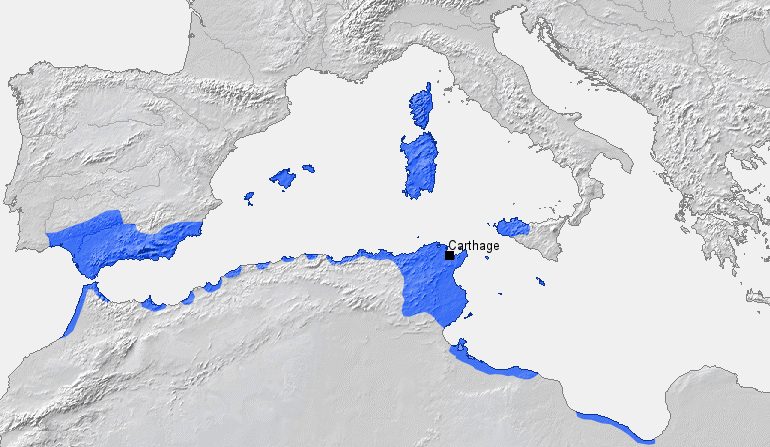
For more than a century, two cities fought for the western Mediterranean. Carthage, founded by Phoenicians on the coast of modern Tunisia, was the older and richer power: a maritime empire of traders whose ships and colonies ringed Sicily, Sardinia, Corsica and southern Spain. Rome was the rising land power of Italy. Their collision began in 264 BC over Sicily and produced three wars — the Punic Wars, from the Latin Poeni, 'Phoenicians' — including Hannibal's legendary crossing of the Alps with elephants in the Second, when Rome came within sight of destruction at Cannae yet refused to surrender, and finally ground Carthage down.
By the peace of 201 BC Carthage was disarmed and indemnified but alive, and within fifty years it had recovered enough to alarm Rome again. The senator Cato the Elder ended every speech, whatever its subject, with the demand that Carthage must be destroyed. In 149 BC Rome found its pretext — a Carthaginian war against Numidia fought without Roman permission — and declared the Third Punic War. This time there was no grand strategy to admire: a Roman army crossed to Africa and settled into a blockade and siege of the great city itself, which held out, starving and rearming from nothing, for three years.
The end came under a young commander, Scipio Aemilianus, appointed in 147 BC. He sealed the harbour, starved the city through the winter, and in the spring of 146 BC stormed it. Roman troops fought street by street for six days through burning districts to the citadel on the Byrsa hill, where the last defenders surrendered. Tradition dates the war's formal end to 5 February 146 BC. The surviving population — tens of thousands of people — was sold into slavery, and the city was systematically destroyed; the famous story that the Romans sowed its fields with salt is a later legend, found in no ancient source. Carthage's territory became the Roman province of Africa, soon one of the empire's granaries.
The fall of Carthage closed the ancient world's greatest rivalry and left Rome without a serious competitor anywhere in the Mediterranean — a sea the Romans could now plausibly call Mare Nostrum, 'our sea'. The same year, 146 BC, Rome also crushed the Achaean League and absorbed Greece. The republic that had nearly died at Hannibal's hands now stood at the threshold of empire, with consequences — conquest wealth, slave labour, and armies loyal to generals — that would eventually destroy the republic itself. A century later Julius Caesar refounded Carthage as a Roman colony, and it became one of the empire's greatest cities: Rome destroyed Carthage, then rebuilt it in its own image.
Why this date matters
February 5 is a day when empires and orders are settled. Rome finished its hundred-year argument with Carthage in 146 BC; Mexico gave itself a revolutionary constitution in 1917; Congress redrew America's gates the same day; Roosevelt tried to remake the Supreme Court in 1937 and a president was acquitted in 2020. Yet the day also belongs to makers: Dunlop and his tyre, Burroughs and his cut-up prose, and Hank Aaron, born in Mobile in 1934, who would quietly outlast the most famous record in American sport. Settlement and invention share the date.
Sources
- Encyclopaedia Britannica — On This Day: February 5
- HISTORY — What Happened on February 5
- Encyclopaedia Britannica — Punic Wars
- HISTORY — Hank Aaron is born
The facts on this page were checked against these sources on 19 November 2026. The History Trail's permanent pages are researched and written for this site; the live profiles elsewhere on The History Trail are assembled automatically from Wikipedia and Wikidata.
About the Author
Researched and written by the The History Trail Editorial Team — the accountable editorial function behind this site's permanent story pages. The team works from the published sources cited on each page; it does not invent historians, reviewers or credentials, and it corrects errors openly.
Fact Check
Every load-bearing fact on this page traces to one of the sources listed above, and significant claims link to their source in the text. Our checking method is described on the methodology page; errors can be reported via the corrections page.
Sources & Citations
Cite this page as: The History Trail Editorial Team, The History Trail — this article's title, publication and update dates are shown beneath its headline. The full source list appears under Sources above; the site's source standards are on the sources page.