
On This Day
February 7 in History
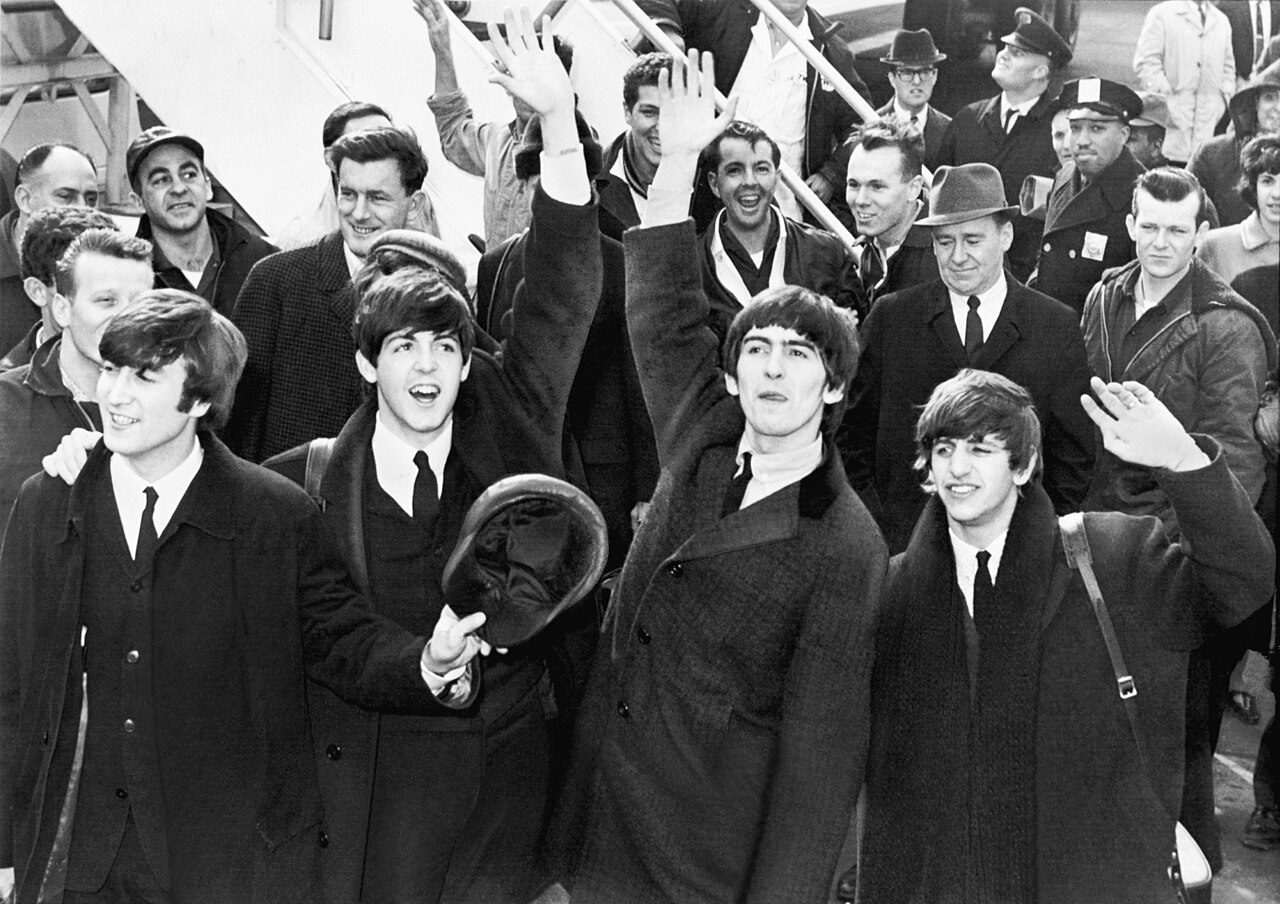
On 7 February 1964 Pan Am Flight 101 touched down at New York's Kennedy Airport carrying the Beatles, and some four thousand screaming fans were waiting — the British Invasion of American pop music had begun. February 7 is also the day of the great New Madrid earthquake, the Great Baltimore Fire, and the signing of the Maastricht Treaty.
Choose another date: open the On This Day calendar to browse events, births and deaths for any day of the year.
At a Glance
- The flight
- Pan Am Flight 101 from London, landing at the recently renamed John F. Kennedy International Airport on 7 February 1964
- The band
- John Lennon, Paul McCartney, George Harrison and Ringo Starr, on their first visit to the United States
- The welcome
- An estimated 4,000 fans, mostly teenage girls, plus some 200 reporters and photographers
- The single
- 'I Want to Hold Your Hand' had reached number one in America days before they landed
- The broadcast
- Two days later their Ed Sullivan Show appearance drew about 73 million viewers
- The manager
- Brian Epstein, who had booked the trip before the band had any American hit, gambling on the Sullivan shows
Events on this day
- 1613Michael Romanov is elected tsar of Russia, founding the Romanov dynasty that rules until 1917.
- 1812The most violent of the New Madrid earthquakes shakes the Mississippi Valley and briefly makes the Mississippi River appear to run backwards.
- 1904The Great Baltimore Fire begins, burning for some thirty hours and destroying much of the city's business district.
- 1914Charlie Chaplin's Little Tramp appears on screen for the first time, in the short film Kid Auto Races at Venice.
- 1940Disney's Pinocchio has its world premiere in New York, becoming one of the studio's most beloved classics.
- 1962President John F. Kennedy broadens the United States trade embargo on Cuba into a near-total ban.
- 1964The Beatles land at Kennedy Airport in New York to begin their first American visit — the featured story above.
- 1974Grenada gains independence from the United Kingdom.
- 1984Navy Captain Bruce McCandless II makes the first untethered spacewalk, floating free of the shuttle Challenger on a jet pack.
- 1986Haiti's president Jean-Claude 'Baby Doc' Duvalier flees into exile in France as unrest topples his regime.
- 1992European Community ministers sign the Maastricht Treaty, creating the European Union and the path to the euro.
- 1999Abdullah II becomes king of Jordan on the death of his father, King Hussein.
- 2023LeBron James passes Kareem Abdul-Jabbar to become the highest scorer in NBA history.
Born on this day
- 1804John Deere — American blacksmith and manufacturer whose steel plough company became an agricultural giant.
- 1812Charles Dickens — English novelist of Oliver Twist, David Copperfield and A Tale of Two Cities, the great storyteller of Victorian England.
- 1885Sinclair Lewis — American novelist and satirist, the first American to win the Nobel Prize in Literature.
- 1908Buster Crabbe — American Olympic swimmer turned screen Tarzan and Flash Gordon.
- 1965Chris Rock — American comedian and actor, one of the most influential stand-ups of his generation.
- 1979Tawakkol Karman — Yemeni journalist and human rights activist, Nobel Peace Prize laureate.
Died on this day
- 1979Josef Mengele — Nazi SS doctor of Auschwitz, the 'Angel of Death', who dies in Brazil after decades in hiding; his death is confirmed only in 1985.
- 1999Hussein — king of Jordan for forty-seven years, a central figure in Middle East diplomacy, dead at 63.
- 2015Dean Smith — American college basketball coach of North Carolina, one of the most successful in the sport's history, dead at 83.
- 2019Frank Robinson — American baseball great, the first Black manager in Major League Baseball, dead at 82.
The featured story: the Beatles arrive in America, 7 February 1964
America in February 1964 was a country still in mourning. Eleven weeks had passed since President Kennedy's assassination, and the airport at which the Beatles landed had just been renamed for him. The band that stepped off Pan Am Flight 101 — four young men from Liverpool in their early twenties, in matching suits and unmistakable haircuts — had conquered Britain in 1963 but were unproven in the United States, where their early singles had flopped on small labels. Their manager, Brian Epstein, had nonetheless negotiated three appearances on The Ed Sullivan Show, the biggest stage in American entertainment, and Capitol Records had finally thrown its weight behind 'I Want to Hold Your Hand', which hit number one in America in the first days of February.
What happened at the airport announced that something larger than a record release was under way. Around four thousand fans — most of them teenage girls who had, as one account put it, supposed to be at school — packed the rooftop observation deck, screaming in a continuous wall of sound, while some two hundred reporters and photographers jostled below. The Beatles, drilled by Epstein and naturally quick, charmed the press conference with jokes at their own expense. Asked about their haircuts, Lennon explained they had had them 'yesterday'. The photographs of the four waving from the aircraft steps became the founding image of a cultural era.
The trip lasted just over two weeks and was engineered like a campaign: the Sullivan broadcast on 9 February, watched by an estimated 73 million people — the largest television audience in American history to that point — then a first concert in Washington, two shows at Carnegie Hall, a second Sullivan appearance broadcast from Miami, and home. Within weeks the Beatles held the entire top five of the Billboard singles chart, a feat never repeated. Behind them came the flood the press named the British Invasion: the Rolling Stones, the Animals, the Kinks, the Dave Clark Five and dozens more, reversing for a generation the direction in which popular music crossed the Atlantic.
The deeper effect was generational. Thousands of American teenagers who watched that February formed bands of their own — among them future stars from Bruce Springsteen to Tom Petty, who said the Sullivan show made music seem like something people like them could do. The Beatles' arrival is often described as the moment the 1960s truly began in America: the point at which a grieving country's youth culture found its soundtrack, its style and its confidence, imported — in the great historical irony — from the old imperial power Britain, seventy-seven days after an American president's death.
Why this date matters
February 7 is a day when the ground moves — literally in 1812, when the New Madrid earthquake rearranged the Mississippi, and culturally in 1964, when four Liverpudlians rearranged American music. It is a day of new structures: a dynasty founded in Moscow in 1613, a European Union founded at Maastricht in 1992, a kingdom passing in Jordan in 1999. And it is a day of first appearances: Chaplin's Tramp in 1914, Pinocchio in 1940, and a young man floating untethered in space in 1984. Beginnings, some joyful and some seismic, are the date's signature.
Sources
- Encyclopaedia Britannica — On This Day: February 7
- HISTORY — What Happened on February 7
- Smithsonian Magazine — Beatlemania Took the United States by Storm
- Mental Floss — Watch The Beatles Arrive in New York City for the First Time in 1964
The facts on this page were checked against these sources on 19 November 2026. The History Trail's permanent pages are researched and written for this site; the live profiles elsewhere on The History Trail are assembled automatically from Wikipedia and Wikidata.
About the Author
Researched and written by the The History Trail Editorial Team — the accountable editorial function behind this site's permanent story pages. The team works from the published sources cited on each page; it does not invent historians, reviewers or credentials, and it corrects errors openly.
Fact Check
Every load-bearing fact on this page traces to one of the sources listed above, and significant claims link to their source in the text. Our checking method is described on the methodology page; errors can be reported via the corrections page.
Sources & Citations
Cite this page as: The History Trail Editorial Team, The History Trail — this article's title, publication and update dates are shown beneath its headline. The full source list appears under Sources above; the site's source standards are on the sources page.