
On This Day
February 8 in History
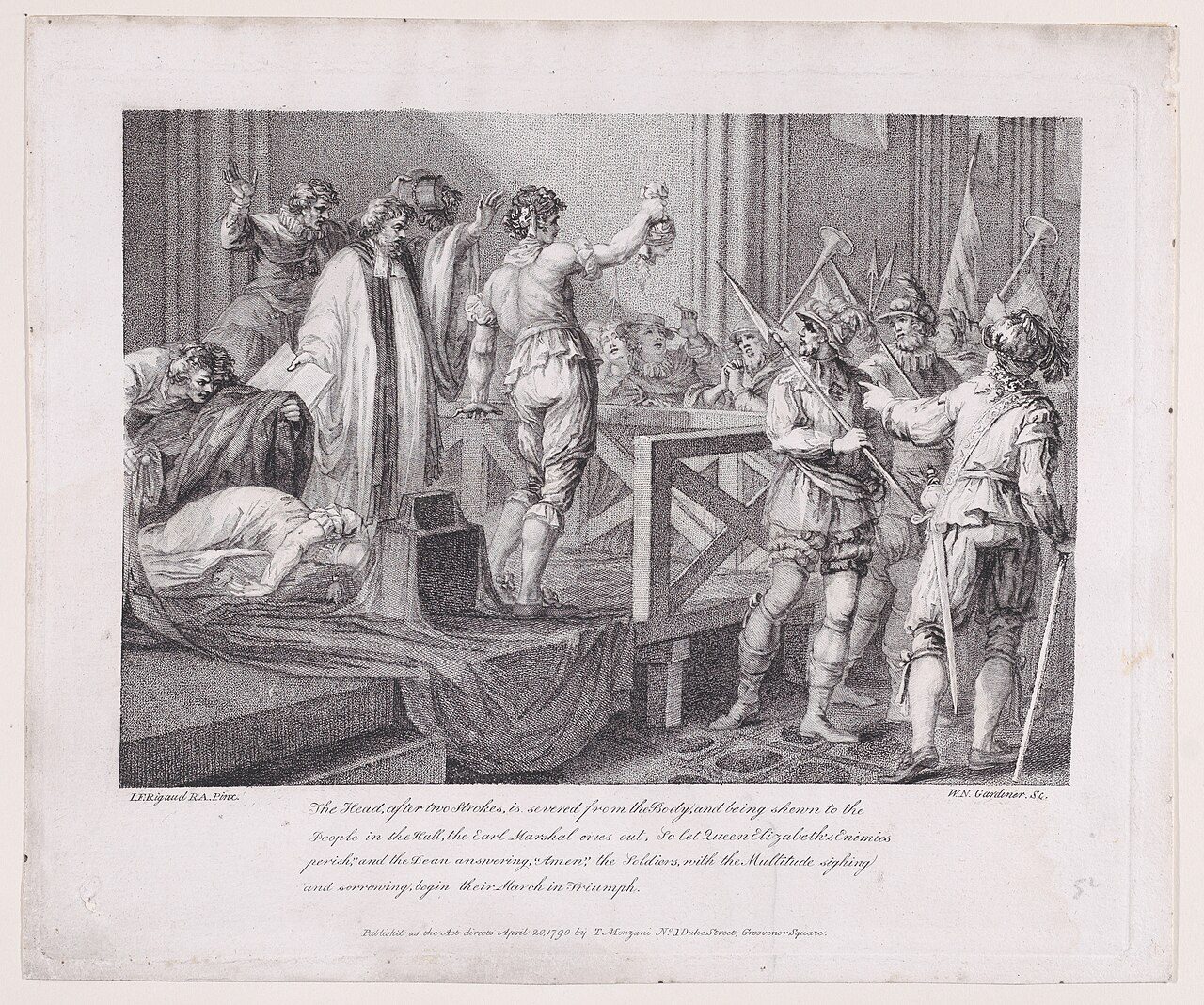
On 8 February 1587 Mary, Queen of Scots was beheaded in the great hall of Fotheringhay Castle after nineteen years as Elizabeth I's prisoner — the first execution of an anointed European monarch. February 8 is also the day the Dawes Act was passed, The Birth of a Nation premiered, and Japan's last troops left Guadalcanal.
Choose another date: open the On This Day calendar to browse events, births and deaths for any day of the year.
At a Glance
- The prisoner
- Mary Stuart, queen of Scotland from infancy, forced to abdicate in 1567 and a captive in England from 1568
- The charge
- Complicity in the Babington Plot of 1586 to assassinate Elizabeth I and place Mary on the English throne
- The trial
- Convicted at Fotheringhay in October 1586 by a commission of English nobles; she denied the court's authority over her
- The warrant
- Elizabeth signed the death warrant on 1 February 1587, then tried to distance herself from its execution
- The execution
- Beheaded on a scaffold in Fotheringhay's great hall on 8 February 1587, aged 44; the first blow missed her neck
- The precedent
- The first legal execution of an anointed European monarch — a precedent remembered at the trials of Charles I and Louis XVI
Events on this day
- 1587Mary, Queen of Scots is beheaded at Fotheringhay Castle after nineteen years as Elizabeth I's prisoner — the featured story above.
- 1693William III and Mary II charter the College of William and Mary in Virginia, the second-oldest institution of higher education in America.
- 1867The Austro-Hungarian Compromise is reached, creating the Dual Monarchy of Austria-Hungary.
- 1887The Dawes General Allotment Act becomes law in the United States, breaking up Native American tribal lands into individual allotments with devastating results.
- 1915D. W. Griffith's The Birth of a Nation premieres in Los Angeles — a landmark of film technique and a poisonous work of racist propaganda.
- 1924Nevada carries out the first execution by lethal gas in the United States, on the murderer Gee Jon.
- 1943Japan completes its evacuation of Guadalcanal, ending the first great Allied offensive campaign of the Pacific War in an American victory.
- 1950East Germany creates the Stasi, the Ministry for State Security, which becomes one of history's most pervasive secret police forces.
- 1971The first Nasdaq trading session takes place, as the world's first electronic stock market begins operating.
- 1974The crew of Skylab 4 returns to Earth after a then-record eighty-four days in space.
Born on this day
- 1591Il Guercino — Italian Baroque painter, famed for the illusionistic frescoes of his Roman years.
- 1820William Tecumseh Sherman — American Civil War general whose march through Georgia hastened the Confederacy's end.
- 1828Jules Verne — French author of Twenty Thousand Leagues Under the Seas and Around the World in Eighty Days, a founder of science fiction.
- 1921Lana Turner — American film star, one of the great glamour figures of classical Hollywood.
- 1931James Dean — American actor of Rebel Without a Cause, dead at twenty-four and immortal ever since.
- 1941Nick Nolte — American actor, star of The Prince of the Tide and 48 Hrs.
Died on this day
- 1725Peter the Great — tsar and first emperor of Russia, who dragged his country toward European power, dead in St Petersburg.
- 1956Connie Mack — American baseball manager of the Philadelphia Athletics for fifty seasons, dead at 93.
- 1999Iris Murdoch — Irish-born British novelist and philosopher, author of Under the Net, dead at 79.
- 2007Anna Nicole Smith — American model and television personality, dead in Florida at 39.
- 2016Violette Verdy — French ballerina and director, a muse of Balanchine at New York City Ballet.
The featured story: the execution of Mary, Queen of Scots, 8 February 1587
Mary Stuart became queen of Scotland at six days old, was raised in France, and was briefly queen consort of France before widowhood sent her home in 1561 to rule a Scotland divided by religion. Catholic queen of a newly Protestant country, she made disastrous marriages — to Lord Darnley, murdered in 1567, and then to the Earl of Bothwell, widely believed his murderer. Forced to abdicate in favour of her infant son James, she escaped, lost a last battle at Langside in 1568, and threw herself on the mercy of her cousin Elizabeth I of England. It was the defining mistake of her life: Elizabeth, who saw in Mary — a Catholic with a strong claim to the English throne — the focus of every plot against her, kept her cousin a prisoner for the next nineteen years.
Those years were a slow duel between two queens who never met. Mary, moved from castle to castle under strict guard, became the hope of English Catholics and of Catholic Europe; plots formed around her name — Ridolfi, Throckmorton — whether or not she directed them. Elizabeth's spymaster, Francis Walsingham, set out to produce proof that would justify the unthinkable: executing an anointed queen. In 1586 his agents intercepted Mary's coded correspondence, smuggled in beer barrels, with the young Catholic Anthony Babington, whose plot aimed to murder Elizabeth, free Mary and land a Spanish invasion. Mary's reply approving the enterprise — its authenticity debated ever since — gave Walsingham his evidence. She was tried at Fotheringhay in October 1586, protesting that an English court had no jurisdiction over a foreign sovereign, and convicted by all but one of the commissioners.
Elizabeth hesitated for months over the warrant, terrified of the precedent and of Europe's reaction, before signing on 1 February 1587 — then, characteristically, hinted that she wished it had not been carried out, and ruined the secretary who sent it. Mary was told on the evening of 7 February that she would die the next morning. She spent the night writing her will and a last letter to her brother-in-law Henri III of France — finished at two in the morning and still preserved in the National Library of Scotland — in which she declared she was to be executed 'like a criminal at eight in the morning'. She walked to the scaffold in the great hall dressed in black, which she removed to reveal a bodice of crimson, the colour of Catholic martyrdom.
The executioner needed three strokes: the first struck the back of her head, the second nearly severed her neck, and a third finished the work. When he lifted the head by its hair, the hair proved to be a wig, and the head fell and rolled — revealing Mary's own short grey hair beneath. She was forty-four and had spent almost half her life in captivity. The execution shocked Europe and fed Spain's case for the Armada the following year; but its longest shadow was constitutional. An anointed monarch had been tried and killed by due process of a neighbouring state — a precedent that would echo when the English put Charles I on trial in 1649 and when revolutionary France guillotined Louis XVI. Mary's son, in the end, inherited both crowns peacefully, and in 1612 moved her body to Westminster Abbey, where she lies opposite Elizabeth.
Why this date matters
February 8 is a day of reckonings handed down by states. A queen is executed in 1587 after the most consequential trial of the century; Native American nations are dispossessed by statute in 1887; a new secret police is founded in 1950. Even its creative landmark, The Birth of a Nation in 1915, is a reckoning — proof that technical genius and moral poison can share one work. Against these stand the day's quieter endings: Japan's withdrawal from Guadalcanal in 1943, closing the Pacific war's first great campaign, and three astronauts splashing down in 1974 after eighty-four days in orbit. Power, judged and judging, is the date's theme.
Sources
- Encyclopaedia Britannica — On This Day: February 8
- HISTORY — What Happened on February 8
- Smithsonian Magazine — This Tragic European Monarch Was Executed for Treason on Her Cousin's Orders
- National Library of Scotland — The Last Letter of Mary, Queen of Scots
The facts on this page were checked against these sources on 19 November 2026. The History Trail's permanent pages are researched and written for this site; the live profiles elsewhere on The History Trail are assembled automatically from Wikipedia and Wikidata.
About the Author
Researched and written by the The History Trail Editorial Team — the accountable editorial function behind this site's permanent story pages. The team works from the published sources cited on each page; it does not invent historians, reviewers or credentials, and it corrects errors openly.
Fact Check
Every load-bearing fact on this page traces to one of the sources listed above, and significant claims link to their source in the text. Our checking method is described on the methodology page; errors can be reported via the corrections page.
Sources & Citations
Cite this page as: The History Trail Editorial Team, The History Trail — this article's title, publication and update dates are shown beneath its headline. The full source list appears under Sources above; the site's source standards are on the sources page.