
Years
1896 in History
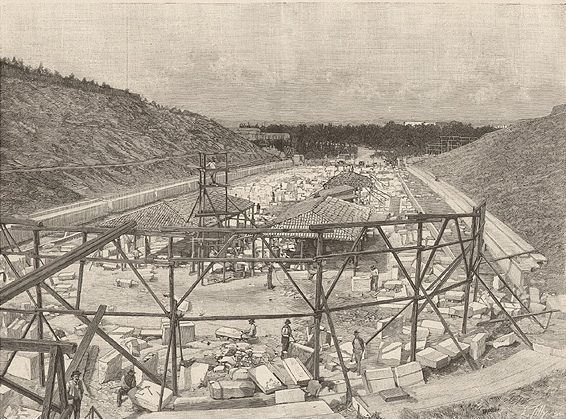
1896 is remembered above all for 6 April, when King George I of Greece opened the first modern Olympic Games in Athens and some 280 athletes from twelve countries contested 43 events in a marble stadium rebuilt for the occasion. The same year patented the wireless telegraph, triggered the Klondike Gold Rush, upheld segregation in Plessy v. Ferguson, and closed with the death of Alfred Nobel.
At a Glance
- Defining event
- The first modern Olympic Games open in Athens, 6 April 1896
- The founder
- Pierre de Coubertin, who founded the International Olympic Committee in 1894
- The Games
- About 280 athletes from twelve countries, 43 events over nine days, in the rebuilt Panathenaic Stadium
- The hero
- Spyridon Louis of Greece, winner of the first marathon, run from the plain of Marathon to the stadium
- The year's shadow
- Plessy v. Ferguson, 18 May, upholds 'separate but equal' segregation in the United States
- Closed the year
- Alfred Nobel dies on 10 December; his prizes will first be awarded on that date five years later
The defining story: the Games return to Athens
On 6 April 1896, in a marble stadium rebuilt on the site of its ancient original, King George I of Greece declared open the first Olympic Games of the modern era. Around 280 athletes from twelve countries contested 43 events over the following nine days, as Encyclopaedia Britannica recounts, before crowds that overflowed the Panathenaic Stadium and lined the surrounding hills. It was the realisation of an idea that had seemed, only a few years earlier, like one Frenchman's eccentricity.
The revival was the work of Pierre de Coubertin, a French educator convinced that organised sport could educate character and draw nations together. He founded the International Olympic Committee in 1894 and chose Athens for the first Games, honouring the ancient festival held at Olympia for over a thousand years. Greece, poor and small, nearly failed to pay for them: the government of the day at one point concluded that it could not host the Games at all, until the Crown Prince intervened and a public subscription, alongside a donation of one million drachmas from the businessman Georgios Averoff, rebuilt the stadium in white marble, while commemorative stamps and medals raised the rest.
The Games themselves were modest by later standards and glorious by their own. Most competitors were Greek, and Greece won the most medals overall, though the United States took the most golds, led by James Connolly, the Games' first champion, in the triple jump. The emotional summit came in the marathon, a race invented for these Games and run from the plain of Marathon to the stadium: the Greek water-carrier Spyridon Louis entered first, to delirium, and won in under three hours — the host nation's only athletics title, and its most treasured.
The rest of the year ran on older energies. On 2 June Guglielmo Marconi applied for the British patent for his wireless telegraphy system, the foundation of radio. On 17 August gold claims were staked at Rabbit Creek in the Yukon — soon renamed Bonanza Creek — setting off the Klondike Gold Rush. And on 30 December José Rizal, writer and national hero of the Philippines, was executed by a Spanish firing squad in Manila, an act that hastened the Philippine Revolution rather than ending it.
Timeline of 1896
- 4 January
Utah is admitted to the Union as the 45th state, after renouncing polygamy.
- 1 February
Puccini's opera La Bohème premieres at the Teatro Regio in Turin.
- 6 April
The first modern Olympic Games open in Athens, with some 280 athletes from twelve countries.
- 18 May
In Plessy v. Ferguson, the United States Supreme Court upholds 'separate but equal' racial segregation.
- 26 May
Nicholas II is crowned tsar of Russia in Moscow, the last coronation of the Romanov dynasty.
- 2 June
Guglielmo Marconi applies for the British patent for his wireless telegraphy system, the foundation of radio.
- 1 July
Harriet Beecher Stowe, author of Uncle Tom's Cabin, dies.
- 10 August
Otto Lilienthal, the German aviation pioneer whose experiments inspired the Wright brothers, is killed in a glider crash.
- 17 August
Gold claims are staked at Rabbit Creek, soon Bonanza Creek, in the Yukon, setting off the Klondike Gold Rush.
- 27 August
The Anglo-Zanzibar War, the shortest war in recorded history, is fought and finished in about 38 minutes.
- 24 September
F. Scott Fitzgerald, novelist of The Great Gatsby and chronicler of the Jazz Age, is born.
- 10 December
Alfred Nobel, inventor of dynamite, dies; his will endows the prizes first awarded five years later.
- 30 December
José Rizal, national hero of the Philippines, is executed by a Spanish firing squad in Manila.
Why 1896 still matters
Athens 1896 proved that an ancient idea could be restarted by organisation rather than empire. The Games nearly died more than once in their first decades — the next edition, in Paris in 1900, was a sideshow to a trade fair — but the template set in those nine April days endured: an international field, a host city, a stadium, and a story, the marathon, invented on the spot and never dropped since. Every four years the world still stops to argue about sport in the way Athens made possible.
The year's American ruling cast the opposite shadow. In Plessy v. Ferguson the Supreme Court upheld 'separate but equal', giving constitutional cover to racial segregation for generations — the doctrine that Brown v. Board of Education would destroy fifty-eight years later, almost to the day. Between the stadium in Athens and the courtroom in Washington, 1896 contains both of the coming century's great arguments: who may compete, and on what terms of equality.
Its quieter patents and claims pointed forward too. Marconi's wireless application began the road to radio and everything carried on it; the Klondike staking began the last great gold rush of the horse age. And when Alfred Nobel died on 10 December, the will he had signed the previous November turned from paper into an institution in waiting — the first prizes would be presented exactly five years later, on the anniversary of his death.
1896 on The History Trail
The reborn Olympic Games lead this year on The History Trail, with Marconi's wireless patent, the Klondike gold strike and the shortest war on record.
- April 6 in History — The first modern Olympic Games open in Athens, the featured story of the year.
- June 2 in History — Marconi applies for the British patent for wireless telegraphy.
- May 18 in History — Plessy v. Ferguson upholds 'separate but equal' segregation.
- August 17 in History — Gold claims staked in the Yukon set off the Klondike Gold Rush.
- August 27 in History — The Anglo-Zanzibar War is fought and finished in about 38 minutes.
- December 10 in History — Alfred Nobel dies, a year after signing the will that created his prizes.
- Olympic Games — The ancient festival and its modern revival, from Olympia to Athens 1896 and beyond.
Sources
- Encyclopaedia Britannica — Athens 1896 Olympic Games
- Encyclopaedia Britannica — On This Day: April 6
- Encyclopaedia Britannica — On This Day: May 18
- Encyclopaedia Britannica — On This Day: June 2
- Encyclopaedia Britannica — On This Day: August 17
- Encyclopaedia Britannica — On This Day: August 27
- Encyclopaedia Britannica — On This Day: December 10
- Encyclopaedia Britannica — On This Day: December 30
The facts on this page were checked against these sources on 19 November 2026. The History Trail's permanent pages are researched and written for this site; the live profiles elsewhere on The History Trail are assembled automatically from Wikipedia and Wikidata.
About the Author
Researched and written by the The History Trail Editorial Team — the accountable editorial function behind this site's permanent story pages. The team works from the published sources cited on each page; it does not invent historians, reviewers or credentials, and it corrects errors openly.
Fact Check
Every load-bearing fact on this page traces to one of the sources listed above, and significant claims link to their source in the text. Our checking method is described on the methodology page; errors can be reported via the corrections page.
Sources & Citations
Cite this page as: The History Trail Editorial Team, The History Trail — this article's title, publication and update dates are shown beneath its headline. The full source list appears under Sources above; the site's source standards are on the sources page.