
On This Day
April 6 in History
On 6 April 1896 King George I of Greece opened the first modern Olympic Games in Athens, where about 280 athletes from twelve countries contested 43 events and Spyridon Louis won the marathon. April 6 is also the day the Declaration of Arbroath was signed in 1320 and the United States entered the First World War in 1917.
Choose another date: open the On This Day calendar to browse events, births and deaths for any day of the year.
At a Glance
- The founder
- Pierre de Coubertin, who founded the International Olympic Committee in 1894
- The stadium
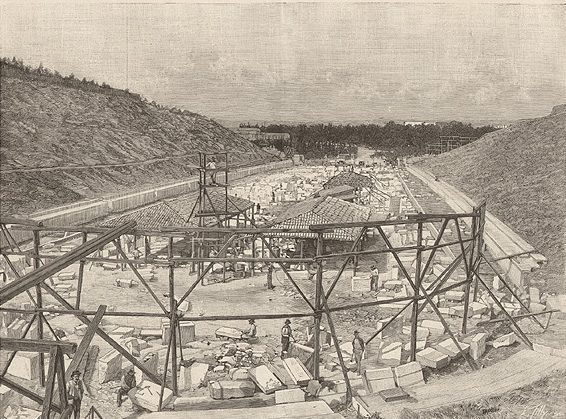
- The Panathenaic Stadium, rebuilt in white marble with Georgios Averoff's fortune
- The athletes
- About 280 competitors from twelve countries, in 43 events over nine days
- The first champion
- James Connolly of the United States, winner of the triple jump
- The hero
- Spyridon Louis of Greece, winner of the first marathon
- The medals
- Greece won the most medals overall; the United States won the most golds
Events on this day
- 1320Scottish nobles sign the Declaration of Arbroath, asserting Scotland's independence to the Pope.
- 1453Sultan Mehmed II begins the siege of Constantinople, the final campaign against the Byzantine Empire.
- 1830Joseph Smith organises the Church of Christ in New York state, the beginning of the Latter Day Saint movement.
- 1862The Battle of Shiloh opens in Tennessee, one of the bloodiest engagements of the American Civil War.
- 1896The first modern Olympic Games open in Athens, with some 280 athletes from twelve countries — the featured story above.
- 1909Robert Peary's expedition, with Matthew Henson and four Inuit companions, claims to reach the North Pole; the claim has been disputed ever since.
- 1917The United States formally declares war on Germany and enters the First World War.
- 1930Mohandas Gandhi reaches the sea at Dandi and makes salt, completing the Salt March against British rule in India.
- 1941Germany invades Yugoslavia and Greece, bombing Belgrade and racing to rescue its Italian ally's failed campaign.
- 1965Intelsat I, nicknamed Early Bird, is launched, the first commercial communications satellite.
- 1974ABBA wins the Eurovision Song Contest in Brighton with 'Waterloo', launching Sweden's conquest of pop music.
- 1994The plane carrying the presidents of Rwanda and Burundi is shot down over Kigali; the assassinations trigger the Rwandan genocide.
Born on this day
- 1483Raphael — Italian Renaissance painter and architect, master of the Madonna and The School of Athens.
- 1884Walter Huston — Canadian-American stage and screen actor, patriarch of the Huston film dynasty.
- 1928James Watson — American molecular biologist who, with Francis Crick, determined the double-helix structure of DNA.
- 1937Merle Haggard — American country singer of 'Okie from Muskogee', born in a converted boxcar in California.
- 1937Billy Dee Williams — American actor, Lando Calrissian in the Star Wars films.
Died on this day
- 1199Richard I of England — the Lionheart, dead of a crossbow wound at the siege of Châlus in France, at 41.
- 1520Raphael — Italian Renaissance master, dead in Rome on his 37th birthday, after a short fever.
- 1528Albrecht Dürer — German artist and printmaker, the great master of the Northern Renaissance, dead at 56.
- 1994Juvénal Habyarimana and Cyprien Ntaryamira — presidents of Rwanda and Burundi, killed when their plane is shot down over Kigali.
- 2016Merle Haggard — American country singer, dead on his 79th birthday.
The featured story: the first modern Olympic Games open in Athens, 6 April 1896
On 6 April 1896, in a marble stadium rebuilt on the site of its ancient original, King George I of Greece declared open the first Olympic Games of the modern era. Around 280 athletes from twelve countries contested 43 events over the following nine days, as Encyclopaedia Britannica recounts, before crowds that overflowed the Panathenaic Stadium and lined the surrounding hills. It was the realisation of an idea that had seemed, only a few years earlier, like one Frenchman's eccentricity.
The revival was the work of Pierre de Coubertin, a French educator convinced that organised sport could educate character and draw nations together. He founded the International Olympic Committee in 1894 and chose Athens for the first Games, honouring the ancient festival held at Olympia for over a thousand years. Greece, poor and small, nearly failed to pay for them, and the government of the day at one point concluded that it could not host the Games at all, until the Crown Prince intervened and a public subscription, alongside Averoff's fortune, carried the day: a donation of one million drachmas from the businessman Georgios Averoff rebuilt the stadium in white marble, and commemorative stamps and medals raised the rest.
The Games themselves were modest by later standards and glorious by their own. Most competitors were Greek, and Greece won the most medals overall, though the United States took the most golds, led by James Connolly, the Games' first champion, in the triple jump. The emotional summit came in the marathon, a race invented for these Games and run from the plain of Marathon to the stadium: the Greek water-carrier Spyridon Louis entered first, to delirium, and won in under three hours, the host nation's only athletics title and its most treasured.
No one in 1896 could have foreseen what had been started. The next Games, in Paris in 1900, were a sideshow to a trade fair, and the movement nearly died more than once in its first decades. But Athens had proved that the ancient idea could live again, and every four years since, through war, boycott and scandal, the world has stopped to argue about sport in the way those nine April days made possible.
Why this date matters
April 6 may be the most various date in this whole series: a declaration of Scottish nationhood in 1320, the first shot of a siege that ended an empire in 1453, a new church in 1830, a new world war for America in 1917, salt defiance in India in 1930, and, in 1994, a plane falling out of the sky over Kigali and a genocide beginning. Against all that, its featured story is the hopeful one: a small, poor country rebuilding a marble stadium to show that nations could compete at games instead. The date holds both the best and the worst of what crowds gather for.
Sources
- Encyclopaedia Britannica — Athens 1896 Olympic Games
- Encyclopaedia Britannica — On This Day: April 6
- HISTORY — What Happened on April 6
- Wikipedia — April 6
The facts on this page were checked against these sources on 19 November 2026. The History Trail's permanent pages are researched and written for this site; the live profiles elsewhere on The History Trail are assembled automatically from Wikipedia and Wikidata.
About the Author
Researched and written by the The History Trail Editorial Team — the accountable editorial function behind this site's permanent story pages. The team works from the published sources cited on each page; it does not invent historians, reviewers or credentials, and it corrects errors openly.
Fact Check
Every load-bearing fact on this page traces to one of the sources listed above, and significant claims link to their source in the text. Our checking method is described on the methodology page; errors can be reported via the corrections page.
Sources & Citations
Cite this page as: The History Trail Editorial Team, The History Trail — this article's title, publication and update dates are shown beneath its headline. The full source list appears under Sources above; the site's source standards are on the sources page.