
On This Day
January 5 in History
On the night of 5 January 1709 the temperature crashed across Europe, and by morning a continent had frozen from Italy to Scandinavia: the opening of the Great Frost, the coldest European winter in 500 years. January 5 is also the day construction began on the Golden Gate Bridge and Edward the Confessor died, setting up the Norman Conquest.
Choose another date: open the On This Day calendar to browse events, births and deaths for any day of the year.
At a Glance
- The night it began
- Temperatures plummeted across Europe on the night of 5–6 January 1709 and stayed down, with brief thaws, for about three months
- The record
- Still the coldest European winter of the past 500 years, running about 7 °C below the twentieth-century average
- The measurement
- At Upminster near London, William Derham recorded −12 °C, the lowest reading since he began observing in 1697
- What froze
- The Thames iced over in London, the Venetian lagoon froze, and the Baltic could be crossed on foot into April
- The human cost
- France, hit hardest, suffered an estimated 600,000 more deaths than in an average year across 1709–10, with famine following the frost
- The suspected cause
- The winter fell within the Maunder Minimum (1645–1715), a period of exceptionally low sunspot activity, though its exact cause still puzzles climatologists
Events on this day
- 1477Charles the Bold, duke of Burgundy, is killed at the Battle of Nancy, and his duchy is partitioned between France and the Habsburgs.
- 1709The Great Frost begins as temperatures crash across Europe on the night of 5–6 January — the featured story above.
- 1757Robert-François Damiens wounds Louis XV with a knife in the last assassination attempt on a French king of the old regime.
- 1781British forces under Benedict Arnold burn Richmond, Virginia, the rebel capital he had once served.
- 1895Alfred Dreyfus is publicly degraded in Paris, stripped of his rank and insignia before his exile to Devil's Island.
- 1919The German Workers' Party is founded in Munich by Anton Drexler — the small party that, renamed, becomes the Nazi Party.
- 1933Construction begins on the Golden Gate Bridge in San Francisco; it opens in 1937 as the world's longest and tallest suspension bridge.
- 1968Alexander Dubček comes to power in Czechoslovakia, opening the reform season known as the Prague Spring.
- 1972President Richard Nixon announces the Space Shuttle programme, promising routine and cheaper access to orbit.
- 1976Ten Protestant workers are shot dead by republican gunmen at Kingsmill, County Armagh, in one of the worst atrocities of the Troubles.
Born on this day
- 1592Shah Jahan — Mughal emperor who built the Taj Mahal as a tomb for his wife Mumtaz Mahal.
- 1876Konrad Adenauer — first chancellor of West Germany, who anchored the new republic in the West.
- 1928Zulfikar Ali Bhutto — prime minister of Pakistan in the 1970s and founder of the Pakistan Peoples Party.
- 1931Alvin Ailey — American dancer and choreographer who founded the Alvin Ailey American Dance Theater.
- 1932Umberto Eco — Italian novelist and scholar, author of The Name of the Rose.
- 1941Hayao Miyazaki — Japanese animator and co-founder of Studio Ghibli.
- 1946Diane Keaton — American actress of Annie Hall and The Godfather films.
Died on this day
- 1066Edward the Confessor — king of England whose childless death triggers the succession crisis and the Norman Conquest.
- 1589Catherine de' Medici — queen and regent of France, the power behind three of its kings.
- 1922Ernest Shackleton — Antarctic explorer, dead of a heart attack aboard ship off South Georgia on his final expedition.
- 1933Calvin Coolidge — thirtieth president of the United States, dead five years after leaving office.
- 1943George Washington Carver — American agricultural scientist who transformed Southern farming with his work on peanuts and soil.
- 2014Eusébio — Portuguese footballer, one of the greatest goalscorers of the 1960s.
The featured story: the Great Frost begins, 5 January 1709
Europe had no warning. The first days of January 1709 were cold, as January days are, but on the night of 5–6 January the temperature fell off a cliff — from Italy to Scandinavia, from England to Russia — and it did not properly recover for three months. In England the winter was remembered as the Great Frost; in France, where it struck hardest, as Le Grand Hiver, the Great Winter. Modern reconstructions make it the coldest European winter of the past five hundred years, averaging some 7 °C below the twentieth-century norm, and it arrived in a world with no forecasts, no central heating and no margin for error.
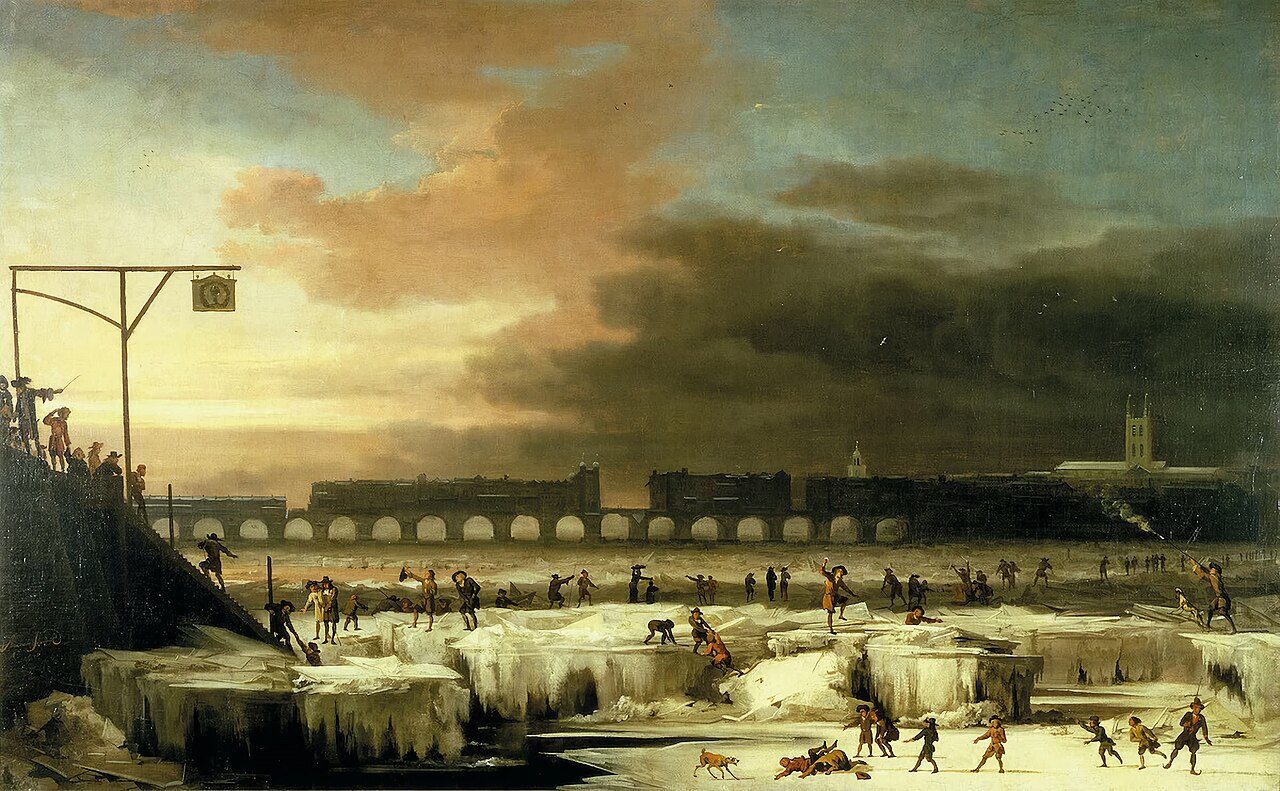
The evidence was written down by men like William Derham, rector of Upminster near London, who had taken weather readings since 1697. That January he recorded −12 °C, the lowest figure of his observing life, and wrote that he believed the frost was greater than any other within the memory of man. Around him the physical world seized up: the Thames iced over in London, the lagoons and canals of Venice froze, wine turned to ice in cellars, birds fell dead from the air, and in the Baltic the sea froze so hard that travellers crossed on foot and on horseback into the spring.
The killing blow landed months later, in the fields. The frost penetrated the soil and destroyed the winter wheat where it lay; fruit trees split and died, vineyards were ruined, and livestock perished in their stalls. When grain prices soared through 1709, cold turned to famine. France, already strained by the War of the Spanish Succession, suffered worst: demographers estimate some 600,000 more deaths than in an average year across 1709–10, and around 200,000 fewer births. Food riots shook French towns, and the disaster weakened Louis XIV's France at the negotiating table as surely as any lost battle.
Why it happened remains genuinely uncertain. The winter fell inside the Maunder Minimum, the decades between 1645 and 1715 when sunspots nearly vanished and the sun's output dipped; blocked Atlantic weather patterns and volcanic dust have also been blamed, and climatologists in the European Union's Millennium Project, reconstructing five centuries of European climate, still cannot fully account for 1709. What is certain is the record: three centuries of thermometers and proxies have found no European winter to match it. It began, all at once, on the night of 5 January.
Why this date matters
January 5 is the year's first lesson in fragility. On it, weather alone — no army, no assassin — broke the food supply of a continent and killed more French subjects than most wars of the age; on it, a king's childless death in 1066 set three rivals racing for a throne and changed England forever; on it, a republic stripped a captain's insignia in a courtyard and began the Dreyfus Affair. Even its constructive entries carry the theme: a bridge begun across a dangerous strait, a shuttle promised to make spaceflight routine. The day shows systems — harvests, successions, reputations — failing or being founded under pressure, and history turning on the difference.
Sources
- Encyclopaedia Britannica — On This Day: January 5
- HISTORY — What Happened on January 5
- National Geographic — Could Europe's Freakish Winter of 1709 Happen Again?
- Wikipedia — German Workers' Party
The facts on this page were checked against these sources on 19 November 2026. The History Trail's permanent pages are researched and written for this site; the live profiles elsewhere on The History Trail are assembled automatically from Wikipedia and Wikidata.
About the Author
Researched and written by the The History Trail Editorial Team — the accountable editorial function behind this site's permanent story pages. The team works from the published sources cited on each page; it does not invent historians, reviewers or credentials, and it corrects errors openly.
Fact Check
Every load-bearing fact on this page traces to one of the sources listed above, and significant claims link to their source in the text. Our checking method is described on the methodology page; errors can be reported via the corrections page.
Sources & Citations
Cite this page as: The History Trail Editorial Team, The History Trail — this article's title, publication and update dates are shown beneath its headline. The full source list appears under Sources above; the site's source standards are on the sources page.