
On This Day
January 4 in History
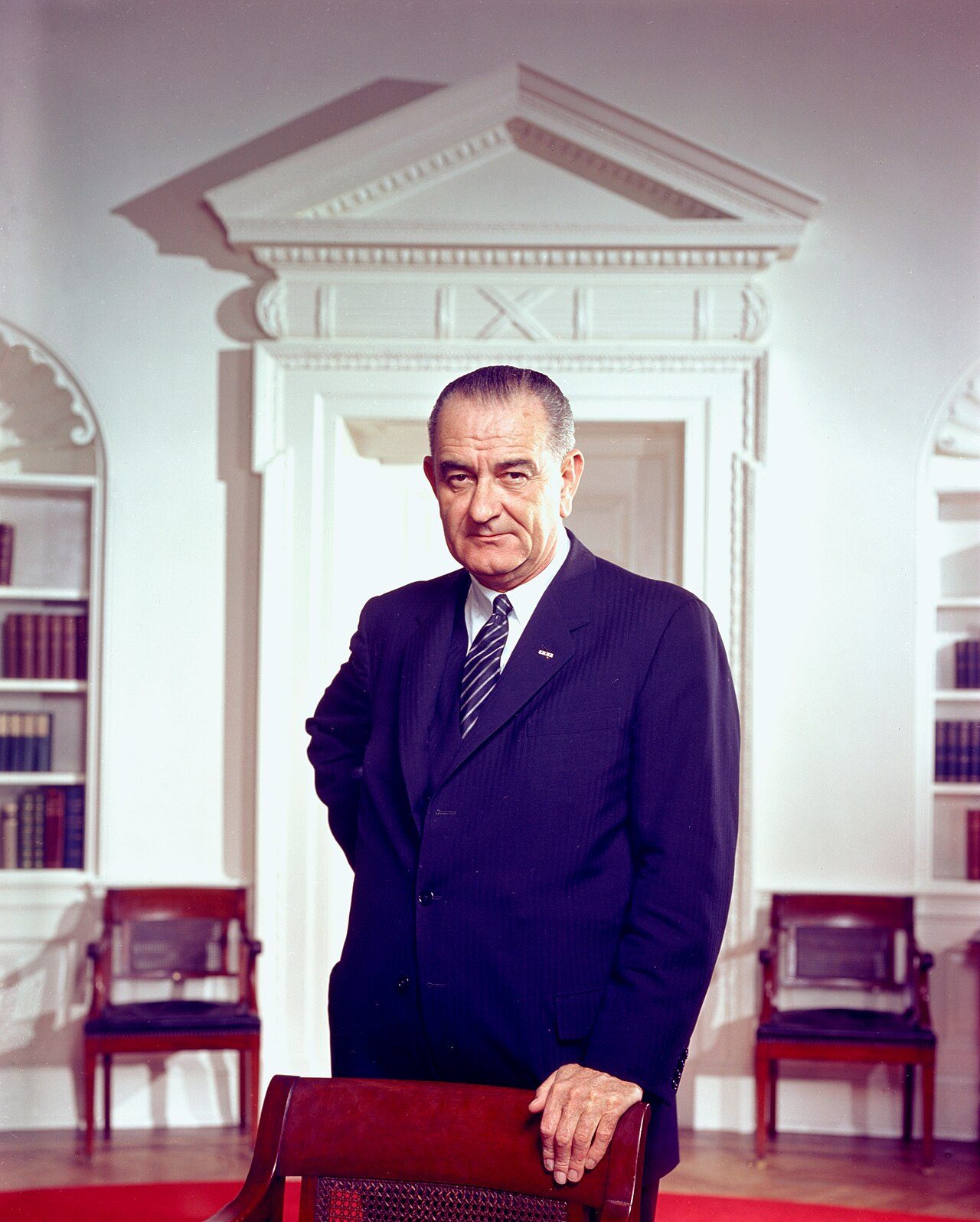
On 4 January 1965 President Lyndon B. Johnson, fresh from a landslide election victory, used his State of the Union address to proclaim the Great Society — the most ambitious programme of domestic reform in modern American history. January 4 is also the day Burma won independence from Britain and NASA's Spirit rover landed on Mars.
Choose another date: open the On This Day calendar to browse events, births and deaths for any day of the year.
At a Glance
- The occasion
- Johnson's State of the Union address to Congress on 4 January 1965, his first after winning election in his own right in November 1964
- The pledge
- A redoubled 'war on poverty', declared a year earlier, and a programme to build a 'Great Society' in America
- The programme
- Federal support for education, hospital care for the elderly through Social Security (which became Medicare), enforcement of the Civil Rights Act 1964, and the removal of barriers to voting
- A broadcasting first
- The first State of the Union address televised in a prime-time evening slot, taking the speech directly to the nation
- What it produced
- Within the year Congress had passed Medicare and Medicaid, the Voting Rights Act and landmark education laws
- The name
- Johnson had first used the phrase 'Great Society' in speeches in May 1964, including an address at Ohio University
Events on this day
- 1649The Rump Parliament votes to put Charles I on trial for treason — the first time a European king is tried by his own subjects.
- 1847Samuel Colt makes his first sale to the United States government: an order for 1,000 revolvers for the Mexican–American War.
- 1853Solomon Northup is freed in Louisiana after twelve years of enslavement; his memoir Twelve Years a Slave appears the same year.
- 1896Utah is admitted to the Union as the 45th state, after renouncing polygamy.
- 1948Burma — now Myanmar — becomes independent of Britain, with U Nu as its first prime minister.
- 1958Sputnik 1, the first artificial satellite, burns up as it re-enters the atmosphere after three months in orbit.
- 1959The Soviet probe Luna 1 passes near the Moon and becomes the first spacecraft to escape Earth's gravity and reach the Moon's vicinity.
- 1965President Lyndon B. Johnson proclaims the Great Society in his State of the Union address — the featured story above.
- 2004NASA's Spirit rover lands on Mars in Gusev Crater; its twin, Opportunity, follows three weeks later.
- 2007Nancy Pelosi becomes the first woman Speaker of the United States House of Representatives.
- 2010The Burj Khalifa in Dubai, the tallest building in the world, is officially opened.
Born on this day
- 1643Isaac Newton — English physicist and mathematician who formulated the laws of motion and universal gravitation; by the Julian calendar then in use in England, he was born on Christmas Day 1642.
- 1785Jacob Grimm — German philologist who, with his brother Wilhelm, collected the fairy tales that bear their name.
- 1809Louis Braille — French educator, blinded in childhood, who devised the tactile reading system named after him.
- 1935Floyd Patterson — American boxer, then the youngest world heavyweight champion and the first to regain the title.
- 1960Michael Stipe — American singer and lyricist of the rock band R.E.M.
- 1990Toni Kroos — German footballer, a World Cup winner in 2014 and one of the great midfield passers of his generation.
Died on this day
- 1941Henri Bergson — French philosopher of time and memory, winner of the Nobel Prize in Literature.
- 1960Albert Camus — French-Algerian writer of The Stranger and The Plague, killed in a car accident at 46.
- 1965T. S. Eliot — American-born poet of The Waste Land, Nobel laureate, dead in London at 76.
- 1967Donald Campbell — British speed record-breaker, killed on Coniston Water attempting the world water-speed record.
- 1986Phil Lynott — Irish singer and bassist of Thin Lizzy, dead at 36.
The featured story: Johnson proclaims the Great Society, 4 January 1965
Lyndon Johnson had become president in the worst way, sworn in aboard Air Force One on 22 November 1963 with John F. Kennedy's assassination only hours old. Fourteen months later he stood before Congress in a wholly different position: elected in his own right by one of the largest landslides in American history, with swollen Democratic majorities in both houses. His State of the Union address on the evening of 4 January 1965 was his moment to say what the power was for. His answer was a name he had tested the previous spring: the Great Society.
The speech renewed and enlarged the 'war on poverty' Johnson had declared in his first State of the Union a year before, but its ambitions ran well past poverty. He proposed federal support for education at every level, hospital care for the elderly financed through Social Security — the seed of Medicare — full enforcement of the Civil Rights Act passed in 1964, and the elimination of the remaining barriers that kept Black Americans from voting. Around those pillars stood a wider vision: cleaner air and water, renewed cities, support for the arts, and a society judged, in the spirit of his address, not by how much it produced but by the quality of its people's lives.
The setting was itself a statement. The address was the first State of the Union delivered in a prime-time evening slot for television, so that the president spoke over the heads of Congress to the whole country at once. Johnson, a former Senate majority leader who understood Congress as few presidents have, then drove the programme through it at extraordinary speed: 1965 alone brought the Elementary and Secondary Education Act, Medicare and Medicaid, the Voting Rights Act, a new Department of Housing and Urban Development and the first major federal support for the arts and humanities.
The Great Society's promise was never fully kept, and its limits became the argument of the next half-century. The war in Vietnam consumed money, attention and finally Johnson's presidency; some programmes were cut back, others endured and reshaped American life — Medicare above all, which still anchors healthcare for the elderly. But the address of 4 January 1965 remains the high-water mark of American liberal ambition: the night a president told the richest country on earth that wealth was not the test, and asked Congress to legislate as if it believed him.
Why this date matters
January 4 is a day when states announce what they intend to be. A parliament voted to try a king and thereby announced that no ruler stood above the law; a president used the same date to announce that a rich nation should be judged by the quality of its people's lives. Utah announced its terms for joining a union, Burma announced the end of its subjection to one, and two spacecraft — Luna 1 in 1959 and Spirit in 2004 — announced arrivals at other worlds. Even Sputnik's fiery return belongs to the pattern: January 4 is when declarations are made, programmes launched and new orders proclaimed, usually before anyone knows whether they will work.
Sources
- Encyclopaedia Britannica — On This Day: January 4
- HISTORY — What Happened on January 4
- Encyclopaedia Britannica — Great Society
- Wikipedia — 1965 State of the Union Address
The facts on this page were checked against these sources on 19 November 2026. The History Trail's permanent pages are researched and written for this site; the live profiles elsewhere on The History Trail are assembled automatically from Wikipedia and Wikidata.
About the Author
Researched and written by the The History Trail Editorial Team — the accountable editorial function behind this site's permanent story pages. The team works from the published sources cited on each page; it does not invent historians, reviewers or credentials, and it corrects errors openly.
Fact Check
Every load-bearing fact on this page traces to one of the sources listed above, and significant claims link to their source in the text. Our checking method is described on the methodology page; errors can be reported via the corrections page.
Sources & Citations
Cite this page as: The History Trail Editorial Team, The History Trail — this article's title, publication and update dates are shown beneath its headline. The full source list appears under Sources above; the site's source standards are on the sources page.